Monthly Archives: January 2010

The BIO Conference

Are you an aspiring or published biographer, historian, writer, or just plain interested in books?  You might want to think about attending the first-ever conference of the newly-formed Biographers International Organization, to be held May 15 in Boston.

The brainchild of my colleague and pal James McGrath Morris (whose biography of Pulitzer is due in bookstores in early February) and the result of tons of hard work by folks like Debby Applegate, fellow WBG member Charles Shields, and devoted locals like Rob Velella, the daylong conference focuses on the nuts and bolts of biography writing.  Ten workshops are offered throughout the day on topics like working with primary documents, choosing a topic, working with the family of your subject, and how to land an agent. Yeah, it’s good stuff.

For the price of admission, you’ll also get fed twice, hear a keynote from a prominent biographer (more on that later), and get to hang out with lots of like-minded folks.  Think of it as a more literary San Diego Comic-Con, but without the filk singing or people dressed as Boba Fett.

“The Compleat Biographer Conference” will be held at the University of Massachusetts Boston on Saturday, May 15.  For more information on BIO and the conference, check out the Biographers International Organization’s website.

Dog Day Afternoon (and Evening)

Around noon yesterday, Barb and I took our dog Abbey to an animal hospital.  If you’re a regular reader here, you know our eight-year-old dog has been hobbled for nearly a year by weak back legs, which our vet initially diagnosed as hip dysplasia.  That seemed to make sense — Abbey’s a big dog, and she’s got a lot of German Shepherd in her, a breed prone to developing dysplasia. 

But what concerned us was how quickly her condition deteriorated.  At first, she would swing her rear left leg in this funny, wide cowboy swagger as she walked.  Then she stopped being able to walk up and downstairs.  Next, she started having difficulty getting to her feet or walking on tile, prompting us to throw rugs down on our tile and wood floors so she could walk from room to room. Eventually she settled into living in  one room in the house — but she’s such a social dog that being by herself for too long was more than she could handle.  Once the lights went out at night, she started barking from her bed –just one or two loud, clipped barks every few minutes — until someone came back downstairs to sleep on the couch nearby.  Now she can barely use her back legs — she hobbles around gamely for a while, then falls to her haunches as her rear legs buckle. It’s heartbreaking.

Our vet, then, referred us to a neurologist. So yesterday, Barb and I spent the better part of the day at an impressive animal hospital that occupies an abandoned and revamped CompUSA building.  We walked Abbey into a back room — using an old towel as a sling to support her rear end as she walked — where the doctor crawled around on the floor with her, poking, prodding, listening and looking.  He then ordered that she be taken in for x-rays and an MRI, which would likely take several hours.

We spent the next few hours getting to know the other pets and pet owners in the waiting area, listening to each other tell stories and sharing that unique bond that pet owners — especially pet owners in duress — seem to have.  There were some happy moments – an injured black lab named Bo sulked in, tail down, humiliated in a muzzle and Victorian collar, and emerged thirty minutes later, stitched and happy. There was Ollie, the biggest black cat I’ve ever seen, mrowing happily from his crate as a nurse waggled her fingers at him as she sent him home.

There were plenty of nervous patients, too.  There was the white dog who cowered beneath my legs when the doctor came out to retrieve him (“That man doesn’t know you, so don’t look for help there,” his owner said, wagging a finger at the wide-eyed dog) and the terrier who nervously left a trail of poop behind him as he walked from the front door to the reception desk.  There was the old pug with a cataract who wandered the waiting area, looking intently under every chair for . . . something.

And there were some heartbreaking moments as well.  A young woman rushed in with a wheezing Boston terrier, flailing with a seizure.  A nurse ran over, scooped him up and disappeared into the back, leaving the woman sobbing in a chair.  Later, we watched as a middle-aged couple staggered out of a back room, the woman stone-faced and her husband — an enormous mountain of a man – red-eyed and tight-lipped, choking back tears. “I’m so sorry,” a young nurse told them as they paid their bill.

Our story doesn’t have an ending yet.  Abbey’s home, and we’re waiting for test results.  I’m hoping to write a happy ending.  Stay tuned.
Toasted

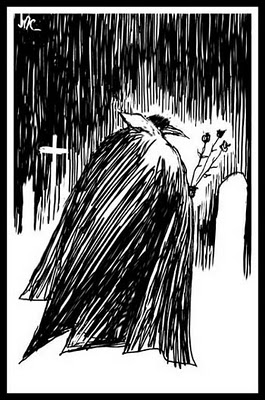
There was a minor stir in the back alleys of American literature yesterday:  for the first time since 1949, the enigmatic Poe Toaster failed to appear at Edgar Allan Poe’s Baltimore gravesite to mark Poe’s January 19 birthday.

The Poe Toaster is the mysterious figure — usually in a black coat and hat — who strolls into Baltimore’s Westminster Hall and Burying Ground in the early hours of January 19, silently walks to at Poe’s gravesite, toasts Poe with a glass of cognac, then departs, leaving behind three red roses and a half bottle of cognac on the grave.  It’s a neat tradition that’s been going on since 1949 — perhaps intentionally begun on the 100th anniversary of Poe’s death — and has gone on uninterrupted for the last fifty years, despite efforts of gawkers to block or unmask the mysterious Toaster.

It’s generally accepted that there have been at least two Poe Toasters — whether it’s a father and son is uncertain — because at one point, the Toaster left a note at the grave saying, “The torch will be passed.”  The newer Toaster, however, has annoyed Poe purists by leaving behind notes commenting on current events, starting with the 2001 Super Bowl between the Giants and Ravens (oddly, the Toaster chose the Giants) and taking an apparent jab at the French in 2004.

News trickled out early yesterday morning that the toaster — who normally makes his appearance between midnight and 5 a.m. on the morning of the 19th — had failed to appear.  I was hoping that perhaps he might be waiting until late last night to make his appearance, perhaps in an attempt to avoid the small crowds that have been gathering to watch his ceremony, but as of this morning . . . no such luck.

Jeff Jerome, curator for the Edgar Allan Poe house in Baltimore, offered several explanations for the Toaster’s absence, from sickness to car troubles to just plain deciding to hang it up for good.  After all, 2009 was the 200th anniversary of Poe’s birth, making a neat bookend for a tradition that began on the 100th anniversary of his death. 

Perhaps appropriately, it’s a mystery worthy of the writer and poet that inspired it.  Happy (belated) 201st, Edgar Poe.

Friday Free for All

Happy Friday!

We’re getting ready to head for Richmond this weekend for a three-day volleyball tournament.  It was during last year’s Richmond tournament, you may recall, that I visited the Poe Museum on that gentleman’s 200th birthday — but this year, I’ve got nothing quite so exciting planned (though I will point out that the Poe 24 Hour Birthday Bash begins at the museum tonight at midnight, with a seance at 2:00 a.m. Dress accordingly.)  There’s lots of sitting around between matches, so I’m hoping to finish off Stephen King’s massive Under The Dome. And yes, I’m enjoying it very much, thank you.

On the homefront, we’re under a cloud of dust as our ever-reliable handyman works to divide our somewhat enormous laundry room in half to create a kitchen pantry on one side, and a cozier laundry room on the other.  Doing so involves cutting a new arched opening from the kitchen, replumbing 60-year-old pipes (always a crapshoot in our house) and replacing the Hoover-era wiring.

It’s one of those small things that we think will make a big difference — at the moment, we really have no pantry space to speak of.  When we were redoing the 1950s-era kitchen when we moved in back in 2003, we took bad advice from the Home Depot kitchen planner, who convinced us we would love having a pantry with roll out shelves.  “It makes it SO much easier to find things,” he told us.

Wrong.

Problem is, if you stack even one can on top of another, as you pull open the shelf, Newton’s law forces the cans to topple.  So it’s completely useless to store anything other than cereal boxes and bags of chips. We’re looking forward to having a place with stationary shelves where we can stack pretty much anything and everything.

Finally, for those of you wondering what’s happening on the Project Blue Harvest side of things . . . well, things are still moving.  As usual, I can’t say much until everything finally firms up — and I know it seems this has been going on forever, but when it all comes together, I’ll explain everything.  Really.

Have a good holiday weekend.

The Game is Afoot

The blog got pushed to the wayside over the past week — but here’s a bit of what’s been going on the past few days:

- We went to see Sherlock Holmes.  Madi is something of a Sherlockian  — as well as a major Robert Downey Jr. fan — so this one was a no-brainer for our family movie outing (none of us — not even the more science fiction-inclined Barb — can get up for Avatar, which seems to be all form, no substance). We absolutely loved it.  I’m not enough of a hardcore Sherlockian (I consider myself a lapsed amateur) to either appreciate some of the small details or get annoyed at liberties with the legend, but it definitely worked for us — and it’s not giving anything away to say it ended on a delightfully predictable cliffhanger.

While we’re on the subject, here’s a neat article in the latest issue of Smithsonian magazine about Arthur Conan Doyle’s — and Sherlock Holmes’ — London.  Or at least what’s left of it.

- While at the mall this weekend, we came across one of the few remaining Waldenbooks in the area — and this one, in fact, was going out of business.  That meant everything in the store was on sale, some of it as much as 70 or 80 percent off.  No dummies, Barb and I dove in.

The shelves were mostly picked over — any new releases were long gone — and there was little sense of organization, but we scoured the shelves nevertheless.  I managed to snag a recent bestselling but terribly trashy bio of Michael Jackson and one of Kevin Smith’s books, while Barb filled up thrillers, an atlas, and a really interesting guide to the burial places of famous people.  Ah, clearance sales — the meth of book nerds.

- And finally, I would be remiss if I failed to mention that last Friday, January 8, would have been Elvis Presley’s 75th birthday.  Play us off, Elvis.

Thangyew. Thangyewverrahmush. 

The One in Which I Win An Award…

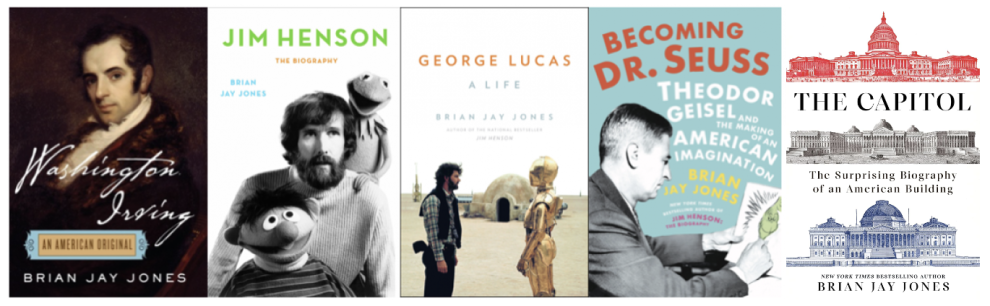
I am thrilled to announce that I have been elected to receive the Washington Irving Medal for Literary Excellence from the St. Nicholas Society of New York.  I’ll be receiving the medal at the organization’s Winter Stated Meeting in New York in early February.

It’s a genuine honor to receive this award — past recipients include David McCullough and Ron Chernow — and the fact that the organization, and the award itself, are affiliated with Washington Irving makes it that much more special for me.   The St. Nicholas Society of New York is an organization Irving himself helped found back in 1835 to commemorate the history and heritage of New York.  (Irving, in fact, can be considered one of New York’s first historians, celebrating his home town’s Dutch heritage in a rollicking, tongue-in-cheek manner in A History of New York in 1809.)

As their most literary of founders, then, Irving’s name appears on their Medal for Literary Excellence — but  writing about Irving is not a requirement for the award! David McCullough won it for Truman in 1993, Ron Chernow received it for Alexander Hamilton in 2005, while Edwin G. Burrows and Mike Wallace got it in 2000 for Gotham. That’s heady company indeed, and I’m humbled beyond words to have my name appear alongside any one of theirs.

My deepest thanks to the St. Nicholas Society of New York for this wonderful award.