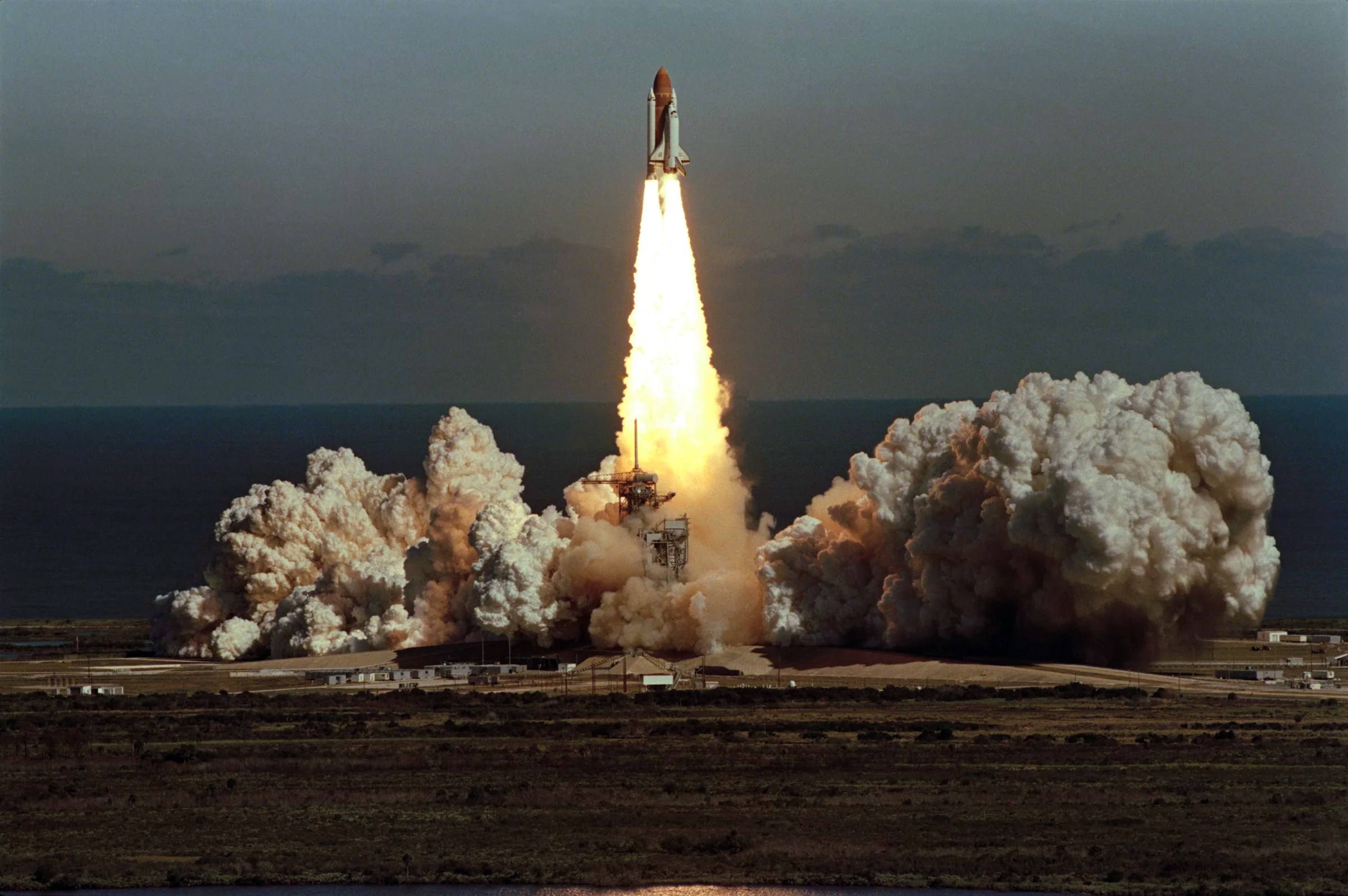
Forty years ago today, the Space Shuttle Challenger disintegrated nine miles above Cape Canaveral, seventy-three seconds after takeoff, following the explosion of its main booster rocket.
It was a pivotal moment in GenX’s collective memory, the one we thought was going to be “our JFK assassination”–the “where were you when…?” question–until a September morning 15 years later. But it’s still a moment seared into our psyche–and yeah, we all remember where we were, when . . .
Me, I didn’t see it happen live. In January of 1986, I was a freshman at The University of New Mexico (and wow, does that make me feel old) and had a job working as the night editor for the campus newspaper, which kept me up into the early morning hours nearly every day. So I was barely out of bed on Tuesday morning when a friend of mine came to pick me up in my dorm room to walk to our 11:00 a.m. class. He asked me if I’d heard the news about the space shuttle. I said I hadn’t.
“It blew up an hour ago,” he told me.
All I remember is stammering the stunned question, “Did the astronauts survive?” He shook his head sadly.
We walked to class not knowing much more–and in the days before cell phones and iPads and lightweight TVs hanging in nearly every classroom, we didn’t get to see any footage until we watched the news much later in the day.
That wasn’t true for a lot of my fellow GenXers, though. An awful lot of you watched in classrooms, on a television rolled in on a wobbly metal cart, to see the launch of the shuttle carrying the first civilian–a schoolteacher–into space. GenX saw the entire thing happen live, a communal cultural experience that shaped a generation as excitement and awe turned to shock and horror. And all broadcast live on CNN, which was the only 24-hour news channel at that time.
Here’s CNN’s live feed from that day–a morning that looked like just another regular January morning and a run-of-the-mill shuttle launch. What we didn’t know is that a combination of politics, parsimony, and publicity had likely made what happened 73 seconds after takeoff mostly inevitable.
I was absolutely captivated by the Challenger story, and over the next decades, read everything I could about it. I was always particularly fascinated by the investigation that happened afterwards, which featured its own kind of political intrigue and drama, with secret informers, passed documents, even a “Deep Throat” figure who would help break open the entire investigation into the cause of the explosion.
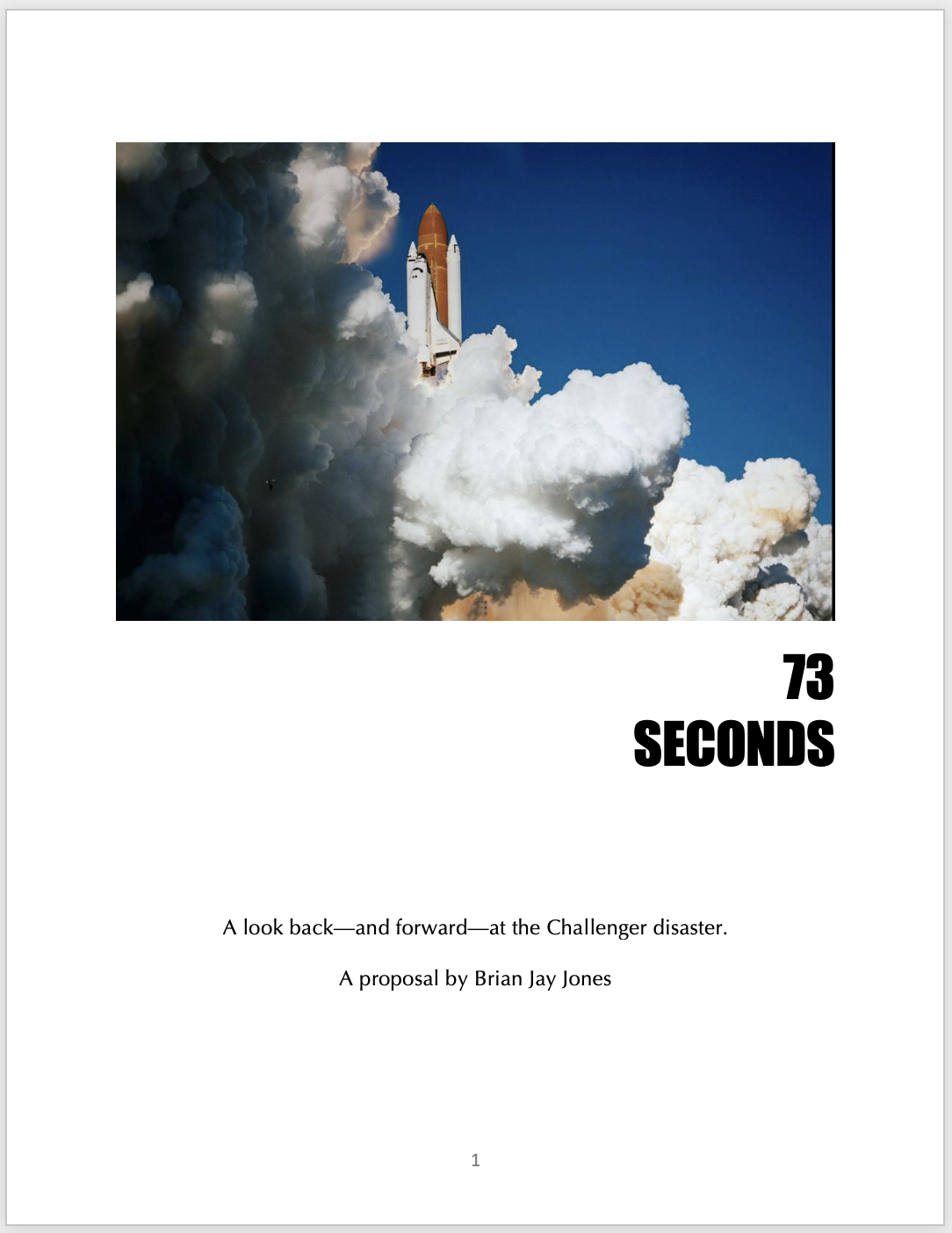
Back in early 2020, in fact, I briefly considered making the Challenger and the subsequent investigation my next Big Project, envisioning it as a kind of political thriller. I had even gotten as far as putting together a proposal for a project I was calling 73 Seconds that had been enthusiastically received by my editor . . . when we learned that Adam Higginbotham, the same author who had written the terrifyingly terrific Midnight in Chernobyl, was also taking on the subject.
I couldn’t even be mad about it; there are certain writers who are just made for certain subjects, and as far as I was concerned, there was no better writer to take on Challenger than Adam. I pulled my proposal, and moved on to The Capitol a little more than a year later. Adam, meanwhile, finished his book, which came out in 2024 to rave reviews. Go read it. That cat can write, man.
Anyway, that’s where I was on January 28, 1986 — a major turning point in American history and in the modern American identity. How about you?
And hello again. It’s been a while since I provided any kind of update of the Current Project, but there’s finally some news to tell you. As of Friday afternoon, this happened:
Yeah, it’s been a long time coming, I know.
I initially pitched the idea for Capitol: An American Biography to my agent in the months after January 6, 2021 for one simple reason: the building is really important to me, and January 6 hit me hard. As I think I’ve talked about here before, I was a staffer in the U.S. Senate for nearly ten years, spending plenty of time in the Capitol building–and this was in the years before 9/11, when access to the building was much looser, especially for staff, than it has been over the last 25 years.
Nearly every evening, I rode my bike from the Capitol to the Lincoln Memorial and back again–always stopping on the way to get a drink at the drinking fountains in the grotto on the Capitol’s northwest lawn, home to the coldest drinking fountains in DC. In the days when you could still do so, I’d ride along the western terrace and just look out over the Mall. I was always trying not to take that view for granted.
As a Congressional staffer, your ID card could get you nearly anywhere in the building–and I’d always make the most of it, giving myself my own guided tour of the building, ducking under ropes to access areas tourists couldn’t go. I loved how I could feel the wear in the marble steps as I walked up them, and I would almost always stop in the Old Senate Chamber and try to imagine what it was like to sit in the chamber and listen to Daniel Webster–or imagine the chaos of the day when Senator Charles Sumner was severely caned by Congressman Preston Brooks. Or I’d stand in the Old House Chamber, now Statuary Hall, and try to picture the grandeur of the place as it was when painted by artist Samuel F.B. Morse (yes, that Samuel Morse) in 1822
Samuel F.B. Morse’s painting of the House in a night session, 1820 or so.
Some weekends, if the Congress was in session and I didn’t have a bill to worry about it, I’d walk up to the Capitol from the house I rented with two other Senate staffers at 6th and C Street NE. I’d walk up those gigantic stairs at the East Front, head for the north wing, and then sit in the staff gallery above the floor and just watch. Working in the Senate was my job, yeah, but I never stopped appreciating how special it was to work in, and just be in, that building.
And any time a bill you were staffing was coming up for consideration–in my case, that meant it probably came out of the Labor & Human Resources Committee (now Health, Education, Labor & Pensions, a name change that came along right about the time I was leaving the Hill)–well, that meant you got to head over to the Senate floor to provide any needed staffing. As a Congressional staffer, you lived for those moments–or, at least, I know *I* did.
I loved everything about going to the floor: the subway ride over, taking the elevators up from the subway level to the main level, checking in with the floor clerk, entering through the cloakroom, and then . . . almost like curtains parting to reveal a gigantic theater set, you would push open the doors of the cloakroom and find yourself on the Senate floor, all dressed in blue and mahogany and marble. The space has been modernized and updated over the last 150 years or so, but it’s still the same room they’ve been using since 1859. This is a room where a lot of stuff has happened.
The floor of the United States Senate. The doors you see at the front don’t lead to the cloakrooms, but onto a really nice suite of meeting rooms. As a staffer, you enter from the cloakrooms at the rear of the chamber. In this photo, you’re overlooking the Republican side of the floor.
As a staffer, you would then generally proceed to take a seat on the benches behind the railings lining the outer edge of the room–that’s where staff sits when they’re not assisting their members. You had to speak to each other in hushed tones–anything louder than a stage whisper would get you a quick admonishment from a floor staffer we all called The Floor Nazi. And if you needed to make a call back to your office–at least in the 1990s era when I was there–you had to go back into the cloakroom and slide inside one of the phone booths that had a folding door you pulled shut behind you. (Six times out of ten, as I entered the phone booth, I would say, with my voice dropping an octave over the course of the sentence, “This . . . looks like a job for . . . Superman!” The clerks had no idea what to make of me.)
And when it was finally time to staff your boss . . . you’d get that little wave and you’d tuck your fat accordion folder stuffed with papers under your arm, walk slowly down the center aisle, then cross over to take your seat–and your seat was a chair which would be brought over to you by a Senate page (my first time on the floor, I sat down in a member’s chair, not knowing how it worked, and HOO BOY that was not good). And you’d sit there with your notebook in your lap and a pen in your hand and your accordion folder at your feet and try not to make eye contact with the C-SPAN cameras, or arch your eyebrows in response to a comment, or even scratch an itchy nose–you didn’t want to do anything to call attention to yourself. Every once in a while, you might nod your head if your boss looked back at you to make sure a fact was correct, or hand up a hastily-scribbled note with a relevant fact or point you wanted to be made. Your job is to be indispensable, but invisible.
So, as you can imagine, the events of that January 6 really, REALLY affected me. I was sitting at my desk that day, watching things unspool on the television in my home office, and I remember standing up at one point and screaming “YOU HAVE NO RIGHT!” when someone plunked down in the Vice President’s chair in the Senate chamber. My phone rang constantly with calls from one old Senate colleague after another–and every call started the same way: Oh my god can you believe this? And no, I couldn’t. It was too surreal. I only knew I felt awful. I felt awful for me. I felt awful for us as a nation. And I felt terrible for that building.
It sounds funny, I know, but after that day, I wanted to do something, to say something, that might do right by that building. In 2021, it had been two years since my last book (Becoming Dr. Seuss, still available at fine booksellers everywhere) and, ever since hunkering down for COVID (remember those days?), I had been looking for another subject to write about. In the Spring of 2021, I started a conversation with my agent about taking on the Capitol as a possible subject–but I was nervous about it, because, hey, I’m a biographer and this sort of thing feels more like history.
“Then treat it like a biography,” my agent said. “Think of the building as your main character and work from there.”
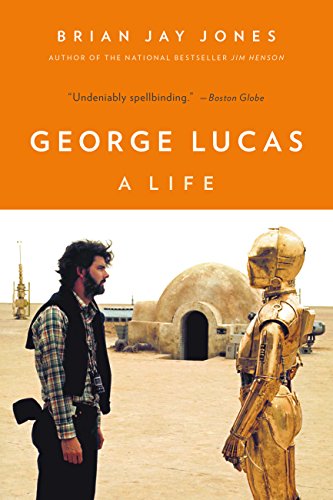
Whoa. I hadn’t really thought of it that way. But as I started to put the proposal together around June–which entailed several months of a lot of reading, a lot of research, and a lot of poring through articles on newspapers.com–I was pretty sure I knew how this could work. By the first week of August 2021, I had a proposal I was happy enough with to let my agent take it to my amazing editor–my same editor for George Lucas and Becoming Dr. Seuss–who quickly said yes, let’s do it. And then . . . I had a horrific case of writer’s block for nearly two years.
Fortunately, one of the nice things about writing non-fiction is that you can keep researching even when you’re not writing–research is actually the fun part–so I just kept researching and reading and looking stuff up, even as I continued to not get a word written. Eventually, the words started coming, albeit slowly — but thanks to the prodding and enthusiasm of another fantastic and very patient editor (I’ll tell that story at another time, but it’s amazing) as well as the support and cheerleading of friends and family . . . well, here we are, three years and nine months after a yes to the proposal with the completed first draft.
Now it’s in my editor’s hands, and together we’re shooting for a publication date of June 2026–and I so appreciated all of you who kept kindly asking when is the book coming out? when all I could say was: soon because oof, I still had no idea when I was gonna finish.
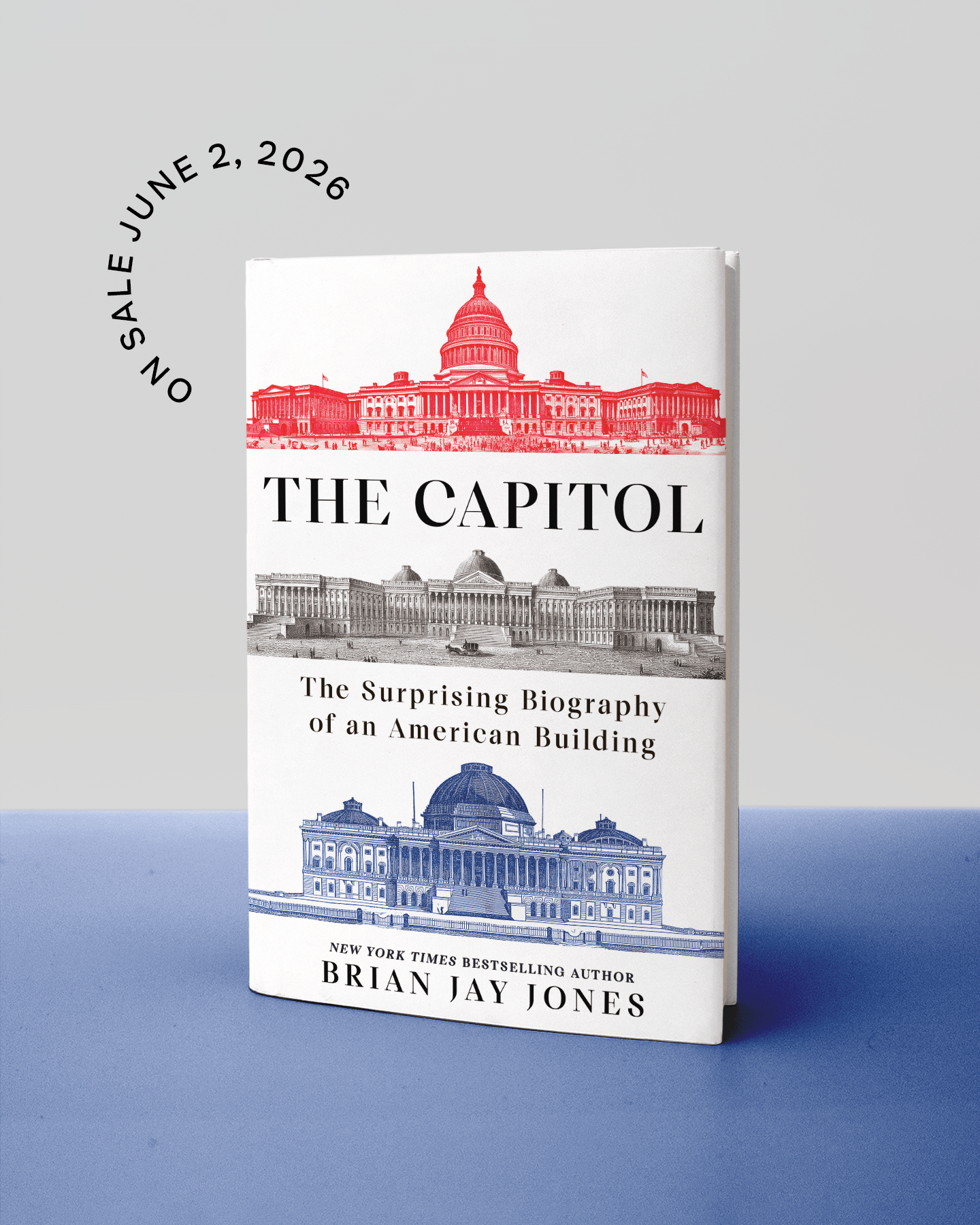
We’re on a fast enough track, too, that I should soon have a cover to show you, along with a title change. Yeah, Capitol:A Biography was the title I pitched it under, and the title that kept me in the proper mindset while writing–but now it’s having its title changed and I know what it is and I love it. But that’ll all have to wait.
For now, I wanted to let you know that everything is moving along, and I appreciate you patiently waiting me out these past few years. Not much longer, okay? Really.
Welcome to the official website of Brian Jay Jones - that’s me, the writer and biographer and not the dead Rolling Stone. Or the live aeronaut. Keep trying.





 Brian Jay Jones