Tag Archives: random musings

Damnboo

Fifty years ago — so I am told — there was an enormous man-made lily pond in our backyard. Even had I not been told this, I would have known. The crumbling remains of the stone wall that lined the edge of the pond are still poking up through the grass in our yard, making a semi-circle under the shadows of the chestnut trees. Several years ago, while clearing away brush, I discovered the buried casing that used to house an underwater light. But there’s a sturdier, more stubborn reminder of the Lily Pond That Was: two thick patches of bamboo.

Oh, it’s lovely stuff, I’ll give you that — tall, leafy, and green almost year-round. Even the slightest wind hisses as it passes through, making the evenings sound warm and exotic.

But it grows everywhere. Its root system — which looks like a human spinal cord — dips and turns and tangles and snakes its way through my yard, weaving between tree roots to shoot up a pencil-thin bamboo shoot at the base of our Japanese maple. It erupts through the cracks in the low stone wall, and spurts up a row of prison bars in the middle of the lawn.

And it grows fast. The morning after a rain storm, I’ll find three-foot stalks of bamboo hunkered together in the corner of the yard. If I catch it fresh, I can usually kick them over — the thicker stalks make a satisfying hollow whonk! as I punt them with my boot — but if I don’t cut it down within the first day or so, the trunks quickly thicken up to the point where I either need to run over the thinner shoots with my riding mower, or cut the thicker trunks down with tree loppers.

It’s a war of attrition, and after several years of fighting these little skirmishes, I’ve actually managed to clear away the largest patch in the middle of the yard — the patch that had forced one chestnut tree and the Japanese maple to twist their branches away from the thick mess of bamboo for over thirty years. I’ve lopped and sawed down over a hundred bamboo trees, leaving behind stumps that gradually became rock-hard stubs that twist ankles and bust lawn mower blades. Only now have they just started to decay enough that I can force them and their stubborn root balls out of the ground by whacking them sideways with a sledgehammer. In this area, at least, they don’t appear to be coming back.

It’s a different story down in the corner of the yard, where a thick patch of the stuff still stands there in exotic defiance. Like Sisyphus pushing his rock, I’ll continue to mow down new shoots each week, only to have them erupt anew, thicker and greener, the next wet day. It would almost be therapeutic, if it wasn’t so frustrating.
Begin At The Beginning

“Begin at the beginning,” the King said, very gravely, “and go on till you come to the end: then stop.”

– Lewis Carroll, Alice’s Adventures in Wonderland

At a recent booksigning, I was asked by a very nice fellow—who’d apparently spent the last several years researching a 19th century figure and was now ready to start writing—about the “right” way to begin a biography. “Should I begin at the beginning of his life?” he asked, “or pick a pivotal event and start there? Or should I start at the end, and tell the book as a flashback?”

It’s a tricky question, and I’m not certain I have a good answer for it. But I know for sure I don’t have the “right” answer for him — because I don’t think there is a right answer. All I can give you, and him, is my opinion. So, here goes.

Those of us who deal in non-fiction have different narrative issues than those of you who write fiction, mainly because we have the hassle—or the luxury, depending on how you want to look at it—of having the story plotted out for us in advance. No matter how much we might wish Aaron Burr hadn’t turned out to be such a skunk, or want Clarence Darrow to win the Scopes trial, that’s not the way it happened. Nor can the North win the Civil War because of the involvement of space aliens, or Jack the Ripper speed away from the scene of a crime in a Ferrari, no matter how cool that might be. We have to be true to the events we’re reporting.

That’s not to say that we don’t have considerable leeway in how we tell our stories. David McCullough, for example, begins John Adams in January 1776, with the 40-year-old Adams riding on horseback through a snowstorm on his way to Philadelphia, while David Michaelis starts Schulz and Peanuts with Schulz leaving for the army following the death of his mother, long before he ever drew a Peanuts strip. We can tell our stories through flashbacks, or on a straight, chronological track. What we can’t do, however, is tell our stories in ways that seem unnatural or forced. Every story has its beginning—and after doing our research, it’s our job to find it.

That doesn’t mean it’s always easy. In fact, I have a rather tumultuous relationship with my beginnings. I usually know structurally how I’m going to start, but I have a heck of a time with that “once upon a time…” clause that I need to kick the whole thing off. So I have an odd in media res approach to working in which I start writing the middle of the piece first– whether it’s a speech or article or what have you — and go until I have one of those Eureka! moments where everything falls into place, and I know where I’m going and how I’m getting there.

Even then, I still usually save the very first pages for last. By that point, I know exactly where I’ve been in the narrative, I know my structure, and I generally feel that, after having “lived it” for so long, I know the best way to kick things off. And yet, sometimes I still don’t get it quite right on the first try, usually because I’ve somehow ignored my own advice on writing the beginning that works for my story.

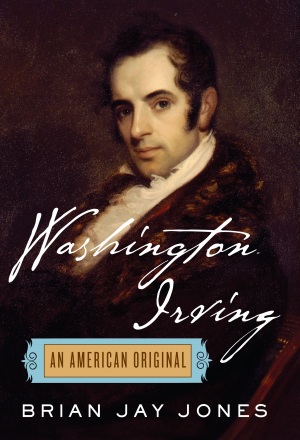
In the first draft of Washington Irving, for example, I wrote what I called my Cinematic Opening. It was artsy and theatrical and beautifully written, and I loved it. I even knew exactly the way it would look on film: We open with a tight shot of Irving, already the most famous man in the world, writing letters at the round table in his parlor at Sunnyside. The camera pans slowly up and moves forward—in a prolonged crane shot—through the window of the parlor and out onto the Hudson River, then makes its way downriver to New York City. As the New York of 1847 bustles away, a special effects shot slowly fades the city backwards through time until it reverts to its Revolutionary War-era face of 1783, and we begin to tell the story of Irving’s life.

It was lovely and very Merchant-Ivory and, ultimately, very terrible, because it wasn’t true to the story. It felt too forced, too dramatic, and my editor summed it up nicely with one word: “No.” Out it went.

She was right, and I knew it. I was trying to be clever and cinematic and beautiful, and that wasn’t really my story. It didn’t work. So I started over, and this time I began at the beginning—my beginning, the one I knew was there all along.

That’s the best advice I can give, then: Begin at the beginning of the story—your story—then go on until you come to the end, and then stop. There really is no “right” way, but there is a way that works best for you and the story you want to tell. Trust me, you’ll know it when you see it. Find it, listen to it, then write it.

Analog Dialogue

When I began working in the Congress in 1990, part of my job—and this was a task that always fell to the last person in the door—was to manage my Senator’s mailroom. For about an hour every morning, I opened constituent mail, date-stamped each letter, and sorted them into issue-related piles to ensure they were routed to the correct staffer for a draft response. The draft response would then be approved by the Legislative Director—or, on particularly touchy issues, the Senator himself—then would be routed back through the system, where it would be logged into the databank, printed, signed, and mailed back to the constituent. In a given week, our office received about 2,500 letters, but even with that volume, when the system worked correctly—as it did 95 percent of the time—constituents received a response within about two weeks of their letter being received. A good turnaround time.

Today, I work in the office of a county official where we receive about a 500 e-mails a week from constituents. As a staff, we sort through the e-mails, draft and vet responses with each other, and send an e-mail back. We try to respond within a week. That’s also a good turnaround, given both the volume of e-mail and our staff size (counting our Councilmember, there are five of us). But any gap of about three days between receiving the constituent e-mail and a response from us often results in an angry follow-up e-mail, usually accusing the Councilmember of being non-responsive or, better yet, of “ignoring” their e-mail.

*sigh*

I like e-mail. I like dashing off a line or two to a friend or colleague, punching “Send,” and knowing that even just that line or two we’re sharing means we’re staying in touch. But e-mail also makes us careless. In the old days, you could scribble out a hotheaded note (or a response to someone else’s hotheaded note), and by the time you got done writing it, typing it, printing it (or whatever), then stuck it in an envelope and wrote the address . . . well, by the time you found a stamp, you’d probably come to your senses and realized that sending your remarks was going to be a mistake. The sheer amount of time and effort required to send a “snail mail” was, in a sense, your first and best editor.

Nowadays, I regularly see e-mails—both from constituents and government officials—that make my eyes bug and my mouth hang open in disbelief. Forget basic spelling and grammar—when anger is in play, those all go out the window—what’s astounding is the complete lack of civility. There’s name-calling, impugning of reputations, wild accusations . . . anything goes. And the responses to such missives can be just as terrible. Many times, it’s clear a response hasn’t been vetted or approved by anyone. (We always keep in mind a “front page” policy, in which we ask How would you feel if your response was printed on the front page of the newspaper?) E-mail, quite simply, has no filter. It’s ready, fire, aim.

While the ability to write and fire off an e-mail has certainly brought us all more in touch than ever, I think it’s also removed some civility from both public and private discourse. There’s something to be said for sitting down and writing out a letter—even if it’s on your computer and printed out—and sticking it in the mail. I like getting mail. I like that someone has taken the time to write a note, address an envelope, stamp it, and send it. It means a lot.

Maybe it’s just me, though. I love writing notes. I have beautiful correspondence cards with lined envelopes with my address already printed on the envelope flap. I write notes in fountain pen—and I have two boxes of different colored inks to play with—and I seal my envelopes with wax and press my initial into it before it cools. It feels ancient and interesting and elegant. It feels right.

But I’m even the kind who doesn’t keep my schedule electronically. I still carry a calendar with me, and I write my appointments and other details in it, all the way down to confirmation numbers and directions. I was on the phone scheduling some meetings with my editor one afternoon, and joked that I was so determined to make a certain meeting that I was writing it in my appointment book “in ink!”

“An appointment book?” she laughed. “My, how analog of you!”

Indeed.

Now, I’m certainly not encouraging us to become Mennonites. I like my DVDs, my satellite radio, my computer, and iPod too much. But there are times I long for the days of written correspondence (and the biographer in me shudders at the loss of written record in favor of unsaved e-mails). At the very least, I wish there was a better way of bringing some sort of decorum to e-mail. Apart from the smiley faces and the “No All-Caps” rule, I mean.