Category Archives: Washington Irving

The Sagging Book Market (of 1819)

Think the beating the book market is taking by a slumping economy is a new phenomenon?  Think again. 

Writing in the latest issue of the journal Common-Place, Fordham University professor Edward Cahill discusses how the rise of easy credit in the early nineteenth century led to a devaluing not only of paper money, but eventually of literary currency as well — culminating in the financial panic of 1819 and the collapse of countless booksellers.  Left standing among the debris was Washington Irving’s Sketch Book of Geoffrey Crayon. “But if the appearance of the Sketch Book marked the economic development of American literary culture,” Cahill says, “it was also haunted by widespread economic unrest.” 

Cahill goes on to explain why The Sketch Book was not only a survivor, but also provided elegant commentary on — and a bit of a eulogy for — the early 19th century publishing industry. Eventually, Cahill concludes, “elite literary culture would be inextricably tied to popular culture, despite many protests to the contrary.”   Well put.  Once again, almost in spite of himself, Washington Irving shaped our perceptions of popular culture.

Professor Cahill’s article,  “The Other Panic of 1819: Irving’s Sketch Book, Literary Overproduction, and the Politics of the ‘Purely Literary,'” can be found right here.  Go get it.

Missed It By That Much…

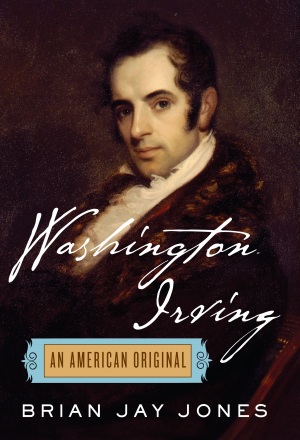
Well, shoot.  I just found out today — through the marvels of Googlecrawl — that the Biography Group of the Harvard Club of New York was discussing Washington Irving: An American Original at its meeting last Thursday. 

Had I known that, I might have crashed it.  But in a polite way, of course.  It is Harvard, after all.

Happy Birthday, Washington Irving!

Happy 226th!

Happy 226th!

On the evening of April 3, 1783 — the same week New Yorkers learned of the British ceasefire that effectively ended the American Revolution — Washington Irving was born on William Street in Manhattan.  (If you’re interested in seeing where he was born . . . well, sorry.  There’s a Duane Reade pharmacy on the site today.  Go enjoy Sunnyside instead.)  Today marks his 226th birthday.

Irving was a not a great celebrater of his birthday — or, at least, he doesn’t indicate as much in his personal letters and journals.  Nonetheless, there were times in his life when important events seemed to fortuitously fall on April 3. 

For example, it was on April 3, 1830 — Irving’s 47th birthday — that Irving learned that the Royal Society of Literature, citing his work on The Life and Voyages of Christopher Columbus and Chronicles of the Conquest of Granada, had chosen to award him one of its Gold Medals for “Literary works of eminent merit, or of important Literary Discoveries.”

Three years later, on April 3, 1833, the 50-year-old Irving learned, to his great amusement, that he had been awarded an honorary Doctor of Laws degree by Harvard.  Irving — who could probably fairly vie for the title of New York’s worst attorney ever — was delighted at the irony. “To merit such rewards from my country is the dearest object of my ambition,” Irving wrote to Harvard president Josiah Quincy, “but, conscious as I am of my imperfections, I cannot but feel that my Countrymen are continually overpaying me.”

In 1845, while serving as U.S. Minister to Spain — an appointment cheerily and astutely conveyed upon him by President John Tyler — Irving made a special note of his 62nd birthday.  “I reccollect the time when I did not wish to live to such an age,” he wrote reflectively, “thinking it must be attended with infirmity, apathy of feeling; peevishness of temper, and all the other ills which conspire to ‘render age unlovely.’ ”

Yet, as he wrote to his sister Sarah that same afternoon, with the warm April sunshine streaming into his Spanish salon, he was feeling good, even optimistic:

“Here my Sixty second birthday finds me in fine health; in the full enjoyment of all my faculties; with sensibilities still fresh, and in such buxom activity, that, on my return home yesterday from the Prado, I caught myself bounding up stairs, three steps at a time, to the astonishment of the porter; and checked myself, reccollecting that it was not the pace befitting a Minister and a man of my years.”

The last birthday Irving would celebrate — his 76th, on April 3, 1859 — was a gray, rainy Sunday. As greetings and bouquets arrived at Sunnyside—“beautiful flowers to a withered old man!” he said—Washington and his nephew Pierre Munroe Irving sorted through a number of unpublished manuscripts, mostly Spanish tales, still lying at the bottom of a desk drawer. Washington let them be; he was done writing. “Henceforth,” he vowed, “I give up all further tasking of the pen.”

He was as good as his word, content to live out his remaining days at Sunnyside in the company of friends and family — but always taking to heart his own words of wisdom: “Whenever a man’s friends begin to compliment him about looking young, he may be sure that they think he is growing old.”

Rome (If You Want To)

As promised, I’m putting up a couple of photos taken during our quick trip to Rome last week.   But first, a brief digression.

Years ago, when Barb and I began travelling together, we would return from trips to find the photos we’d snapped were either of Barb in front of something, or me in front of something, or featured neither one of us.  We rarely had any of us together.  And that was because we just never seem to get around to asking random tourists or locals, “Would you take our picture?”

I don’t know why we don’t ask this; as DC residents, we’ve been asked hundreds of times to snap photos of strangers in front of the Lincoln Memorial or Smithsonian, and don’t find it an inconvenience at all.  Yet, we never think to bother anyone with a similar question when we’re travelling.   Consequently, we were returning from trips with lots of great photos, but with absolutely zero indication that we were ever actually there because we weren’t in any of them.  They were photos that looked like  postcards.

So we decided to start bringing along the pets.com (remember them?) sock puppet and take pictures featuring him.  He’s photogenic, absolutely incapable of taking a bad picture, and he cracks us up.  We get lots of stares when we’re standing in front of some iconic structure as Barb fearlessly waves Sock Puppet around and I try to shoot the photo without laughing too hard. 

Right.  Now that you’ve got some context, here we go:

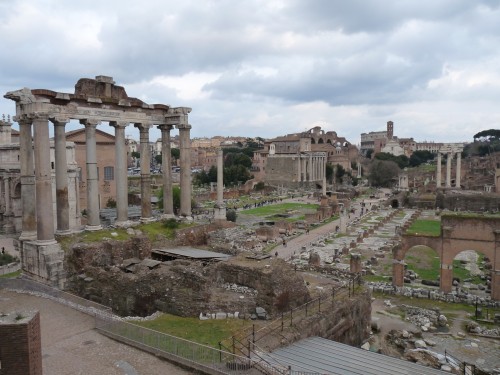
First up, the remains of the Roman Forum, an impressive field of fallen marble arches, broken columns, and crumbling foundations that still provide a tantalizing hint of what must have been a glorious open space for debating politics, arguing philosophy, or just people watching.

The remains of the Roman Forum.

The remains of the Roman Forum.

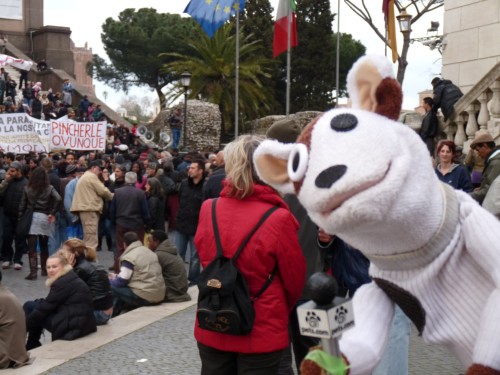
As we made our way around the Roman capital building, we came across a vocal and somewhat rowdy protest.  We’re still not entirely sure what they were protesting, but it was an enthusiastic crowd, regardless.

Pincherle ovunque!!

Pincherle ovunque!!

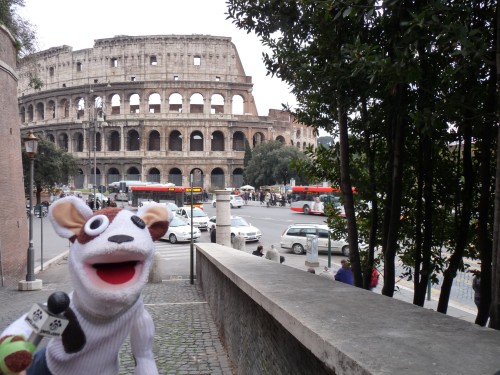
Next up was a stroll past the Colosseum, one of Rome’s most impressive sites and dangerous traffic circles:

Today's score: Lions 14, Trojans 7.

Today's score: Lions 14, Trojans 7.

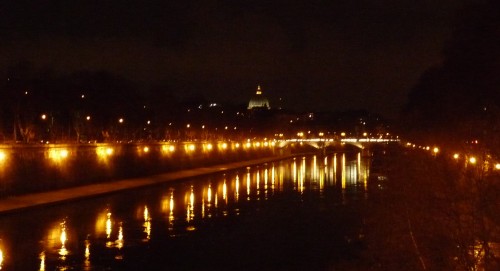
That evening, I attempted an Artsy Photo of St. Peter’s, taken from a bridge crossing the Tiber, about a mile away. 

St. Peter's Basilica, night.

St. Peter's Basilica, night.

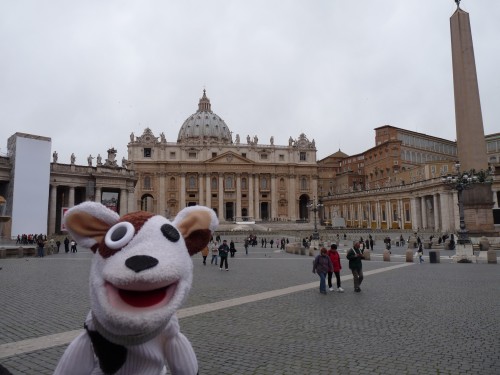
We made an easy trip through Vatican City, likely due to colder-than-usual weather, which kept the crowds away.  The square in front was relatively deserted.

St. Peter's Basilica, taken from St. Peter's Square.  Alas, the Pope was not at home.  And I had a good knock-knock joke for him, too.

St. Peter's Basilica, taken from St. Peter's Square. Alas, the Pope was not at home. And I had a good knock-knock joke for him, too.

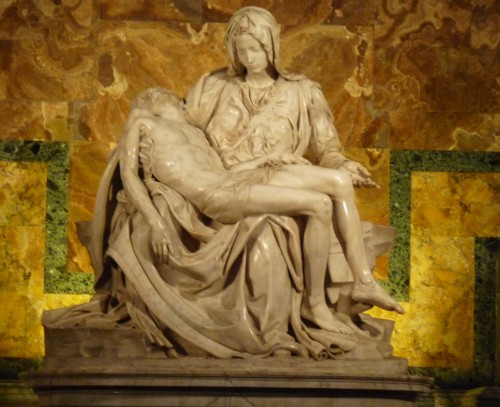
Even to this decidedly non-religious tourist, St. Peter’s was an impressive and truly inspiring building, with some amazing art — including Michelangelo’s Pieta, shielded behind plate glass but still a marvel to behold:

Michaelangelo's Pieta.

Michelangelo's Pieta.

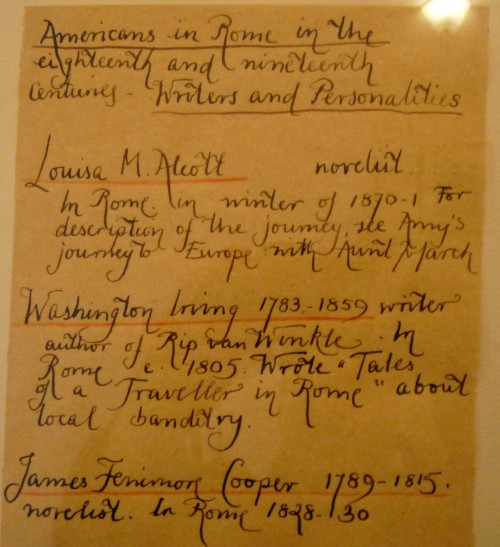
And finally, as we made a quick tromp up the stairs in the Keats-Shelley house — the house where the poet John Keats lived and died, just off to one side of the famous Spanish steps — I caught sight of this framed bit of paper, listing “Americans in Rome in the eighteenth and nineteenth centuries”:

Washington Irving makes a cameo appearance on our Roman holiday.

Washington Irving makes a cameo appearance on our Roman holiday.

Yup, a cameo appearance by Washington Irving.  Perhaps I’ll devote a bit of space here shortly to Irving’s brief time in Rome.  He spent only slightly more time in the city than we did, yet nearly changed careers, thanks to his friendship with the painter Washington Allston.  But that’s a story for another day.

Washington Irving, Cultural Continuity, and Iconoclasm

First Things magazine — a magazine and blogging site which calls itself the “Journal of Religion, Culture, and Public Life” — has a really thoughtful piece on Washington Irving, and how Americans would do well not only to re-embrace the man, but to learn from the lessons he taught us:

Washington Irving is of particular importance, especially now that so many of those who howled at the specter of a systemically evil nation are silent at the election of Barack Obama. What will many faculties do, now that their view has been thus radically altered or at least thrown into question? The culture of iconoclasm can only endure so long as one wants to smash an icon. Once one reveres the icon, an inevitable conservatism sets in—there is a natural desire to preserve memories and eventually even the traditions and institutions recognized as having been virtuous.

Intrigued?  You should be.  You can get the rest of it right here.  And my thanks to Eric Seddon at First Things for his column — and for the very kind tip of the hat in the first paragraph.  I’m delighted to be considered one of the “saner minds.”

Cold Hands, Good Company

It’s been a cold and windy week here in Maryland — made even colder by the little tease of Spring weather we’ve had over the past few weeks, where you can walk the dog, run to the store, or get the mail without needing your coat.  This week, though, just running from the house to the car makes your cheeks sting and your fingertips burn.  Each evening I build a fire in the living room fireplace and press my nose against the front window, staring at the dead flowerbeds and counting the weeks until I can go out and start playing in the mud again.

The crafty Aaron Burr.

The crafty Aaron Burr.

Meanwhile, I’m having lunch today with David O. Stewart, whose book The Summer of 1787 made the proceedings of the Constitutional Convention read like a great suspense novel.  David’s presently hard at work on a book about Aaron Burr and the comedy of errors that was the Burr Conspiracy, and he’s being either kind enough or crazy enough to ask me to blather on at length about Washington Irving and his relationship with Burr, and Irving’s observations as a semi-official correspondent at Burr’s trial in 1807.  Plus, David’s just plain good company, so it’s pretty much a double bonus for me.

Oh, and I’d be remiss if I didn’t mention that David’s latest book, Impeached: The Trial of President Andrew Johnson and the Fight for Lincoln’s Legacy hits bookstores on May 12.  You can advance order a copy here.

The Real “Legend of Sleepy Hollow”

As I discussed here yesterday, Washington Irving’s tale “The Legend of Sleepy Hollow” is one of those true rarities in American literature — a tale nearly all of us can summarize, even if we’ve never read the original story.

Or can we?

Most of us recall Irving’s tale mainly through a series of strong visual images: Ichabod Crane on horseback, looking like a scarecrow on a hobby horse. Ichabod Crane dancing gawkily with Katrina Van Tassel. Crane spurring his horse Gunpowder through darkened woods, with the Headless Horseman in hot pursuit. And, perhaps the sharpest picture — thanks largely to Walt Disney — a pumpkin hurled straight at Ichabod Crane’s own head.

Irving — who called his tale merely a band connecting a series of “descriptions of scenery, customs, manners, etc.” — would likely be delighted that so many of his mere “descriptions” have been burnt into our brains. But what we’ve buried among those strong visuals is the tale itself, which unfolds in a slightly different manner than we may remember, and ends with a bit of a twist and a flourish.

Let’s revisit Irving’s “Legend” — or maybe you’ll be visiting it for the first time — and experience his tale as Irving really wrote it. I think you’ll find it’s just as good, if not better, than the way we think we remember it.

Much of “Sleepy Hollow” is actually set-up for the climactic chase, and Irving devotes pages to descriptions of his characters — especially Ichabod Crane — and their motivations. Here’s Irving describing the physical traits of his gawky school teacher — and you can see why this was a no-brainer for a Disney animator:

He was tall, but exceedingly lank, with narrow shoulders, long arms and legs, hands that dangled a mile out of his sleeves, feet that might have served for shovels, and his whole frame most loosely hung together. His head was small, and flat at top, with huge ears, large green glassy eyes, and a long snipe nose, so that it looked like a weather-cock perched upon his spindle neck to tell which way the wind blew. To see him striding along the profile of a hill on a windy day, with his clothes bagging and fluttering about him, one might have mistaken him for the genius of famine descending upon the earth, or some scarecrow eloped from a cornfield.

Next, Irving makes certain we understand that Crane is easily spooked and has a whiff of nervous-nelly about him, information we need for later:

…as he wended his way by swamp and stream and awful woodland, to the farmhouse where he happened to be quartered, every sound of nature, at that witching hour, fluttered his excited imagination . . . and if, by chance, a huge blockhead of a beetle came winging his blundering flight against him, the poor varlet was ready to give up the ghost, with the idea that he was struck with a witch’s token….

…How often was he appalled by some shrub covered with snow, which, like a sheeted spectre, beset his very path! How often did he shrink with curdling awe at the sound of his own steps on the frosty crust beneath his feet; and dread to look over his shoulder, lest he should behold some uncouth being tramping close behind him! And how often was he thrown into complete dismay by some rushing blast, howling among the trees, in the idea that it was the Galloping Hessian on one of his nightly scourings!

Now enters the love interest of the tale, Katrina Van Tassel, “a blooming lass of fresh eighteen,” Irving says, “plump as a partridge; ripe and melting and rosy-cheeked as one of her father’s peaches, and universally famed, not merely for her beauty, but her vast expectations.” Not quite a “huge tracts of land” joke, but close. Anyway, Irving then establishes that Ichabod Crane’s interests toward Katrina aren’t based purely on the power of her looks or personality:

…as he rolled his great green eyes over the fat meadow lands, the rich fields of wheat, of rye, of buckwheat, and Indian corn, and the orchards burdened with ruddy fruit, which surrounded the warm tenement of Van Tassel, his heart yearned after the damsel who was to inherit these domains, and his imagination expanded with the idea, how they might be readily turned into cash, and the money invested in immense tracts of wild land, and shingle palaces in the wilderness.

Vying for Katrina’s hand — and making up the third point in the tale’s love triangle — is the brash Brom Bones. While we likely remember Brom as either the bullying blowhard from the Disney cartoon, or the sulky Captain of the Football Team from the Tim Burton film, in Irving’s original tale, Brom is actually a rather likeable rogue:

He was always ready for either a fight or a frolic; but had more mischief than ill-will in his composition; and with all his overbearing roughness, there was a strong dash of waggish good humor at bottom . . . The neighbors looked upon him with a mixture of awe, admiration, and good-will; and, when any madcap prank or rustic brawl occurred in the vicinity, always shook their heads, and warranted Brom Bones was at the bottom of it.

Irving has neatly set up the two rivals competing for the hand of the love interest — now it’s time to bring them together. In “Sleepy Hollow,” Irving brings Ichabod and Brom to the Van Tassel home for an evening dinner and dance — and where Ichabod listens to some of Sleepy Hollow’s “sager folks” telling ghost stories. Here’s Irving setting up the appearance of the Headless Horseman, as well as the rules of the coming chase. And you might want to check the doors and windows before you read it:

The chief part of the stories, however, turned upon the favorite spectre of Sleepy Hollow, the Headless Horseman, who had been heard several times of late, patrolling the country; and, it was said, tethered his horse nightly among the graves in the churchyard.

The sequestered situation of this church seems always to have made it a favorite haunt of troubled spirits. It stands on a knoll, surrounded by locust-trees and lofty elms, from among which its decent, whitewashed walls shine modestly forth, like Christian purity beaming through the shades of retirement. A gentle slope descends from it to a silver sheet of water, bordered by high trees, between which, peeps may be caught at the blue hills of the Hudson. To look upon its grass-grown yard, where the sunbeams seem to sleep so quietly, one would think that there at least the dead might rest in peace. On one side of the church extends a wide woody dell, along which raves a large brook among broken rocks and trunks of fallen trees. Over a deep black part of the stream, not far from the church, was formerly thrown a wooden bridge; the road that led to it, and the bridge itself, were thickly shaded by overhanging trees, which cast a gloom about it, even in the daytime; but occasioned a fearful darkness at night. Such was one of the favorite haunts of the Headless Horseman, and the place where he was most frequently encountered. The tale was told of old Brouwer, a most heretical disbeliever in ghosts, how he met the Horseman returning from his foray into Sleepy Hollow, and was obliged to get up behind him; how they galloped over bush and brake, over hill and swamp, until they reached the bridge; when the Horseman suddenly turned into a skeleton, threw old Brouwer into the brook, and sprang away over the tree-tops with a clap of thunder.

We’re approaching the climax. With the party over, Ichabod Crane — who we’ve already seen is a nervous wreck about the dark — rides away on his horse, Gunpowder. Here’s how Irving describes the night, so effectively that you can practically feel the chill and hear the sounds. If this isn’t a Halloween night, I don’t know what is:

It was the very witching time of night that Ichabod, heavy-hearted and crestfallen, pursued his travels homewards, along the sides of the lofty hills which rise above Tarry Town, and which he had traversed so cheerily in the afternoon. The hour was as dismal as himself. Far below him the Tappan Zee spread its dusky and indistinct waste of waters, with here and there the tall mast of a sloop, riding quietly at anchor under the land. In the dead hush of midnight, he could even hear the barking of the watchdog from the opposite shore of the Hudson; but it was so vague and faint as only to give an idea of his distance from this faithful companion of man. Now and then, too, the long-drawn crowing of a cock, accidentally awakened, would sound far, far off, from some farmhouse away among the hills—but it was like a dreaming sound in his ear. No signs of life occurred near him, but occasionally the melancholy chirp of a cricket, or perhaps the guttural twang of a bullfrog from a neighboring marsh, as if sleeping uncomfortably and turning suddenly in his bed.

[. . .]

He was, moreover, approaching the very place where many of the scenes of the ghost stories had been laid. In the centre of the road stood an enormous tulip-tree, which towered like a giant above all the other trees of the neighborhood, and formed a kind of landmark. Its limbs were gnarled and fantastic, large enough to form trunks for ordinary trees, twisting down almost to the earth, and rising again into the air . . . As he approached a little nearer, he thought he saw something white, hanging in the midst of the tree: he paused and ceased whistling but, on looking more narrowly, perceived that it was a place where the tree had been scathed by lightning, and the white wood laid bare. Suddenly he heard a groan — his teeth chattered, and his knees smote against the saddle: it was but the rubbing of one huge bough upon another, as they were swayed about by the breeze. He passed the tree in safety, but new perils lay before him.

As a famous television ghost hunter might say: Zoinks! And now, Irving unveils his ghost, giving him a casual entrance that may leave readers feeling as if they’ve just swallowed a whole snow cone:

In the dark shadow of the grove, on the margin of the brook, he beheld something huge, misshapen and towering. It stirred not, but seemed gathered up in the gloom, like some gigantic monster ready to spring upon the traveller.

. . . Though the night was dark and dismal, yet the form of the unknown might now in some degree be ascertained. He appeared to be a horseman of large dimensions, and mounted on a black horse of powerful frame.

… On mounting a rising ground, which brought the figure of his fellow-traveller in relief against the sky, gigantic in height, and muffled in a cloak, Ichabod was horror-struck on perceiving that he was headless! —- but his horror was still more increased on observing that the head, which should have rested on his shoulders, was carried before him on the pommel of his saddle!

And away we go, in the mad dash through the woods, as Ichabod sprints for the church bridge — which, you remember, it was established the Horseman cannot cross! — and nearly falls off his horse in the process:

His terror rose to desperation; he rained a shower of kicks and blows upon Gunpowder, hoping by a sudden movement to give his companion the slip; but the spectre started full jump with him. Away, then, they dashed through thick and thin; stones flying and sparks flashing at every bound. Ichabod’s flimsy garments fluttered in the air, as he stretched his long lank body away over his horse’s head, in the eagerness of his flight.

As yet the panic of the steed had given his unskilful rider an apparent advantage in the chase, but just as he had got half way through the hollow, the girths of the saddle gave way, and he felt it slipping from under him. He seized it by the pommel, and endeavored to hold it firm, but in vain; and had just time to save himself by clasping old Gunpowder round the neck, when the saddle fell to the earth, and he heard it trampled under foot by his pursuer…

An opening in the trees now cheered him with the hopes that the church bridge was at hand . . . “If I can but reach that bridge,” thought Ichabod, “I am safe.” Just then he heard the black steed panting and blowing close behind him; he even fancied that he felt his hot breath . . .

Ichabod and Gunpowder finally make the church bridge . . . only to discover that the Horseman isn’t about to play by the rules — and provides poor Ichabod, and readers, with one of the most memorable departing gifts in literature:

Gunpowder sprang upon the bridge; he thundered over the resounding planks; he gained the opposite side; and now Ichabod cast a look behind to see if his pursuer should vanish, according to rule, in a flash of fire and brimstone. Just then he saw the goblin rising in his stirrups, and in the very act of hurling his head at him. Ichabod endeavored to dodge the horrible missile, but too late. It encountered his cranium with a tremendous crash,—he was tumbled headlong into the dust, and Gunpowder, the black steed, and the goblin rider, passed by like a whirlwind.

End of story? Not quite — and here’s the part most of us don’t remember. Irving actually gives us three denouements to choose from — the first of which is the creepier, Hammer horror film ending:

The next morning the old horse was found without his saddle, and with the bridle under his feet, soberly cropping the grass at his master’s gate…In one part of the road leading to the church was found the saddle trampled in the dirt; the tracks of horses’ hoofs deeply dented in the road, and evidently at furious speed, were traced to the bridge, beyond which, on the bank of a broad part of the brook, where the water ran deep and black, was found the hat of the unfortunate Ichabod, and close beside it a shattered pumpkin.

The brook was searched, but the body of the schoolmaster was not to be discovered . . .

Don’t like that one? Here’s the second:

It is true, an old farmer, who had been down to New York on a visit several years after, and from whom this account of the ghostly adventure was received, brought home the intelligence that Ichabod Crane was still alive; that he had left the neighborhood partly through fear of the goblin and … that he had changed his quarters to a distant part of the country; had kept school and studied law at the same time; had been admitted to the bar; turned politician; electioneered; written for the newspapers; and finally had been made a justice of the Ten Pound Court.

Did Ichabod Crane really survive his midnight ride through Sleepy Hollow, then? If so, was there really a Headless Horseman? And what became of Brom Bones and Katrina Van Tassel? Irving answers our questions in the story’s true payoff:

Brom Bones, too, who, shortly after his rival’s disappearance conducted the blooming Katrina in triumph to the altar, was observed to look exceedingly knowing whenever the story of Ichabod was related, and always burst into a hearty laugh at the mention of the pumpkin; which led some to suspect that he knew more about the matter than he chose to tell.

Despite the punchline, Irving can’t resist wrapping up his story with a creepy flourish, swirling his cloak about him as he ends his tale and disappears into the fog:

The old country wives, however, who are the best judges of these matters, maintain to this day that Ichabod was spirited away by supernatural means; and it is a favorite story often told about the neighborhood round the winter evening fire. The bridge became more than ever an object of superstitious awe; and that may be the reason why the road has been altered of late years, so as to approach the church by the border of the millpond. The schoolhouse being deserted soon fell to decay, and was reported to be haunted by the ghost of the unfortunate pedagogue and the plowboy, loitering homeward of a still summer evening, has often fancied his voice at a distance, chanting a melancholy psalm tune among the tranquil solitudes of Sleepy Hollow.

You can read “The Legend of Sleepy Hollow” in its entirety by clicking here. And please do.

Have a happy Halloween.
A Spooky Sleeper of a Tale…

Tomorrow is Halloween, which means it’s time to re-read one of the classics of American literature, “The Legend of Sleepy Hollow.” Pull your copy down off the shelf, and turn to pa . . . what’s that? You don’t own a copy? You’ve never even read it?

It’s okay.

Washington Irving’s “The Legend of Sleepy Hollow” is one of the great sleeper hits in American literature, a story whose elements stay in our collective American consciousness even as the book itself fades from college and high school syllabi or other reading lists. As I say often, it’s become such a part of our American DNA that most of us can summarize the story even if we’ve never read it.

“The Legend of Sleepy Hollow” made its first appearance on March 15, 1820, as the third and final story in the sixth installment of The Sketch Book of Geoffrey Crayon, Gent., a collection of short stories and essays that Irving had been publishing at irregular intervals since June 1819. “It is a random thing,” Irving said of his tale of Ichabod Crane, “suggested by recollections and scenes and stories about [Tarrytown, New York]. The story is a mere whimsical band to connect descriptions of scenery, customs, manners, etc.”

While “Sleepy Hollow” takes most of its basic plot elements from Dutch and German folklore, it can rightly be called our first true American ghost story. Irving not only gives his tale a unique American setting, with distinctly American references (he mentions, for example, the tree where the spy John Andre was hanged during the American Revolution, and Ichabod Crane is said to be from Connecticut), but he tells the tale in a uniquely American voice — funny, self-confident, and with just a touch of self-deprecating cockiness. It also contains all the elements we expect of a good Halloween story: a cold autumn night, a spooky bridge, a shimmering apparition, a clattering chase, and yes, there’s even a pumpkin.

Irving’s ghost story was an immediate hit. “In my opinion [it] is one of the best articles you have written,” Irving’s best friend, Henry Brevoort, wrote to him in April 1820. The critics agreed, even as they only somewhat joked that Irving was the finest British writer America had ever produced. “[Irving] seems to have studied our language where alone it can be studied in all its strength and perfection,” wrote a reviewer in the English Quarterly Review, “and in working these precious mines of literature he has refined for himself the ore which there so richly abounds.”

“Sleepy Hollow” remains perhaps the most memorable item in Irving’s large oeuvre, his perpetual crowdpleaser. So popular was the story in Irving’s lifetime that when he prepared an Author’s Revised Edition of his works late in life, Irving slightly reordered the essays in The Sketch Book to end the volume with “Sleepy Hollow” as its exclamation point.

Thanks in part to two movies — the 1958 Disney short, and the 1999 Tim Burton film — “Sleepy Hollow” remains as popular today as it did in Irving’s time. And thanks to those movies, if I were to ask you to summarize Irving’s tale, you’d probably come up with a series of images rather than the actual plot: Ichabod Crane sitting gawkily on his horse Gunpowder. Crane dancing goofily with Katrina Van Tassel. Ichabod Crane riding Gunpowder for all his might, as the Headless Horseman gains on him. A flaming pumpkin hurled through a covered bridge, straight at the viewer.

That’s all fair enough — the story probably is more about mood than plot, and as Irving himself noted, the tale was simply a “whimsical band” to connect various “descriptions of scenery, customs, [and] manners.” But there’s still a bit more to it than that — including an ending that no one seems to remember.

And tomorrow, I’ll talk about it.

In Which I Meet Washington Irving (For Real!)

I had a most extraordinary experience up in Newport this week — so extraordinary that I’m not even certain I can convey it here in this blog. With your indulgence, though, I’ll see if I can at least give you a feel for what the past few days have been like. I’m not even going to begin to do it justice, so for everything you read, please ratchet it up by a factor of ten for the appropriate amount of awesomeness.

On Wednesday morning, I traveled with Sainted Wife Barb up to Newport, Rhode Island, to make an appearance at the Redwood Library & Athenaeum. If you’re a bibliophile, you should make a pilgrimage to the Redwood at least once in your life, if not once a year, for it’s not only the oldest lending library in the United States, but also the one that’s been in continuous use the longest. It was established in 1747, and it’s a thing of beauty. The pic over there doesn’t even begin to convey how beautiful it is.

The oldest part of the library, the Harrison Room, is still crammed with books from the original collection–all there on the shelves for you to look at, marvel over, and think about what your well-read 18th century American wanted to see in his or her library: Encyclopedias. Jonathan Swift. Homer. Poetry. Every book a gem, and every one still in gorgeous shape. And what hangs above the shelves isn’t too shabby, either: original portraits — originals! — of notable Rhode Islanders by painters like Gilbert Stuart.

Well. Making an appearance in a room like that is an honor and a thrill, not to mention sphincter-clenching; it’s The Perfect Room, and you try your best to be worthy of it — and you’ve got almost 300 years of history staring down at you from the walls, reminding you not to embarrass them.

But there was another element in the mix at the Redwood that made this talk so important to me: members of Washington Irving’s family would be in attendance. In fact, I was in Newport at their invitation — an enormous honor, so I wanted to ensure I gave a talk that would give them, and all in attendance, a feel for just how remarkable their ancestor was and, I insist, still is. Barb had encouraged me — quite rightly — not to use any of the talks I had given in the past, and insisted I write a brand new set of remarks. So I had in hand what I called my E! True Hollywood Story speech. I knew it was going to run somewhat on the long side, but I hoped it would be informative enough, and funny enough, to keep everyone interested.

I had a crowd of nearly 100 jammed into the already intimate Harrison Room, and received a very nice introduction from, first, Cheryl Helms, the Library Director, and then from one of the editors of The Providence Journal (whose name, I am embarrassed to say, escapes me at the moment. I’ll edit this piece to insert it when I track it down.) I walked from the back of the room, through the crowd, to the podium, took a deep breath, and off I went.

…and it went even better than I had hoped. Because I had only finished my remarks the night before, I hadn’t had time for what I call a Deep Drill (where I read everything through in real time and “listen” to it) to determine whether it worked. I come from a speechwriting background, so I tend to script out everything — even what may sound like a casual aside — but my Deep Drill helps me determine where there may be dead air, where a joke has landed flat, or whether something has gone on too long — and right now, live on stage, I was Deep Drilling as I went along, getting a feel for the crowd as I talked, and deciding how to hit the beats as I approached them. And to my delight, it all went just fine. Laughs came in the right places, heads nodded or shook where I expected, the questions were interesting, and when I was finished, I got a really long, genuinely warm round of applause (as someone told me later, “We’re not a clapping crowd. We only clap when we mean it.”)

I signed and chatted for another thirty minutes or so, then after the crowd had gone, Barb and I got in our obscure rental car (an HHR? What the hell is that?) and followed Jan Gordon — head of Marketing for the library, who had also taken very good care of us — down Bellevue Avenue and over to the home of our host for the evening, the gentleman who had first approached the Redwood about inviting me to speak: Washington Irving.

Yes, for real.

In this case, it was Washington Irving III — or Rip, as everyone calls him — and he’s in a direct line of descent from Irving’s older brother, Ebenezer (since Washington Irving himself never had children, my first question to Rip upon meeting him — probably rather brusque, but I couldn’t help it — was “Which one do you come from?”) And what a charming gentleman, with an equally charming son (also Washington, though he goes by Knick, as in ‘Diedrich Knickerbocker.’ Cool, huh?).

Rip and Knick had very graciously put together what they called a “small” dinner party of about 3o guests, at his beautiful house, which he had carefully designed to reflect the contours and overall mood of Sunnyside, Irving’s home in New York. The food, conversation, and overall hospitality were all wonderful, the company exquisite.

And with their easy patter, gracious manners, and way of making everyone feel like the most important person at their house, it was obvious that Rip and Knick had the blood of Washington Irving coursing through their veins. If they’re any hint of what Irving was like in his day, it’s no wonder doors flew open for him to parlors around the world.

And staring down from his place of prominence over the fireplace, of course, was ‘Uncle Washie,’ in a beautiful Jarvis portrait that I had never seen before (“it was just cleaned,” Knick told me with a somewhat embarrassed laugh).

It was a true honor — it’s really the only word that carries the right amount of weight — to stand there in that house, under that portrait, and have the Irving family (I also met Rip’s brother Pierre, and his really acidly-funny wife, Kathy) tell me that my book had done their family proud. It was all at once humbling and enormously flattering, and it’s a moment of my life I’ll never forget.

And I think Washington Irving — who valued family perhaps more than anything else — would also have been enormously pleased to see just how much his own family is doing him proud. His name, reputation, and legacy are in good hands.