Can You Hear Me Now?

Ever listened to an audiobook and thought, “Reading a book out loud seems pretty cool.  I could totally do that, if only someone would give me an opportunity.  And man, I could so go for some pie right about now.” 

Except for the pie part, you’ve got your chance during the American Library Association’s annual conference here in Washington, DC.  Random House Audio will be setting up a recording studio inside OverDrive’s Digital Bookmobile — which will be parked right across the street from the conference site at the Renaissance Hotel on 9th Street NW — and inviting aspiring audiobook readers to come read a passage from The Wonderful Wizard of Oz.  Eventually, the audio clips will be edited together, in a sort of audiobook mashup, to create a “community sourced” audiobook that participants can download. Pretty neat, huh?

Anyone can participate — you don’t have to be attending the conference, though you do have to be in DC.   The Digital Bookmobile will be parked outside the hotel, ready for you to step up to the microphone, on June 25, 26 and 27.  Start practicing your Tin Man voice now.

For more information, go here.

R.I.P. Martin Gardner (1914-2010)

I apologize for being late to the game on this one, but I only just learned this morning that Martin Gardner died back in late May at age 95.  Gardner was a math and science writer, a creator of math and logic puzzles, and a famous debunker of pseudoscience–but what earned him my respect and admiration was his work on one of his fellow mathematicians who also happens to be one of my all-time favorite writers: Lewis Carroll.

Gardner is considered perhaps the authority on the writings of Lewis Carroll, and has released two wonderful, readable, annotated editions of Carroll’s work, The Annotated Alice — drilling down in both Alice’s Adventures in Wonderland and Through the Looking Glass — as well as  The Annotated Snark, which dissects one of Carroll’s lesser-known extended poems. In Gardner’s books, I learned to appreciate some of Carroll’s more morbid jokes, ruminated on possible answers to the Mad Hatter’s unanswered riddle (“Why is a raven like a writing desk?”), came to appreciate the Red King Syndrome, and watched him map out Alice’s moves through the looking glass world on a chess board — including one moment when the King is actually in check.

I don’t know much else about Gardner except that I loved his books — they’re still on my shelf — and encourage any fan of Carroll’s work to seek them out and read them. Well done, Martin Gardner.

Reviews in Brief: Funny, Peculiar: The True Story of Benny Hill (Mark Lewisohn)

Beatles expert Mark Lewisohn brings the same pop culture awareness and spry writing style he lavishes on the Boys to Alfred Hawthorne “Benny” Hill, one of England’s most watched and — in public, at least — least admired comedians. You’ll quickly find that Lewisohn’s surtitle — Funny, Peculiar — is entirely appropriate, for what an odd, complicated, and interesting life it is, full of conflict, sadness, success, unrequited love, stage fright, a little luck, and quite a bit of genius.

You’ll get Benny’s early life, from growing up in a tightfisted family that made its money selling condoms to his brief military service and the odd jobs that would serve as the inspiration for later sketches. A lover of the stage — though terrified of audiences — Benny works his way through the seaside circuit (often as a straight man!) before finding his true calling, and talent, as a television comedian.

Those of us who know Benny only from The Benny Hill Show episodes that aired in the United States actually got to know Benny toward the tail end of his career, when clever comedy gave way to more suggestive sketches that had American audiences howling with laughter, but British critics and self-appointed purveyors of Good Taste groaning. Early in his TV career, Benny was admired for his quick-change ability (playing all the parts, for example, on a live version of “What’s My Line?”), his ability to mimic almost any accent, and his genuine charm. Even as Benny nipped the material of other comedians and (admittedly) raided old American joke books for materials, British audiences adored him, regularly voting him their favorite television personality well into the 1960s.
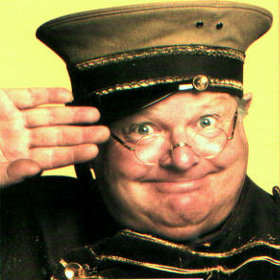
But as Benny’s fame soared internationally — his agent brilliantly marketed select shows for the new syndication markets in the early 1970s — his interest in even his own material waned, and Hill became a parody of himself, relying on bawdier material and deliberately pushing the censors to their limit.

Yet, those who knew Benny by his material would be surprised to learn that, privately, Benny was a very different man. Rather than a leering, dirty old man, he was haunted by fears of unrequited love — and love lost to an unworthy rival — yet once he was in a relationship, his standoffishness and apparent disinterest (which was most likely shyness) kept him from finding true love. And while he would never marry, he carried on extremely close — and secret — friendships with two disabled women for decades.

Even with his enormous fame and fortune, Benny was one of England’s famous tightwads, living happily in his parents’ unheated flat or in his own sparsely furnished apartment, eating great gobs of cheap food, walking everywhere, and generally baffling friends who would find uncashed checks for enormous sums tucked away in the back of a drawer.

Whether you’re a fan of Benny’s or not (and I am), you’ll be genuinely touched and saddened by Benny’s final years, watching his reputation decline at home, his sad rompings with the children and families of women he could have married, and his often fractuous relationship with his family. When Benny died in his flat in Teddington in 1992, his body sat for days, slumped in front of the television, before finally being discovered by police.

All told, a remarkable story, told in a typically wonderful, readable manner by Lewisohn.
Rolling Stone Picks The 500 Greatest Rock Songs

The newly-released issue of Rolling Stone names what its editors believe to be the top 500 rock and roll songs of all time — an ambitious task that’s certain to provoke debate and fistfights.  Lord knows I disagree with their choice for the greatest song ever — “Like a Rolling Stone” by Bob Dylan — but disagreements are part of what makes these kinds of lists so much fun to begin with. (Here’s the top five.)

While I might quibble with their pick for number one, I’m thrilled that the group with the most songs on the list — a total of 23 — is the Beatles.  Their highest-rated song is “Hey Jude” at number eight, with “Yesterday” clocking in at lucky number 13.  In fact, “Yesterday” still holds the record as the most recorded song in pop history.

Let’s take a peek at one of those versions right now, shall we?  Here’s “Yesterday” as it was meant to be done: by the VentriloChoir, a sea of ventriloquists and their dummies:

Have a good weekend!

Decimal Points Matter

Regarding yesterday’s entry: Mark Bartlett, Head Librarian at the New York Society Library, informs me that the replacement cost for the missing Law of Nations was actually $1,200, and not $12,000, as reported in the New York Daily News article that I quoted here yesterday.  He also provided this link to an NBC New York story on the matter, with a short video of the book in question.

Thanks for the clarification, Mark!

No Longer Long Overdue

Yesterday at the New York Society Library, the estate of George Washington’s Mount Vernon presented the library with a copy of one of the two overdue books the first president checked out in the late 1700s. (You can read my original post about this right here.)

In a formal ceremony at the NYSL, James Rees, the executive director of Mount Vernon, presented NYSL chairman Charles Berry with a copy of The Law of Nations, one of the two books that Washington checked out of the library in October 1789.  (You can read the full story of the ceremony here.)

The book isn’t the copy that Washington checked out — staff at Mount Vernon had no luck locating the original, so the estate purchased a similar copy, published the same year, from an online vendor for $12,000.  That raised some eyebrows among Mt. Vernon fans, who would rather have seen that money spent at the Washington home.

For Mr. Rees, though, it was a matter of principle.  By not returning the book on time, Rees explained, George Washington “did not do his public duty.”  I think Washington — who took civic duty seriously — would have approved. Sometimes a symbolic gesture is priceless.

Reflections on the BIO Conference

The first Compleat Biographers Conference — sponsored by the Biographers International Organization (BIO) — was held in Boston this past weekend, and I’d have to call it an enormous, unqualified success.  It was easily the best, most informative conference I’ve ever attended, with plenty of interesting sessions, great speakers, and — perhaps the best part — plenty of opportunities to sit and talk with fellow writers, editors, agents, or book lovers. 

Want a highlight reel?  Here’s a sampling of  just a few of this weekend’s many memorable moments:

  • Starting the weekend by diving into a cab — with the super polite super British super agent Andrew Lownie — and being driven all over south Boston by a driver who clearly had no idea where he was going.  I ended up taking out my phone and paying for a day’s worth of its GPS function so we could get where we needed to go.  And the guy still charged us 15 bucks!  (Best quote of the ride came from Andrew, who shouted, “You’re to go right! No, right! GET IN THE RIGHT LANE!” as our driver cluelessly ignored my phone’s spoken directions. Only the British can get so charmingly annoyed.)
  • By my count, there were at least four Pulitzer Prize winners sitting in the same room at the same time, and — delightfully — there wasn’t a single ego to be found. Debby Applegate — BIO’s interim president and the 2007 prize winner for The Most Famous Man in America: The Biography of Henry Ward Beecher — was genuinely flattered when I approached her with a hardcover copy of her book I had brought with me from DC.  “Thanks for buying the book,” she inscribed on the title page, ” — and in hardback!”
  • On a similar note, Debby’s opening remarks sparked one of the first jaw-dropping moments of the conference, as she told the story of her struggle to find just the right narrative voice and story arc for her Beecher biography, which also just so happened to be her first book. When she brought her concerns to the attention of her editor, the response was “I don’t know what to tell you.”  “Those were the last words we ever spoke,” Debby said to a stunned room. She cancelled her contract, gave back her advance (another gasp-inducing moment) and started over again with a new editor and publisher.  A great story.
  • I had a nice breakfast with fellow WBG member Charles J. Shields (Mockingbird: A Portrait of Harper Lee), to whom I owed huge thanks for some advice he had given me on Project Blue Harvest.  We chatted over fruit and bagels about our projects (he’s in the midst of edits on his Kurt Vonnegut bio) and he didn’t even flinch when I nearly splattered hot coffee into his lap.
  • The keynote speech for the day was delivered by Jean Strouse — the recipient of the first BIO award for Excellence in Biography — whose masterful Morgan: American Financier was the result of more than 15 years of writing and research. Strouse talked about learning finance, choosing a subject, and sticking with a project that nearly engulfed her.
  • Kitty Kelley — who’s in the midst of a massive tour for her equally massive Oprah: A Biography— gave the conference several hours of her time and participated in an incredibly useful session on How To Deal With The Family of your chosen subject.  While three of the panel’s participants gave valuable advice on how to work with family, friends, and heirs, Kelley told one funny story after another about the hows and whys of covering  your ass. (“I ask the hard questions first,” she said, “because I’m always afraid they’re going to throw me out.”)
  • Another writer who interrupted a book tour to participate (and made it with only minutes to spare) was another Pulitzer winner:  T.J. Stiles of The First Tycoon: The Epic Life of Cornelius VanderbiltStiles ran point in a session on self-editing, which evolved into an entertaining discussion on a variety of topics, from narrative arcs to the future of publishing (which included a heartfelt tangent on why self-published books, unfortunately, have a tendency to suck). Stiles also reiterated the point — with a funny story about a long digression on Nigerian steamboats in an early draft of his Vanderbilt biography —  that not all your research drives your narrative, no matter how interesting you think it might be. “It was like someone had dropped another book right into the middle of mine,” Stiles said.  Out it went.
My thanks to Jamie Morris — the soul of the operation — as well as to Ray Shepard of the Boston Site Committee and all those who participated.  It was a memorable weekend — and we’ll see you next year in Washington, DC.

See You In The Funny Papers!

When I was in junior high — heck, even high school, if I’m being honest — I had dreams of being a newspaper cartoonist. Hey, it didn’t seem that unreasonable at the time — I was (and kinda still am) a fairly respectable cartoonist (though my repertoire is admittedly limited) and I read nearly every strip out there, even those I considered snoozers like Mary Worth or Garfield.  Further, I wasn’t naive about it: I knew selling a strip took more than just the ability to write and draw.  I did research into distribution and syndicates, I knew who the editors of the major comic pages were, and I read up on how folks like Charles Schulz, Jim Davis, and Berke Breathed had gotten their starts.  I knew  it was an uphill battle, but I at least had a plan.  Sort of.

Anyway, the real problem I ran into was . . . well, producing a comic strip is really hard.  Not the drawing part of it, necessarily — though working in the confines of panels is a challenge — but it’s tough to stare at those blank squares and come up with a joke or, if you’re really ambitious, establish a compelling storyline. I would draw comic strips I thought were rip-roaringly clever or funny, then proudly show them to my brother or friends, certain they would laugh uproarously at my witty combination of words and pictures. Unfortunately, more often than not the response was: “I don’t get it.”

Lesson learned: any strip you have to constantly explain is not a good one. Suffice it to say, I wasn’t cut out to have my own comic strip. 

But maybe you are.  And this is where it gets interesting.

The Washington Post — yeah, the Washington Post — is looking for America’s Next Great Cartoonist.  If you’ve got a strip you’ve been working on — maybe it’s on a blog, or you produce one for your high school or college newspaper, or maybe it’s just camped somewhere in the back of one of your private notebooks — the Post wants to see it (the only thing they’re not taking is editorial cartoons, sorry).  Your work will be judged by a panel that includes Pearls Before Swine’s Stephen Pastis, Cul de Sac’s Richard Thompson, and Garry Trudeau. And if I really have to tell you who Garry Trudeau is, you have no business entering the contest.  Just sayin’.

The winner gets to have his or her work appear for a month in the Post‘s comic section (that’s the Style section to us locals), get to consult with the judges, and generally get a good push out the door and down the path toward a career as a professional comic strip artist.

The contest is open until 5:00 p.m. on June 4.  What are you waiting for? Go here and get all the information you need.

Hip To Be From ‘Burque

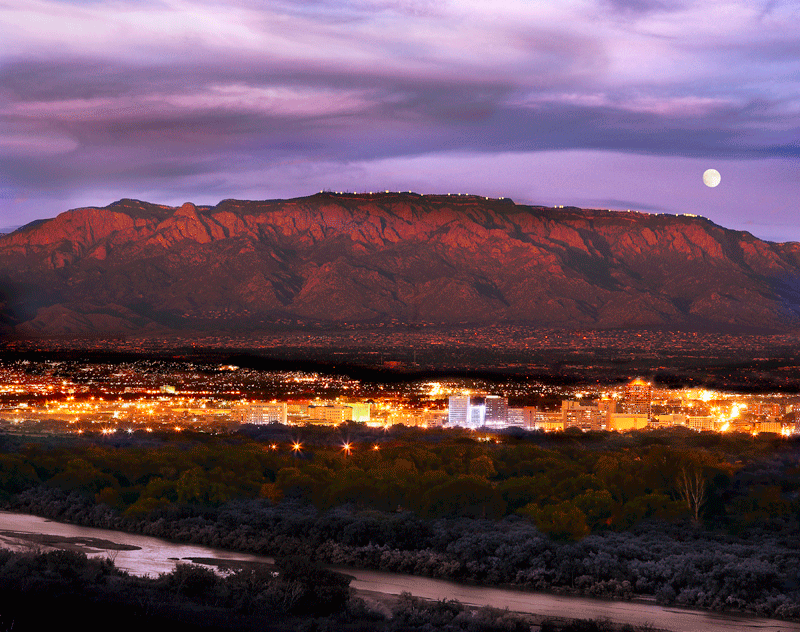
While I was born in Kansas and have lived for most of my adult life on the Atlantic Seaboard, if you ask me where I’m from, I’ll tell you that I’m a New Mexican. More specifically, I’m from Albuquerque.  That’s it in the photo above — you’re looking across the Rio Grande, past the glowing downtown, with the Sandia Mountains squatting on the city’s east side. Pretty nice.

I moved to Albuquerque when I was six years old — and while I briefly attended junior high school in the Midwest, I still did most of my growing up in the Duke City. I played Roadrunner little league baseball on scraggly grass fields hacked from vacant lots we always called “mesas,” even if they technically weren’t.  I considered three inches of snow to be a snow storm.  I drove my first car on old Route 66 in the center of town, and ate carne adovada burritos at The Frontier.  I graduated from Eldorado High School and the University of New Mexico. I oriented myself using the Sandia Mountains. And to this day, I still know how to answer The Single Most Important Question a New Mexican Will Hear: “Red or Green?” (Green, thank you very much — and why would you want it any other way?)

Those of us from New Mexico are used to our state causing confusion.  Certainly, having the word “Mexico” in your address can lead to a bad case of Mistaken Identity with our neighbor to the south. During a brief move to the Midwest, for example, I was asked if we had lived in huts or rode horses to school.  When I moved back to New Mexico in the early 1980s, one of the movers nervously asked if it was okay to drink the water. 

Even in the mid-1990s, New Mexico still wasn’t always feeling the love.  During the 1996 Summer Olympics in Atlanta, a New Mexican called to order tickets for the games — and when he informed the ticket agent where he was calling from, he was told he had to consult either the Mexican or Spanish delegations. 

 “No, no, no — it’s NEW Mexico,” the exasperated Santa Fean told the attendant.

“New Mexico, old Mexico, you still have to go through the Mexican delegation,” he was told.

And Albuquerque?  Forget it.  It was a punchline.  When the seven-year-old daughter of one of my coworkers found out I was from Albuquerque, she burst out laughing.  She had heard Bugs Bunny complain that he “shoulda turned left at Albuquerque,” she said, “but I never knew the place was real!

Now, though, things are changing.  Suddenly, it’s positively hip to be from ‘Burque.  All three installments of High School Musical take place there, for instance, though it doesn’t appear an inch of film was actually shot in town — when you see Troy and Gabriella on the roof of the fictional East High School, the palm trees in the background are a giveaway that you are definitely not in the Duke City.

On television, AMC’s Breaking Bad takes place in Albuquerque — and unlike the High School Musical series, is actually filmed in the city, though it uses some of the less charismatic locations, in keeping with the main character’s drug selling business.  Things look better on USA’s In Plain Sight, which follows a federal marshall housing witnesses in the Witness Protection Program.  Not bad, considering the last major features to take place in Albuquerque (regardless of whether they were filmed there) were the gloriously trashy made-for-TV movie Sparks: The Price of Passion, with Victoria Principal, and the gawdawful serial killer film Suspect Zero.

I’m not sure if it really has become hip to hail from Albuquerque, but that’s all right.  I’m still pretty pleased to call it home.

Still More Credit Where Credit’s Due

Last winter, when I junked my old and slow Dell desktop in favor of a MacBook laptop, I had to switch my home banking program to a new software.  I had been running Microsoft Money for years, and was generally happy with it.  I don’t need anything fancy in the home finances department — I don’t invest in the stock market or track my retirement or anything like that — so my requirements are fairly simple: I  want it to look like a checkbook, and I want to be able to print out reports at the end of the year.  When I changed operating systems, then, I was hoping I could just load Money for Mac, move my data with a zip drive, and just keeping going along like nothing had changed.

There was just one problem:  they don’t make Microsoft Money any more.  So whether I wanted to or not, I had to switch.  Again, I don’t need anything fancy, so I opted to pick up the newest version of Quicken — which I had never used, but which seemed to be a fairly easy and intuitive program to work with.  I went to the Intuit website and advance ordered it — this was last winter, and it wasn’t scheduled to ship until early this Spring — paying about 69 bucks for the newest version.

Long story short, then — so I can get to the point — the program worked great, I’m very happy with it, and consider it a good investment of 69 dollars.  Imagine my surprise, then, when I received an e-mail from Intuit last month that included the following:

Thanks to the direct feedback we have received from customers like you, we are making changes to Quicken Essentials for Mac. Here is what we have planned for the next couple of months:
 
Price reduction and $20 refund—we are dropping the price from $69.99 to $49.99 and you will receive a $20 refund! Your credit card will be credited automatically in 4-6 weeks; you don’t have to do anything. 

Sure enough, last week, my bank account was credited for twenty dollars and some change from Intuit.  Imagine that: a company actually giving customers money back when they lower the price of their product.  That was a classy move on Intuit’s part, and they’ve made me a loyal customer who will recommend their products to others.  And I do.