Monthly Archives: June 2008

Diet Books, Serial Killers, and . . . *gasp!* Mulching?

Jonathan Karp, publisher and editor-in-chief of the Twelve imprint, discusses the impact of “disposable books” in yesterday’s Washington Post. You can read Karp’s piece right here. (Oh, and writers everywhere, prepare to cringe while reading Karp’s opening paragraphs. You’ll never hear the word “mulching” quite the same way again…)

I’m one of those who’s still skeptical of the ability of self-publishing and print-on-demand to really compete — meaning with a truly viable product — in the publishing industry. But I share Karp’s hope that a wider availability of materials will start to sway publishers toward higher-quality books, rather than their perpetual wooing of the latest flame.

An alternate view, courtesy of Bookslut, will run later this week.

First Books: Meet Abraham Lincoln (1965)

From the mailbag, Mark in Chicago writes:

“I’m really enjoying your First Books segment on your blog, and I’m wondering: Since you’re a biographer, what would your ‘first biography’ be?”

Thanks for the question, Mark. When I was in second grade, I was given a collection of hardcover books called “Step-Up Books.” This was a series of about twenty non-fiction books for kids, with titles like Birds Do The Strangest Things (with an owl on the cover, peering at you with an upside-down head) and The Story of Flight, which pretty much sums it up. There were also a number of books about prominent Americans, including John F. Kennedy and Martin Luther King. But the book I liked the most, and still remember best, is Meet Abraham Lincoln.

Author Barbara Cary does a fine job with the subject matter, and hits all the highs of Lincoln’s life in a style aimed squarely at young readers, even addressing the Civil War in easy-as-pie terms. But I was equally as taken with the artwork, by the brilliant Jack Davis, working in his familiar “bigfoot” style that was perfectly suited for the gawky 16th president. Together, the text and art were in perfect syncopation, neither getting in the way of the other, and I read and re-read this book more times than I can remember, filing away the moments Cary had so carefully chosen to bring Lincoln to life, while matching Davis’ thickly-inked and cross-hatched art with its place in the narrative.

I haven’t read the book in decades — and my original copy of it is long gone — but three moments from the book still stay with me. Here’s young Abe trying to comfort his sister, following the death of their mother, with a raccoon that I was dying to pet:


Next is Lincoln with Union General Ulysses S. Grant, whose cigar you can practically smell:


And finally, the picture that’s stayed with me my entire life — President Lincoln at his desk in the White House, trying to hold the Union together during the darkest hours of the Civil War:


Really, it doesn’t get much better than that.

To me, Meet Abraham Lincoln is a biography doing everything a great biography should do: educating while entertaining. For that reason, Meet Abraham Lincoln holds the high honor not only of being my very First Biography, but also the First Book To Show Me That Non-fiction Could Be Dramatic. And indeed it is.

Institutional Memories: St. Pete

I moved to Washington, D.C. to begin working for U.S. Senator Pete V. Domenici in March 1990, when I was 22 years old. At that time, Domenici was just wrapping up his third term in office — meaning he had been serving as a U.S. Senator for 18 of my 22 years on this planet. To us twentysomethings, he was already an institution, a name and face we’d been seeing on television and in the pages of the Albuquerque Journal our entire lives.

While New Mexicans have always called him “Pete,” to those of us working in his office, he was always “Senator.” It wasn’t something he asked us to call him — he would probably have preferred that we call him Pete as well — but it just seemed natural to us; he had earned it. Plus, it instilled in most of us a sense of protocol and respect that we always thought was somewhat lacking in other Congressional offices — and to this day, I still refer to any elected officials by their formal titles. (I once called over to the office of New Mexico Congressman Steve Schiff, and spent several minutes on the phone with a staffer who kept telling me “Steve thinks…” and “Steve wants to…” When I hung up, I sat at my desk for several minutes thinking, “Do I know a Steve over there?” before finally realizing he meant Congressman Schiff.)

Anyway, although we called him “Senator,” and constituents called him “Pete,” to many in New Mexico, he was more deserving of the nickname the media had at first snarkily, then affectionately, given him: St. Pete.

Senator always laughed at this title, and with good reason: he’s a humble guy. It’s always easy to sneer at elected officials — especially powerful, long-serving members of Congress — as out-of-touch, easily influenced, and overly full of themselves. And certainly, there are some like that. But Senator wasn’t — and still isn’t. He’s the son of Albuquerque grocers, both Italian immigrants. His parents didn’t speak English well, and always insisted that their son learn the language immediately, go to school, and take advantage of what their adopted country had to offer.

I’d say he lived up to their dreams for him. After attending the University of New Mexico (go Lobos!), he briefly pitched for New Mexico’s Triple-A baseball team, the Albuquerque Dukes (his real claim to fame as a pitcher, he once told me, was that he had hit Ernie Banks in the back), taught middle school math, served as an attorney and then as Chairman of the Albuquerque City Council, the de facto mayor of the city. After a failed bid for governor in 1970, he successfully ran for U.S. Senator in 1972. He’s been there ever since.

Yet, despite being a New Mexico institution, Senator remains a regular guy, with endearing regular guy habits. He walks to work. He apologizes to his wife for leaving a ring on her coffee table. He’s a terrible driver. When he sits in a chair, he pulls one leg up underneath him, carefully hidden behind his desk. He and his wonderful wife, Nancy, raised eight children. He forgets names. He enjoys his wine. He laughs at dumb jokes. And he treats people with an almost disarming respect that makes every constituent feel like a close personal friend — probably his biggest strength as an elected official. In my time, we were forever answering phone calls and letters from “close friends” who, we discovered, had talked with him only once in a restaurant in Socorro.

He took good care of his constituents, and his state. Any New Mexican who wanted to meet with him was given a moment on his schedule — and let me tell you, he kept quite a schedule. Every day, each staffer was given a copy of his multi-paged schedule — always carefully and deliberately typed, on a manual typewriter, by his long-time assistant, Angela — with his life scheduled in fifteen-minute sized chunks. And always, always, constituents were part of that day. If he was in his office, he would spend 15 minutes with them, discussing concerns and taking pictures. And if he wasn’t in his office, we were always instructed to walk them over to wherever he may have been — whether in committee or on the Senate floor — where Senator always took a moment to step away from business to chat. Out of touch? Hardly.

As a legislator, he’s always fought passionately for the issues he believes in. During my seven years in his office, he was either ranking member or chairman of the Senate Budget Committee, and budget drove almost everything we did. Want to create a new program? Great — just come up with a way of paying for it. He was a stickler for keeping the books in order, and made a name for himself by standing up to even Republican presidents when he thought tax cuts were too irresponsible or new programs too expensive. There were programs he liked that he voted against simply because no one had come up with a way to pay for them. It was a principled stand, though not always a popular one.

Away from the budget, he believes strongly in investing in our energy policies, and continues to be one of the Congress’ most impassioned advocates for those suffering from mental illness.

Last October, citing health reasons, Senator announced he would not seek re-election. His retirement is a genuine loss, not only for New Mexico, but for the U.S. Senate, where very few of the Old Guard remain who still respect the institution, respect their colleagues, respect their constituents, and understand the advantage of being able to disagree without being disagreeable.

For the last six months, New Mexicans have, quite rightly, been honoring his life and achievements with one celebratory dinner or event after another — including one this weekend in Albuquerque. I’ve not been able to attend any of them, and thus I appreciate you staying here with me for just a moment while I’ve said a bit about him.

Senator, I thank you for your service to your country, your state, and your community. More than anything, I thank you for your basic decency. Those of us who worked for you consider ourselves part of one large extended family, and I feel very honored to have played even a small part in your exceptional legacy.

Hey You! Don’t Watch Dat! Watch Dis!

I’m guest blogging over at Historic Hudson Valley’s HVBlog today, celebrating the 189th anniversary of the birth of the American bestseller . . . Washington Irving’s The Sketch Book.

You can read all about it right here. I’ll see you over there.

Coming Attractions

Be sure to tune in this weekend to League of Reluctant Adults, where Agent J (SuperAgent Jonathan Lyons) will be making a guest appearance. Jonathan will answer your questions, dish the dirt, and try really hard not to get annoyed when you ask him how the Spurs managed to choke it so badly in the NBA playoffs this year.

More fun begins on Monday over at Book Roast, where a virtual salmagundi stew of books of varying genres will be discussed, fawned over, and mocked in a sorta kinda MST3K-style. In the non-fiction category, Dennis Cass’ Head Case and Doreen Onion’s fun Queen of the Road are on the spits for the first week. Race ya over there.

Finally, on Monday, I’ll be guest-blogging over at Historic Hudson Valley’s always-interesting HVBlog, where I’m helping celebrate an anniversary, of sorts. See you then.

Have a good weekend. Happy Summer!

Frailing, Frailing

I’m pretty much the world’s most untalented aspiring musician. My problem is I love music, and I can play it juuuuust well enough to think I’m decent at it.

I’m not. But that doesn’t mean I’m not always trying.

In elementary school, we were given recorders — though in my day we called them “song flutes” — and I was good enough at playing it by ear to be selected as one of five kids from my school to appear on a TV show . . . where I learned to my horror that I was going to have to sing. The song we performed? “Up With People.” Good lord.

In third or fourth grade, I took up the clarinet. It was another instrument I played by ear, and it was fingered enough like a recorder that I could do a reasonable job faking my way through songs like “Do-Re-Mi.” But for some reason, I don’t ever recall my elementary school band teacher teaching us to read music. I think it’s because band was more of a voluntary activity, in which those of us with instruments left class for thirty minutes to go to band practice in the cafeteria, and not a part of the formal curriculum.

Consequently, when I moved to a new school in the middle of my fifth grade year and enrolled in band at a school where they took band seriously, I found myself immediately in over my head. I was relegated to third clarinet status, which meant I wasn’t carrying the melody. And when I couldn’t play the melody by ear and actually had to read music, the jig was up. I was finished. Embarrassed, I gave up the clarinet.

In sixth grade, I went into the embarrassing phase that so many boys go through — that phase where you want to be a rock musician more than anything in the world. Oddly, I was attracted to the bass guitar, probably because of Paul McCartney. While Brian Wilson had shown that the bass player could be a front man, McCartney made it cool to be a bass player, paving the way for players like Roger Waters and Geddy Lee.

Well, I never was cool, but for the next three years, I was a decent bass player. I learned to read bass clef, albeit barely, and I got good enough at it that I was recruited to play in the school jazz band — a gig I loved so much that I still annoy my wife talking about it.

Then I moved again. I briefly considered playing bass in the jazz band at my new school, but the thought of being subjected to an audition — in which I might be required to sight read — was too intimidating. I put the bass aside, and got into journalism instead. I didn’t pick up an instrument again for twenty years.

In the late 1990s, with my hands itching for another stringed instrument — one that could carry the melody (the bass, while fun, is usually backbone, not melody) — I turned to the banjo. An odd choice, I know — I mean, why not the acoustic guitar, right? — but there was something about the thing that just seemed to be so much fun. Besides, if it was good enough for Steve Martin and Kermit the Frog, that was enough for me.

A decade later, I’ve learned to play only somewhat decently, but it’s an instrument I love. I can’t play in the Scruggs or fingerpicking styles that sound so cool and take real skill (no “Foggy Mountain Breakdown” or “Dueling Banjos” for me — at least not yet), but I’m a competent frailer — that bum-diddy style so distinct to the banjo.

I play on a beautiful Deering Boston banjo — pictured just above — a banjo that’s far more deserving of a better player than me. It’s sorta like giving a Porsche to someone who hasn’t the slightest idea how to drive. Me, I’m just hoping not to wrap it around a pole.

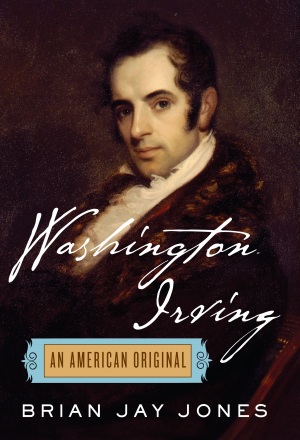
Washington Irving Meets The 217

This week’s installment of The 217 — the magazine from the University of Illinois Urbana-Champaign — does a nice job looking at the two Irving bios that are currently on bookshelves, namely mine and . . . er, another. In the end, reviewer Jeff Nelson gives Washington Irving: An American Original a slight edge.

You can see the review right here.

Thanks for the kind words, Jeff.

Me and WI in the NYT

I’m in the New York Times this weekend . . . kind of.

In this weekend’s installment of his “On Language” column, William Safire discusses the etymology of the term “the almighty dollar,” which Irving coined in his 1836 short story “The Creole Village.” (Yup — apart from giving New Yorker’s the words “Gotham” and “Knicks,” he also gave economists and op-ed writers “the almighty dollar.”)

I point you to this article not only because it’s Irving, but because I was Safire’s source when it came to ensuring he got everything involving Irving correct, pointing him toward the original magazine article in “The Magnolia,” and providing him with a copy of the original story. I’m not mentioned in the article, but that’s still pretty neat, huh?

Anyway, you can read Safire’s column here. But if you’re a fan of writing and language, I’ll bet you’re reading Safire’s column already.

Chapliniana

I absolutely love Charlie Chaplin. I love watching his movies, I love reading anything about him, and I love that I’ve been able to share his films with my daughter Madi, who’s been watching and laughing at his movies with me for six of her twelve years. The other evening, she and I were watching Richard Attenborough’s biopic Chaplin, and when we reached the point in the movie where Chaplin starts grumbling that he can’t figure out how to make a blind girl mistakenly believe the Tramp is a millionaire, Madi brightened and said, “Hey, he’s talking about the scene from City Lights!”

I love that she knows that.

Plenty has been written, and is continuing to be written, about Chaplin’s life and work (in fact, one of my colleagues at Arcade has just written a new one, due in late 2008, which you can see right here). But if you’re interested in getting to know a little more about One of My All-Time Favorites and don’t know quite where to start, I’m here to help.

First up, of course, are Chaplin’s films, many of which were recently released on DVD by Warner Home Video in two gorgeous boxed sets. The prints are beautiful, and each set is loaded with extra goodies and bonus features.

Naturally, I’d advise you to invest in both sets, but if you really have to choose only one, I lean toward set two. Sure, set one offers Modern Times and The Great Dictator, but set two offers what I consider to be Chaplin’s funniest film (The Circus), his best film (City Lights) and his biggest weepy (The Kid). It also offers The Chaplin Revue, a collection of six of his best shorter films, including A Dog’s Life and Shoulder Arms.

Next is David Robinson’s 1985 biography Chaplin: His Life and Art. Written with the cooperation of the Chaplin family, who allowed Robinson access to the family archives in Switzerland, Robinson’s book does a good job discussing Chaplin’s films, and takes a clear-eyed approach to Chaplin’s complicated personal life. It’s still the best biography available — it’s the book the film Chaplin is based on — and Robinson covers a remarkable amount of ground while still keeping the book to a manageable size.

If Robinson’s even-handed treatment of Chaplin’s tumultuous personal life leaves you wanting more dirt, Joyce Milton is more than happy to provide it in her 1998 biography Tramp: The Life of Charlie Chaplin. In the past, I’ve characterized this book as mean spirited — and looking through it again, I still think it takes a bit too much relish in kicking Chaplin when he’s down. But it certainly does a thorough job of digging into Chaplin’s troubles with women and politics — a completely fair and valid focus, especially when Chaplin hands biographers both issues, neatly wrapped, on a platter.

But if you’re looking for Chaplin to dish any of the dirt himself in his My Autobiography, you’re out of luck. Chaplin certainly doesn’t portray himself as a saint — he’s always more than willing to acknowledge his own shortcomings — but he’s generally respectful towards those he lived and worked with. Where My Autobiography shines is in Chaplin’s stories of growing up poor in London, his experiences in the early days of film making, his friendships with Douglas Fairbanks, William Randolph Hearst and H.G. Wells, and his general humility when it comes to his work on humanitarian causes. Plus, it’s always fascinating to see what people think are the most important or interesting parts of their lives — it’s not always the elements that we might choose as fans!

Finally, there’s Kenneth Lynn’s hefty 1997 Charlie Chaplin and His Times, a book reviled by fans but admired by many critics. I’m mixed on it. Lynn definitely takes his task as a deep-driller and debunker seriously, working to paint Chaplin’s childhood as not quite as poverty-stricken as Chaplin has led us to believe, and analzying Chaplin’s relationship with, and embarassment over, his mentally ill mother. It’s fascinating stuff and the amount of detailed research is appreciated, if often head-spinning. Lynn’s most valuable contribution to the Chaplin story, however, is in his discussion of Chaplin’s politics. Was Chaplin a Marxist? Perhaps — but Lynn will help you put it all in context of his times.

Oh, and let me add one more interesting item to this list: Charles Chaplin: Film Music, a collection of music composed by Chaplin for use in his films. Besides acting and directing, Chaplin also wrote terrific music for his movies — his most famous piece is probably the hummable tune “Smile” from Modern Times, which Nat King Cole turned into a standard. More than mere incidental music, Chaplin uses music as mood; I defy you to listen to “Kidnap” from The Kid without choking up a bit. The music of Modern Times brings the album to an appropriate close, with the refrain from “Smile” fading out as the final fanfare swells — fittingly enough, it was this music that played as The Tramp (with the girl finally on his arm) walked off into the sunset (or sunrise, in this case) in the final scene of what would be his last truly “silent” film.

There. I hope that helps. And for any Chaplin fans out there, what do you think? What books do you recommend?
First Books: Peanuts Treasury (1968)

The 1968 Peanuts Treasury — a collection of late 1950s to mid-1960s Peanuts strips — is, perhaps, one of the most influential books of my life.

It was given to me for my fifth birthday, and I remember laying on my stomach in an armchair in the den, my head hanging down over the front of the seat, looking down at the book on the floor. Right away I was fascinated by the panel on the front cover that showed Charlie Brown standing on the pitcher’s mound with his head simultaneously facing two directions at once as he watched the conversations taking place around him. Why does he have two faces? I wondered — and then suddenly, in one of those Eureka! moments I’ll never forget, I understood what it was that Schulz was doing.

It was my First Contact With The Genius of Charles Schulz, certainly, but it was so much more.

The Peanuts Treasury was the place where I learned you could tell a story with words and pictures, though in a way that was different from the Little Golden Books. Each page was filled with four-paneled cartoons — reprinted in glorious black and white — each of which had its own little drama and a punchline. Each was wonderful on its own, but when taken as a whole, they created something remarkable — a complete universe with its own continuity and characters.

To my five-year-old mind, Schulz was writing these just for me. Characters yelled at each other, threatened to slug each other (or, my favorite, knock your block off!), watched television, played baseball, and read comic books. It was like a soap opera starring kids, for kids — except, of course, that Schulz wasn’t just writing for kids, but for everyone. The fact that he could make you think you were his target audience is part of what made him so terrific at what he did.

But there was more. The Peanuts Treasury was where I first puzzled my way through words and concepts like “grief,” “psychiatrist,” “Beethoven” (which I pronounced “BEE-thuvven”) and “humanity.” There were references to people I’d never heard of, like Sam Snead, Dr. Spock and Gordie Howe, and to odd concepts like “new math.” I learned friends could be fickle — playing with you one day, laughing at you the next — and that basic human decency, like Charlie Brown’s, almost always prevailed.

I was particularly fascinated by Snoopy and the range of characters he played: a sinister vulture, a mountain lion, and my favorite, the helmeted World War I Flying Ace (which I always pronounced in my head as “World War Eye Flying Ace”). I was proud that I knew the name of his doghouse plane (the Sopwith Camel!) and I had my mom sing the song “It’s a Long Way to Tipperary” slowly and deliberately for me so I could remember it, since Snoopy’s Flying Ace seemed always to be singing it in some lonely European pub that existed, I knew, only in his imagination.

Snoopy, in fact, was my hero for years. I learned to draw by drawing Snoopy, with that big looping head, the floppy ears, the button nose, and the slashed dots for eyes that had to be placed juuuust right. I drew my own comic books in which Snoopy — dressed in a Batman costume, of course — fought crime and drove the Batsnoopymobile. Snoopys of every size covered my notebooks at school and every classmate asked me if I wanted to draw Snoopy when I grew up. I would smile and nod enthusiastically and say that I did.

Alas, I never did get to take over the Peanuts comic strip. But I’m pleased to say today that I can still draw a pretty mean Snoopy.