
Stranded on Saturn: An Open Letter to GM

SATURN_logoDear GM:

I don’t understand a thing about bankruptcy, or what it means to file for Chapter 11 versus Chapter 7, so I can’t comment on your actual financial status.  Nor would I presume to tell you about business practices or pretend to understand whether you are truly worth the huge amount of tax dollars that we — make that I — am investing in you.

But hear me out here for a moment.  I’ve bought American cars my entire life, starting with a 1978 white Trans Am with a gas guzzling 434 horses under its hood — which I totaled (not my fault!) and then promptly bought a 1979 blue Trans Am, with a, uh, much more efficient 403 at its front end.  After spending more than a decade carless, I bought a Jeep Wrangler, and a Ford Explorer which I later traded for a Saturn sedan, in an effort to ratchet up my fuel efficiency.  So, you can’t say I haven’t played ball.  You can’t say I haven’t been supportive.  I’ve bought American, even when others were pointing and laughing.

But now, in the midst of all this mess, I see you’re phasing out the Saturn.  You’ve officially lost me. 

Say what you will about the Saturn — that it’s stodgy, non-sexy, non-soccer or non-hackey Mommish — it’s still one of the best cars I’ve ever owned.  At seven years old, it’s got nearly 130,000 miles on it, it’s on its original transmission, it’s only grudgingly needed new brake shoes and new tires, and has never been in the shop for any major work.  It has, without a doubt, earned the nickname we’ve given it: the Man of Steel.

Further, my local Saturn dealer in Frederick, Maryland is perhaps the most honest dealership I’ve ever seen.  Every time I bring my car in, convinced some odd noise or herky jerk behavior means a major, expensive repair, they inform me it’s a minor problem that can be fixed easily and inexpensively.  When a tail light went out, they charged me six dollars for the light itself, and nothing for the effort of installing it.

Further, they’ve picked up my business for maintenance on our Jeep Wrangler.  When our local Jeep dealer, which shall remain nameless (*cough*Fitzgerald*cough!*), kept finding one absolutely critical problem after another — each of which, I was told, had to be repaired right then and there or the Jeep would implode on the spot like the Bluesmobile — I finally decided I had had enough.  I took it to our Saturn dealer, told them we had been informed the Jeep was teetering on the edge of disaster and gave the mechanics carte blanche to find the problem.  After an hour, they came back to me with puzzled faces, saying it needed new spark plugs, and there was a minor repair that needed to be made in the passenger-side wheel well, but that was about it. For someone who can’t diagnose a car problem, much less fix one, that’s the kind of service I need. 

Look, I get it.  You need to downsize and become more efficient.  But really, you’re demolishing the one room of the house that seems to be structurally sound while trying to salvage the other rooms that might be prettier, but have already been corroded by termites.

The management at my Saturn dealer informed me that they’re hoping the Saturn brand can survive independent of GM.  I hope so.  As one of your millions of newly-seated stockholders, I’ll be watching  carefully — but so far, you’ve not done much to persuade me to stick around.  You’ve kept your showhorses while letting your workhorse go.  Not a promising start, in my book.

As I said above, I’ve been in your corner all along.  Convince me to stay there.

Your pal,

Brian

“My Beloved Island of Manna-hata!”

The Wildlife Conservation Society has created a neat project on a topic near and dear to Washington Irving’s heart, and to mine.  It’s a history of New York, but with a twist — unlike Irving’s History of New York, which traced the rise and fall of the Dutch settlers, this one traces Manhattan’s ecological history.

The Wildlife Conservation Society’s Mannahatta Project imagines what Manhattan Island was like only hours before Henry Hudson and his men set foot on the island 400 years ago, in 1609.  As the WCS puts it:

[T]he center of one of the world’s largest and most built-up cities was once a natural landscape of hills, valleys, forests, fields, freshwater wetlands, salt marshes, beaches, springs, ponds and streams, supporting a rich and abundant community of wildlife and sustaining people for perhaps 5000 years before Europeans arrived on the scene in 1609.  It turns out that the concrete jungle of New York City was once a vast deciduous forest, home to bears, wolves, songbirds, and salamanders, with clear, clean waters jumping with fish.  In fact, with over 55 different ecological communities, Mannahatta’s biodiversity per acre rivaled that of national parks like Yellowstone, Yosemite and the Great Smoky Mountains!

The website for the project is a lot of fun, allowing you to see what New York neighborhoods looked like four centuries ago.  Most familiar sites sit in what was then dense forest, while other familiar locations — like Ground Zero — would be smack in the middle of the Hudson River, centuries before groundfill molded the island to its current shape.

Go poke around on the website, and visit your favorite New York spot or neighborhood as it might have looked in 1609.  And be sure to check out the real work behind the project, Eric W. Sanderson and Markley Boyer’s Mannahatta: A Natural History of New York City.

Memorial Day Weekend

Memorial Day weekend starts early in the Jones house, as we head north this afternoon for our now-annual three-day volleyball tournament at Penn State.  It’s a great experience for all the girls — over 700 teams, I think, from all over the East Coast — as they get to stay in the dorms and live like college students for three days.  God help them.

Enjoy your weekend — but while you’ve got the grill fired up, take a moment to remember what this holiday is all about.  A bit of context, you ask?  You got it.

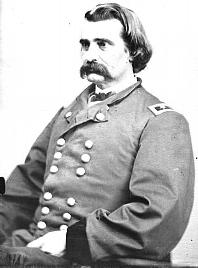
General John Logan

General John Logan

On May 5, 1868, General John Logan, a decorated veteran of the Civil War, issued General Order Number 11, declaring May 30, 1868 as “Decoration Day.”  On that date, the graves of Civil War soldiers in Arlington National Cemetery — regardless of whether those soldiers served in the Union or Confederacy — would be decorated with flowers.

Logan’s order was not without precedent.  On May 5, 1866, at the prompting of local druggist named Henry C. Wells, the town of Waterloo, New York became the first community to declare a formal Memorial Day to remember its Civil War dead.  In the 1960s, the Congress and President Lyndon Johnson made Waterloo’s claim as the birthplace of Memorial Day official, by designating Waterloo, NY, as the hometown of Memorial Day.  There’s even a Memorial Day museum there you can visit.  Pretty neat.

Anyway, getting back to Logan and Decoration Day: in 1873, the State of New York — perhaps inspired by the example at Waterloo –was the first to recognize Memorial Day as an official holiday; by 1890, all northern states had also fallen in line.  It would take longer, and another war, for the Southern states — which viewed the celebration as a bit of a nose-rubbing — to come around.  After World War I, the South recognized it as a day to commemorate soliders who had fallen in any war (some states, however, still declare separate holidays to honor Confederate dead).

In 2000, President Clinton issued a Presidential Proclamation asking Americans to reaffirm the true meaning of Memorial Day by observing a “National Moment of Remembrance” at 3:00 p.m. on Memorial Day. Not a bad idea — but those who we’re remembering also gave you the right to celebrate the day as you like.  Remember them in your own way — but please remember them.

Dear Abbey

abbeyAbbey came to us as a stray puppy back in March of 2001. From what we could tell, she had been running with a pack of stray dogs — which probably included her mother — and after one of those famously impressive Phoenix monsoons that come rolling in on Spring evenings, she had somehow gotten separated from her pack.  A group of neighborhood kids found her and brought her to us, having heard that Barb’s Golden Retriever had died several months before.  At 30 pounds, the dog looked like a puffy German Shepherd, and a neighbor told us he guessed she was about 6 or 7 months old.

Wrong.  We took her to the vet who took one look in her mouth, saw all baby teeth and pronounced her only a little more than three months old.  She was going to be a big dog.  To this day, I tell people that had you asked me if I wanted a dog that was a cross between a Doberman Pincher and German Shepherd and that was going to weigh more than a hundred pounds, I’d have thrown you off the porch.

Yet, she’s turned out the be the best dog I’ve ever had.  You can tell me you’ve got the smartest dog there is, and I’d smile and nod, but you’d be wrong — because I’ve never seen a dog as sharp as Abbey (we named her Abbey not only as a nod to Abigail Adams, but also to the Beatles album Abbey Road).  It’s more than just, “Go get your dolly!” or “Find the leash!”  She really does understand complex sentences.  If you tell her, “Go downstairs and eat your breakfast, then wait in the front parlor for me to come down,” she’ll do exactly that.  I’ve never seen anything like it.

Even though we live along a state highway, Abbey knows enough to stay away from the road.  When I go out to get the newspaper with her, she’ll walk only two-thirds of the way down the driveway and will wait for me to come back from the street with the rolled up paper — at which point I hand it to her so she can sprint back into the house with it.

And she owns the neighborhood.  The four houses in our immediate vicinity are all accustomed to regular visits from her, and most keep dog treats to feed her, even though none of them have dogs of their own. Some mornings I’ll go looking for her, only to find her laying on our next door neighbors’ kitchen floor, swishing her tail happily while they read the paper over coffee.

When I’m writing, she’ll come quietly in and lay down on the rug I keep on the floor of my office (that’s her laying in her spot in the pic above), thunking her tail when I look up at her. Every once in a while she’ll beg for one of the Milk Bones I keep in a ceramic jar on my bookshelf, giving her head one of those irresistible doggy tilts.

Quite simply, she’s the best canine family member, friend, and companion any of us have ever had.  That makes it all the more heartbreaking for us to struggle with the reality that, at eight years old, she’s starting to get old. Like many big dogs, Abbey’s starting to develop problems with her hips, her legs sliding awkwardly out from under her as she tries to climb stairs or climb out of her bed.  The other morning, she took a tumble down the stairs; this morning, we helped her down, then — to her great disappointment — blocked her from coming back up.  As I finished dressing this morning, she laid at the foot of the steps, looking up wistfully, and once or twice giving a low boof! to hurry me up.

It’s not the end of the world, of course — Abbey likely has a number of years left in her — but we’re going to have to change some of the habits we’ve all long grown used to.  It’s also a reminder to continue to enjoy and treasure every moment we’ve been allowed the pleasure of having with this incredibly loving and special dog, who somehow found us all those years ago.

Here’s to you, dear Abbey — every moment we have you in our lives is a special one.

Impeached!

It’s not quite Happy Launch Day — the book’s been Officially Out for a week now — but I attended the Launch Party last night in Georgetown, so I’ll say it anyway:  Happy Launch Day to David O. Stewart, whose Impeached: The Trial of President Andrew Johnson and the Fight for Lincoln’s Legacy is already burning up the shelves and earning great reviews.  Here’s the feared Kirkus, for instance, which gave David one of those highly-coveted starred reviews:

“A riveting look at one of American history’s most dismal episodes. The [Johnson] impeachment spectacle qualifies as the last battle of the Civil War and the first act of the tawdry Gilded Age . . . Stewart demonstrates his legal acumen, explaining the constitutional bases for impeachment and teasing out “the tenacious opacity of the phrase ‘high crimes and misdemeanors’ . . . Also an adept historian, Stewart stresses the political nature of impeachment, where developments and outcome depend as much on events and the character and convictions of the protagonists. The author also profiles Benjamin Butler, the prosecution’s headstrong manager, the surprisingly slippery president-in-waiting, Ulysses S. Grant, and Edmund G. Ross, whose deciding vote against impeachment was likely purchased . . . Stewart vibrantly renders these atmospherics, the poisonous politics, the personal animosities and the unbridled corruption that will leave readers rooting for both sides to lose.  Likely to become the standard version of this historic clash between a president and Congress.”

Pretty nice, eh?  But really, I expected no less from Mr. Stewart,who’s not only a smart guy and a great writer, but a true gent.  Go get it.

Institutional Memories: Gentleman Jim

Jim_JeffordsIt’s a bit old news now, but the party shift of Senator Arlen Specter last month got me thinking about the last U.S. Senator to change parties – an old boss of mine, Senator Jim Jeffords of Vermont.

In late 1997, I left the office of my home state’s U.S. Senator, Pete V. Domenici, to take a position with the Senate Committee on Labor and Human Resources (now the HELP Committee), which Jeffords had just started chairing.  I knew the Jeffords staff fairly well—I had worked closely with several of them on welfare reform legislation—but didn’t know much about the Senator himself.  All I knew is that he was a moderate Republican, with views on social issues closely aligned with my own on things like abortion, funding for the arts, welfare reform, and Head Start.  I was a good fit on his committee staff.

While I would technically be working for the Subcommittee on Children and Families, under Senator Judd Gregg of New Hampshire, Jeffords was our chairman, our go-to guy, our chief. We worked closely with him and with his personal staff as we negotiated and steered legislation through the committee. During the two years I served under Jeffords, I got to know him a bit—and the more I got to know him, the more I liked him.

Jim (I always called him “Mr. Chairman” and never “Jim” during my time on the committee, but ten years later, it just seems natural) is an incredibly nice guy and a true gentleman. While his quiet demeanor in meetings sometimes made it seem like he might not be paying attention, once he had you out in the hallway, it was clear he’d heard, and analyzed, every word. He’d pepper you with questions and ask you to go back and make changes in wording or call another member’s office to negotiate.  He was always impressive.

And still, he couldn’t quite overcome a slight shyness.  One of the first events I ever attended with him was a visit to a Head Start provider.  Jim sat at kid-sized tables talking quietly with the students, but then would stand awkwardly off to one side, quietly munching from a veggie tray, and clapping softly when someone began pounding enthusiastically on a piano.  I later spoke with a longtime Jeffords staffer, nervously asking if I had staffed him poorly.  “He looked like a lost little kid,” I said.  “He always looks that way,” she told me with a laugh.

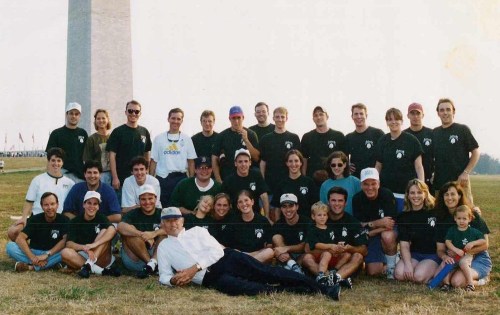
He was also genuinely interested in his staff.  Every year, he could be counted on to take part in the annual softball game between his office and the office of the other Vermont Senator (which was, and still is, Senator Patrick Leahy), taking his turn at bat and playing an inning or two in the field.  He would leave early to go hold a table for the entire team at one of the nearby bars on the Hill, making sure appetizers (and pitchers of beer) were waiting when his victorious staff (as we always were) arrived.  I still have a photo of the Jeffords softball team, taken on the evening of one of the delegation games.  We’re all decked out in our Vermont green uniforms (we were called the Jeffords Vermont Saps), with the Senator proudly propped up on one elbow in the grass in front of us.  His delight is clear, and genuine.

Your 1998 Team jeffords: Vermont Saps.  That's me sitting on the ground behind the Senator, just to the left.

Your 1998 Team Jeffords Vermont Saps, with the Washington Monument in the background. That’s me sitting in the front row behind the Senator, third from the left.

From a speechwriter’s perspective, Jim was an absolute dream. “I am not God’s gift to oratory,” he once joked—but boy, could he make the written word come alive.  He would read verbatim what you had written, but he could make it sound like he was speaking extemporaneously.  The only giveaway was a series of hand gestures I took to calling the Jeffords Gyrations—he would mechanically knife the air with both hands in front of him, then open his arms up at shoulder length to accent a point, make a quick curving U back toward center, and start again.  It was elegant, and he could use it to give all the high points of a speech the proper beats they needed—a tricky skill he’d likely learned as Vermont’s Attorney General in the late 1960s.

For years, Jim was the tenor member of a barbershop quartet called “The Singing Senators” that he’d formed with fellow Republican Senators Trent Lott, Larry Craig and John Ashcroft.  At least one morning each week, we knew we’d find him ducking into Lott’s hideaway in the U.S. Capitol so the four of them could practice—and in 1998, they even released a ten-song CD you can probably find on ebay.  Jeffords loved it—there was a part of him, I think, that always saw himself strumming a guitar at folk venues around the country, harmonizing with anyone who wanted to pull up a stool.

The Singing Senators ended on May 24, 2001, when Jim announced he was leaving the Republican party to become an Independent who would caucus with the Democrats.  Because the makeup of the U.S. Senate at the time was split 50-50 between Republicans and Democrats, Jim’s switch tilted control of the Senate over to the Democrats.  At the time of his switch, I had been working in Arizona for nearly two years, but the phone in my office in Phoenix rang off the hook all morning.  “Your boss!” people shouted.  “What’s he doing?”

Well, he wasn’t my boss at that point, but I knew exactly what he was doing.  It was what he had done all along: quietly standing up for his principles, and fighting for those he thought couldn’t fight for themselves. Jim’s decision annoyed the Republican leadership and cost him friendships, but citing a basic philosophical disagreement over spending priorities, Jim knew it was a decision he could live with. “Just as my colleagues couldn’t understand how I could go ahead and switch,” Jim later wrote, “I couldn’t understand how I could stay a Republican.”

For health reasons, Jim retired from the U.S. Senate in 2006 after 32 years of public service, and returned to his farm in Vermont.  He’s still back in DC from time to time, and from what I hear, his health is better and he’s getting by.  I hope so.  Jim was one of the last of a dying breed of pragmatic politicians.  He was passionate, and smart, and more than anything, he was always a gentleman.  I loved working for him, and I wish him the best.

Just for fun, here’s The Daily Show’s Jon Stewart and Stephen Colbert lamenting the demise of The Singing Senators, from May 31, 2001. When you see the clips of the quartet singing, that’s Jeffords standing at far right, belting his heart out to “Elvira.”  Enjoy.

Reviews in Brief: Columbine (Dave Cullen)

columbine-coverOn April 20, 1999—the day all hell broke loose at Columbine High School near Littleton, Colorado—I was working as an assistant state education chief in Arizona. We had a close relationship with our counterparts in Colorado, and as the Columbine story was breaking on national television, we were on the phone with officials in Denver, asking what they knew. Their answer was always the same. “Not much,” they kept telling us. 

Not much.  That would remain the case most of the days and weeks to come. No one really knew much of anything—and the more information that came out, the more conflicting and unclear everything became.  Eventually, we all came to understand Columbine through snippets reported in the media—and by putting together all the little stories, we came up with one terrible story of epic proportions:  Take two picked-on loner/losers—members of a “Trench Coat Mafia”—and agitate them with Goth culture, German speed metal, violent video games, and a fascination with Hitler.  Throw in bad parenting and bullying and easy access to guns, and you’ve got the Molatov cocktail that eventually exploded in a high school shooting that left 12 students—including one brave girl who declared her faith in the Lord and died at point-blank range—and one teacher dead. 

It all makes for a fascinating, tragic, terrifying, and sometimes uplifting story.  The only problem is that not much of it is true.  And that’s what makes Dave Cullen’s book Columbine so important. 

Sorting through a decade of interviews, police reports, recorded 911 calls, psychiatric analyses, and tens of thousands of pages of assorted documents—many of which were intentionally buried by local authorities—Cullen puts together the definitive story of the what really happened at Columbine and, perhaps even more daring, tries to explain why it happened. 

Prior assumptions are dashed almost immediately as we learn that killers Eric Harris and Dylan Kleibold were neither loners nor geeks nor members of the Trench Coat Mafia.  They dated, had jobs, participated in student theater, went to football games, and got good grades.  As far as Cullen can tell from the data and careful discussion with an incredibly competent FBI psychiatrist, Eric Harris, the mastermind behind the spree, was simply a psychopath with a superiority complex, incapable of true emotion but a master of mimicry, becoming whatever it was parents, police, teachers, or friends needed him to be—all while secretly declaring his hatred for the world and plotting for years his own version of Judgment Day.  Dylan Klebold, meanwhile, was more introspective and empathetic (his journals contain more of the word love than hate), but silently spiraled into petty theft, poor grades, and depression, no longer caring whether he lived or died.  Together, they made for a volatile combination. 

That’s not to say the signs weren’t there—and what Cullen uncovers is both frightening and appalling. Parents had complained for years about Harris’s bullying and threats.  Harris kept a very visible website on which he detailed his progress with bombmaking and ranting about murder.  One police officer, in fact, had written a meticulously detailed request for a search warrant of Harris’s house more than a year before the shooting, but the paperwork was either bungled or ignored and never went before a judge.  After the shooting, local officials huddled together and squashed the report and hid away police records.  Most wouldn’t see light of day until 2005.  Others were shredded or remain hidden. 

There’s been some grumbling that Cullen doesn’t give every victim the same amount of page space, and that’s true—Cullen doesn’t give some any space at all.  But I think Cullen makes the most of the stories he does focus on, giving stories of wasted potential, bravery under fire, teachers and administrators who put their students first, and anguished parents who sometimes can’t cope, whether they lost a child or not. Cullen chooses stories that are illustrative and compelling, and I don’t think the absence of anyone’s particular story made the tale any less tragic or forceful. 

Cullen begins his book with a literal bang, starting with the shooting (and botched bombing) at the high school, then works backwards, alternating Eric and Dylan’s story with chapters on the some (though not all) of the victims, and the investigation.  It might sound like a disjointed approach, but it works.  Further, Cullen writes in a compelling manner—I’ve seen some reviews call his style novelistic, but it’s more magaziney, in the best sense of the word: easy to start, broken into easily managed installments, and always tough to put down.  Cullen’s description of the shootings is as cold and impartial as it deserves to be—very little drama, reporting the events in a matter-of-fact manner, almost as if they were all caught on the unflinching tape of a security camera (as some of it was)—while his discussions of psychopathy and depression never get bogged down in terminology. 

Perhaps his most unpopular job is debunking the Cassie Bernall story, in which Bernall was allegedly asked by one of the shooters “Do you believe in God?” and shot in the head when she answered in the affirmative.  The conversation did occur, but it happened with Val Schnurr—who lived to tell the tale—and was attributed incorrectly to Cassie by an eyewitness.  The story was debunked early, but Cassie Bernall was nevertheless embraced, martyred, and exploited by the religious community. It would be easy to either make fools of the religious community and their stubborn refusal to let go of the story (wouldn’t it have been just as powerful, Cullen rightly asks, to have an example of someone who had proclaimed their faith in the face of certain death and through God’s grace lived to deliver the message?) or to deferentially caveat the story, taking neither side.  Cullen doesn’t do that.  Instead, he relates the tale and the controversy respectfully but firmly, making clear what really happened, but respectfully refusing to condescend. 

Cullen’s narrative is full of plenty of bad guys—including some in unexpected places—and plenty of good guys, but it’s at its best when telling the stories of regular people trying to make sense of the horrifying.  They’re all stories that deserve to be told, and Cullen tells them well without ever stooping to sensationalism.

Ultimately, Columbine will challenge you to re-examine almost everything you know—or think you know—about that horrific April afternoon. Check it out.

I Love This Place

We live in a small town about 45 miles northwest of Washington, DC. We’re still considered part of what they call the Greater Washington DC Metro Area, but we’re far enough removed from a lot of the hustle and bustle that goes with living in the city or the typical suburbs.

Our town straddles the intersection of three state highways — all three of which are really just two-lane country roads maintained by the State of Maryland — and horse farms and orchards line the roads approaching town. We have an honest-to-goodness small-town locally-owned diner, one high school, and more churches per capita than any other community in the state. We’re also the only dry community in the county–alcohol sales have been prohibited since the late 1800s.

That’s not to say it’s perfect.  Apart from the prohibition on alcohol–which intimidates most potential restauranteurs–there’s no book store, no movie theater, and no real walkable, shop-lined main street.  But the good far outweighs the bad–and almost every day, there are little moments that make me shake my head with a smile and say, “I love this place.”

One night last week as I was preparing dinner, I kept hearing our dog Abbey barking out on the back patio.  Given that Abbey isn’t much of a barker–she’s one of those rare dogs who really only barks when she’s got something serious to bark at–I leaned over the sink to look out the window so I could see what had caught her attention. 

Three horses and a pony were grazing in the corner of our back yard.

There’s a horse farm that backs catty corner onto the property next door to us, with a corral lined by a split-rail wooden fence.  Somehow, one of the rails had come loose, leaving a V-shaped opening at one of the corners–and four horses had made the most of it, heading for the greener pasture–our yard–on the other side.

I went outside and walked slowly down to the corner to see if perhaps I could use my latent horse whispering powers to somehow convince them to wander back through the break in the fence, back into their corral.  As I approached, the largest horse — a beautiful chestnut-colored fellow with a white star in the middle of his head — looked up at me and snorted.

I backed away slowly, palms up, the way I might back away from someone who had just waved the business end of a broken bottle at me, and then stood about ten feet away, apologizing to the horse in that high-pitched baby-talk voice you use when you talk with an animal.  The horse nickered slightly, then suddenly sprinted up the side yard, between our house and the house next door.  The other horses followed, thundering up behind — a beautifully impressive sight — leaving deep U-shaped depressions in the rain-soaked yard. 

I ran up the hill into the front yard, whistling loudly — it was still rush hour, and I was worried the horses might try to cross the two-lane highway in front of our house — only to find the herd grazing happily on the unmown grass.  “Just stay out of the flowerbeds!” I yelled, shaking my fist like Mr. Magoo.  As it turns out, I needn’t have worried about traffic — the sight of horses running wild had all but stopped traffic in both directions.

The horses bolted back down the side yard again, before finally settling down to graze on a long strip of grass next to our neighbor’s driveway.  By then, their owner had realized what had happened and came sprinting up the hill with a bridle.  He slipped it over the head of  my chestnut-colored friend — clearly the ringleader of the group — and led him back through the break in the fence with the other three following.

A week later, I still have deep-rutted hoof prints in my front yard.  But I’m not complaining at all.  How often does one look out the window to find horses casually grazing in their back yard?  I love this place.

Within A Budding Grove

Once again, my apologies for the lack of posts here lately, but things have been rather hectic.  Apart from sheer scheduling issues, Spring weather — even when it rains — is never terribly conducive to my pen.  There’s too much to look at, too many pots to fill, too many holes to dig.

But there is some progress being made; in fact,  I just shipped something off to Agent J for comments and further discussion.

In the meantime, for your literary enjoyment, let’s take a peek in on the “Summarize Proust” competition:

Hollywood Shuffle

My pal Scott Phillips wrote a great piece in his “Hollywood and Whine” column for the Eye Crave Network  about life in Hollywood as a spec screenplay writer, script polisher, and project pitcher.  As Scott puts it:

There’s no doubt about it — it’s exciting as hell: you, the struggling screenwriter, finally get lucky enough to have somehow stumbled onto the right combination of spec screenplay and hard-working manager or agent, and you find yourself “taking meetings” all over Tinsel Town. That’s when the Hollywood Hand-Off begins.

Go read it — and be sure to check out the pic of Scott with Gunnar “Leatherface” Hansen.  And some day soon, I’m hoping Scott’ll tell the story about a pitch meeting with Steven Seagal, even though you really need to hear Scott doing his Seagal impression to fully appreciate it.

Oh, and you are watching Scott’s TV show Kamen Rider Dragon Knight weekly on the CW aren’t you?