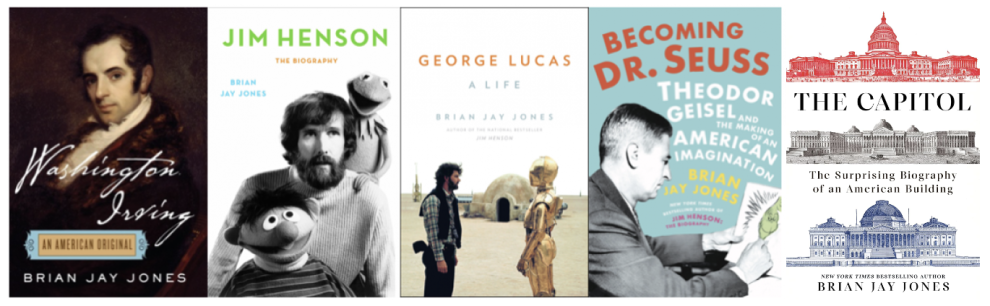
Washington Irving, Cultural Continuity, and Iconoclasm

First Things magazine — a magazine and blogging site which calls itself the “Journal of Religion, Culture, and Public Life” — has a really thoughtful piece on Washington Irving, and how Americans would do well not only to re-embrace the man, but to learn from the lessons he taught us:

Washington Irving is of particular importance, especially now that so many of those who howled at the specter of a systemically evil nation are silent at the election of Barack Obama. What will many faculties do, now that their view has been thus radically altered or at least thrown into question? The culture of iconoclasm can only endure so long as one wants to smash an icon. Once one reveres the icon, an inevitable conservatism sets in—there is a natural desire to preserve memories and eventually even the traditions and institutions recognized as having been virtuous.

Intrigued?  You should be.  You can get the rest of it right here.  And my thanks to Eric Seddon at First Things for his column — and for the very kind tip of the hat in the first paragraph.  I’m delighted to be considered one of the “saner minds.”

Cold Hands, Good Company

It’s been a cold and windy week here in Maryland — made even colder by the little tease of Spring weather we’ve had over the past few weeks, where you can walk the dog, run to the store, or get the mail without needing your coat.  This week, though, just running from the house to the car makes your cheeks sting and your fingertips burn.  Each evening I build a fire in the living room fireplace and press my nose against the front window, staring at the dead flowerbeds and counting the weeks until I can go out and start playing in the mud again.

The crafty Aaron Burr.

The crafty Aaron Burr.

Meanwhile, I’m having lunch today with David O. Stewart, whose book The Summer of 1787 made the proceedings of the Constitutional Convention read like a great suspense novel.  David’s presently hard at work on a book about Aaron Burr and the comedy of errors that was the Burr Conspiracy, and he’s being either kind enough or crazy enough to ask me to blather on at length about Washington Irving and his relationship with Burr, and Irving’s observations as a semi-official correspondent at Burr’s trial in 1807.  Plus, David’s just plain good company, so it’s pretty much a double bonus for me.

Oh, and I’d be remiss if I didn’t mention that David’s latest book, Impeached: The Trial of President Andrew Johnson and the Fight for Lincoln’s Legacy hits bookstores on May 12.  You can advance order a copy here.

California Dreamin’

It’s confirmed:  Agent J and I are flying out to L.A. in early March for a meeting we’ve been working to schedule for some time.  No, we’re not discussing movie options for Washington Irving (though I still argue it would make a great HBO movie); rather, we’ll be discussing a potential new project.

I can’t say too much about it yet, but if we can make everything come together, it’ll be very cool indeed.

Stay tuned.

Why My Wife Rocks

Sure, we guys like to complain about Valentine’s Day being a fake holiday — a day when we knock ourselves out with flowers, cards, candy, jewelry, or whatever, and we don’t necessarily expect gifts in return.  It is, in our minds, a Holiday For The Ladies.  And we’re generally okay with that.  Despite the pressure, it lets us show off a little bit and prove that we really do have a sentimental or romantic side.

That said, here’s why my wife is the Best. Wife. Ever.

For Valentine’s Day, I gave her jewelry.

She gave me Absolute Watchmen.

My wife rocks. 

And how was your Valentine’s Day, hmm?

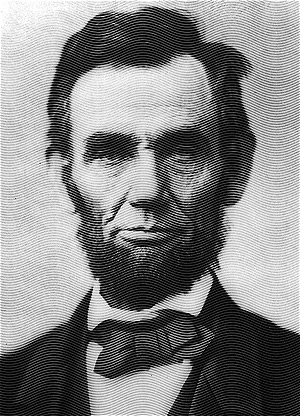
Happy 200th, Abraham Lincoln

abraham_lincoln“With malice toward none, with charity for all, with firmness in the right as God gives us to see the right, let us strive on to finish the work we are in, to bind up the nation’s wounds, to care for him who shall have borne the battle and for his widow and his orphan, to do all which may achieve and cherish a just and lasting peace among ourselves and with all nations.”

— Abraham Lincoln
Second Inaugural Address,
March 4, 1865

Abraham Lincoln was born 200 years ago today, on February 12, 1809.   Forty-two days after delivering the remarks above, he was shot dead at Ford’s Theater in Washington, D.C.  He was only 56 years old.

There are literally thousands of Lincoln bios out there, many of them still in print.  But to me, Lincoln’s story works best in his own words.  If you don’t have it already, then, you must get this

You Would Be Great If You Could Make a Figure Eight

Buried on the back page of today’s Washington Post is an obituary for one of jazz’s truly unique voices:  singer, songwriter and sophisticate Blossom Dearie, who passed away over the weekend.  She was 82.

Here’s the basics, courtesy of the Associated Press:

Born April 29, 1926, in East Durham, N.Y., Marguerite Blossom Dearie dropped her first name to bolster a musical career that began with early training in piano and moved to jazz vocals. By the mid-1940s, she was a member of the Blue Flames, associated with Woody Herman’s orchestra and with the Alvino Rey band.

What the Associated Press article doesn’t mention, however, is that there’s an entry on her resume that makes Blossom Dearie a major figure in the Pop Culture Pantheon of GenXers:  she was the voice behind several Schoolhouse Rock!  tunes.

It’s true.  Blossom lent her unique little girl voice to two of SHR’s most memorable songs, “Figure Eight” and “Unpack Your Adjectives.”  The song “Figure Eight” is probably remembered best for its creepy melody, which Dearie sings in a spooky “I see dead people!” sing-song sorta tone.  Once you heard it, it was a song you couldn’t forget, even if you changed the channel with a shudder the moment you heard its  faux vibraphone opening notes on Saturday morning.

Put a bowl of Freakies cereal in your lap and listen as Blossom does her thing for the number eight:

Thanks for the memories, Blossom Dearie.

Stephen King vs. Stephenie Meyer

The dither continues over comments Stephen King made late last week regarding the writing skills of several other writers, including Erle Stanley Gardner, Dean Koontz, and James Patterson.  But it was his comments on Twilight author and phenom Stephenie Meyer that created the greatest uproar.  Here’s King on Meyer:

“…when [Richard] Matheson started to write about ordinary people and stuff, that was something that I wanted to do. I said, ‘This is the way to do it. He’s showing the way.’ I think that I serve that purpose for some writers, and that’s a good thing.  Both [Harry Potter author J.K.] Rowling and [Stephenie] Meyer, they’re speaking directly to young people. … The real difference is that Jo Rowling is a terrific writer and Stephenie Meyer can’t write worth a darn. She’s not very good.”

I read those comments to my daughter Madi — whose 12-year-old wheelhouse is the target at which Meyer is aiming — and she politely harummphed in disagreement.  And knowing I’m a devoted Stephen King fan, she encouraged me to read the Twilight series and decide for myself, rather than taking Stephen King’s word for it.  “I know you like him,” she told me rather flatly, “but I don’t want you thinking Stephenie Meyer is a bad writer just because he says so.”

The irony in Stephen King’s remarks, of course, is that many people have said the same of him — that he’s a great storyteller but a terrible writer.  Me, I love Stephen King.  Ever since a ninth grade English teacher of mine babbled effusively on about The Shining and encouraged me to read it — which I did, in the form of a dog-eared paperback I checked out of the library — I’ve been a fan.  But really, I don’t care if he’s considered a good writer or a bad writer.  He entertains me enormously and, at times, touches me. I consider that enough.

And that’s why I’m going to have to respectfully disagree with his opinion of Stephenie Meyer — who I’ve never read and, despite Madi’s suggestion, don’t know that I will.  But Madi reads her faithfully — and once she finished the Twilight series, she moved on to Meyer’s more adult novel, The Host, which she’s been devouring for the past week.

On Saturday night, as we were driving back from a volleyball tournment in one of the more rural parts of Maryland (Madi’s team placed third, thank you very much), Madi was sitting quietly in the back seat, reading The Host with the help of her booklight.  Thirty minutes into the drive, over the sounds of the radio, I heard her softly sniffling.

“Did your book just get sad?” I asked her.

Chin quivering, she informed me [***SPOILER ALERT**] that a character she really liked had just died, then put her head down and kept reading.  Moments later, she began choking back sobs and smearing away tears with her palms. 

She took the tissue Barb offered her and dabbed at her eyes, explaining what had happened and still crying, but also laughing at her own deep emotion.  It was, I think, one of the sweetest things I’ve ever seen.

And that’s why I can’t come down on Stephen King’s side on this one.  Say what you will about Stephenie Meyer, but she entertained my Madi.  She genuinely touched her and moved her to tears. And regardless of whether I ever read Meyer or not, that moment was enough to make me a fan.

“No Masks. No Capes. No Gadgets or Experimental Weapons.”

A public service announcement — courtesy of 1977’s Keene Act — in the name of keeping you safe from masked vigilantes.


God, I love this stuff.

Burning a Hole in My Pocket

My mom — who never saw a Sunday newspaper supplement she didn’t like — is one of the world’s most devoted coupon clippers.  She’s the person you hate to stand in line behind at the grocery store, because you’ll be standing there with your two items while my mom hands the clerk a phone book of coupons that pertain to the six items she just purchased.  Usually the store ends up owing her money by the time she’s through.

Anyway, for my entire life, I’ve listened to my mom say — in only semi-jest —  “I have a coupon burning a hole in my pocket!” I always laugh, but I guess I’m my mother’s son, because I know exactly what she means.   With me, though, it’s not coupons — I’m far too lazy to clip those coupons, and far too unorganized to remember to take them with me to grocery store.  But I am one of those people who has a member’s discount card for just about every store I visit. 

You know the kind of card I’m talking about.  You make your purchase at Safeway, or PetSmart, or wherever, and as the cashier is ringing you up, she asks, “Do you have your I’m A Member Of  A Not Really All  That Exclusive Club But Still So Much Better Than You Are Membership card today?”

“Um, no?” I always say, ending my response with an audible question mark.

“Would you like one?” she asks, still ringing up the cookie dough I’ll be having for dinner.

“Is it free?” I ask — and it is, provided I fill out a form that has my name and address and email so they can send me all sorts of ads that I’ll immediately throw away or delete.  Then I’m given a card — or, even cooler, a tag I can hang off my keychain! — that I can scan when I make my purchases and get discounts or deals.

I love these cards, and I love the deals they offer.  But I’m an enormous sucker and I’m easy prey for a cleverly worded come on.  If I’m at Staples, and a sign under gum erasers says “Buy three, get 2 free (with membership card),” well, it doesn’t matter that I only need one gum eraser.  I’ll come home with five.

The other day, my wife sent me to Safeway to pick up hotdogs.  I came home with four packages.  A single package of Esskay hotdogs was 2 bucks — but a red sign just below offered “Buy 2, Get 2 (with membership card)”.  Come on, that’s just way too good a deal to pass up.  Spend four bucks, and get four packages instead of two.  Even I can do that math.

“And just what are we going to do with four packages of hot dogs?” my patient wife asked.

“Freeze them,” I said.  Really, I don’t know why my wife can’t think of these things.

On my way home from work tonight, I’ll be stopping at Borders to take advantage of a 40% off coupon, probably to buy a CD of hoedown calls and Alps yodeling.  It’s not something I would normally listen to, but you can’t beat that price.

And then, of course, I’ll be having hot dog soup for dinner.

Not Fade Away

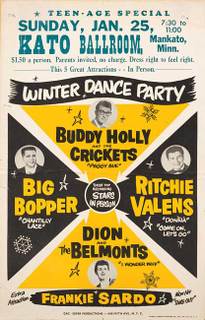
winterdancepartyposter1959February 3, 2009 marks the 50th anniversary of the day a single engine Beechcraft Bonanza B35 airplane plummeted to the earth in a frostbitten cornfield near Clear Lake, Iowa. On board were three musicians who, only a few hours earlier, had rocked the stage in Clear Lake’s Surf Ballroom: Ritchie Valens, J.P “The Big Bopper” Richardson, and Buddy Holly.

I’m nowhere near old enough to do the whole “Where were you on the day the music died?” thing (to put it in equally iconic musical terms, I was born eight years later, the summer Sgt. Pepper came out), but as a biographer – and because it’s just plain fascinating – I’m always interested in seeing how iconic events were reported in their time, before events could be colored or tainted by hindsight, adulation, and wishful thinking.

Years ago, I went to the library and pulled the microfiche of the February 4, 1959 Albuquerque Journal and several other papers to see how the crash was being reported by the media — which at that time had only a yawning interest in what it considered the passing fad of the fledgling rock and roll scene. The crash received quite a bit of coverage, with most newspapers going with the UPI story, which devoted the first third of its coverage to an almost clinical description of the crash and the crash site (the UPI reports, for instance, that the plane “skidded across the snow for 558 feet”).

Given what we now know and accept as their relative places in the rock’n’roll pantheon, what’s really interesting is how little ink Buddy Holly earns in the press coverage. That’s probably because, of the three performers killed, Holly – whose “I Guess It Doesn’t Matter Any More” had made it to number 13 in January – hadn’t had a monster hit since September 1957, when “Everyday” peaked at #3 (incredibly, five months earlier, “It’s So Easy” had stalled out at a rancid #82). Meanwhile, Richardson’s “Chantilly Lace” had hit #6 the previous summer, while Valens’ “Donna” was sitting at number 4 on the charts the week he was killed – Valens, in fact, gets most of the column inches, where his death is grieved as the loss of “the next Elvis Presley”:

1959article1a

Fifty years later, even as all three can be assured of their iconic stature, we’re still fascinated by the poetic tragedy of that winter morning — thanks in no small part to Don McLean, who gave the moment a nearly Biblical heft in “American Pie.” We play the “what if?” game — especially with Holly, who seemed to be bending and breaking the rules of rock and roll almost daily.

And like any good iconic moment in time, there always seems to be a new legend or rumor associated with it. As recently as two years ago, the body of Richardson was exhumed to try to put to rest one of the Great Conspiracies tying together two odd elements of the crash: the discovery in the cornfield several months later of a gun registered to Buddy Holly, and the fact that Richardson’s body was found farther away from the crash site than the others. The rumor was that Holly’s gun had accidentally discharged during takeoff, killing the pilot and causing the crash – a crash Richardson survived, before staggering away from the plane and dying of exposure.

To the dismay of conspiracy theorists everywhere, forensic anthropoligst Bill Bass, who performed the autopsy on Richardson’s remains, concluded that, “He did not crawl from the plane. He died of massive fractures.”  Sorry.

Take a moment today to think about Buddy, Ritchie, and J.P. But more than anything, don’t think of the way they died; remember the way they lived, and the music they loved.

A love for real not fade away.