Be A Part Of History, Wherever You Stand

My ticket to President Bill Clinton's first inauguration ceremony.

My ticket to President Bill Clinton's first inauguration ceremony.

If all goes as anticipated, one week from today — on January 20, 2009 — Washington, D.C., will swell with a record 4 million tourists, guests and V.I.Ps, all of whom have come to the area to attend the inaugural ceremonies for President-elect Barack Obama.

It’s going to be a mess.

Washington, D.C. is a place that’s used to managing and moving enormous crowds of people into and out of the District.  Every day, DC’s huge workforce — made up mainly of government workers, lobbyists, and advocates, most of whom don’t live in the city itself — commute from Maryland, Virginia, even Pennsylvania, West Virginia and Delaware, ballooning the population of the city from its normal 600,000 into the millions.  They — we — come in by car, by commuter train, by subway, and by bus.  We’re well used to sitting in traffic on the Beltway for hours or packing ourselves uncomfortably onto the Metro or commuter trains, our faces pressed against each others’ backs and our briefcases lost somewhere down by our feet.

We’re  a town that prides itself on elaborate public events, from Fourth of July celebrations to gigantic parades.  We’re used to the inconveniences that come from being the seat of government.  We hardly blink at protests or sit-ins, for example, or being waved across streets by heavily-armed soldiers in fatigues or Men in Black, out in force because of visiting heads of state.  We’re used to traffic being stopped to make way for caravans of black limousines, their windows tinted almost impossibly dark, sirens blaring, as Cabinet officials or the President make their way through the city.

All this we’re used to.  Still, we’re bracing ourselves for next Tuesday as a day unlike any we’ve ever seen.  Schools are closed for the day to keep buses off the roads.  The bridges crossing the Potomac from Virginia into DC will be closed to all but inaugural traffic — which means the countless shuttle buses that will pour into the city, looking for places to park.  Metro will run at capacity all day, but with its ability to move only 150,000 riders per hour, it may well take attendees all day to wait for their train.  In short, it’ll be a zoo.

And yet . . . when I’m contacted by friends from across the country who want to make a “quick trip” to DC to to take part in history, or just want to catch a glimpse of the new President, I just can’t discourage them.  While this is indeed a historic event, any Presidential inauguration is worth seeing.  Regardless of your political affiliation or who you may have voted for, it’s the chance to witness firsthand one of great miracles of  a republican form of government: the transfer of power — through the will of the people — to a new head of state.  And it’s truly thrilling.

I had the opportuity to attend the inaugural ceremonies for President Clinton’s first swearing in, on January 20, 1993.  At that time, I was working in the Senate and living on Capitol Hill at 4th and Constitution, just four short blocks from the U.S. Capitol.  I had secured my ticket through our office — while excitement for Clinton was high, the demand for inaugural tickets was nowhere near what it was for Obama — and on the morning of the 20th, my roommates and I walked over to the west side of the Capitol, where our tickets permitted us to stand in a cordoned off area at the northwest corner of the Capitol’s lawn.  Here’s the map on the back of the ticket to give you some perspective:
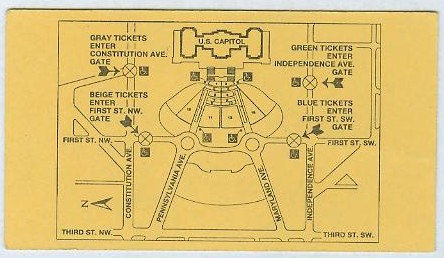
ticket2

While that doesn’t appear to be too shabby, you need to appreciate just how huge the Capitol complex is.  Once you’re beyond the steps of the building and across the west lawn, you’re pretty far away.  I ended up standing right where Pennsylvania Avenue dead-ends at the low stone wall surrounding the Capitol, near one of the enormous Chinese lanterns that lights the entrance to the lawn.  From my position, here’s what I could see of Clinton’s swearing in on that morning in 1993:
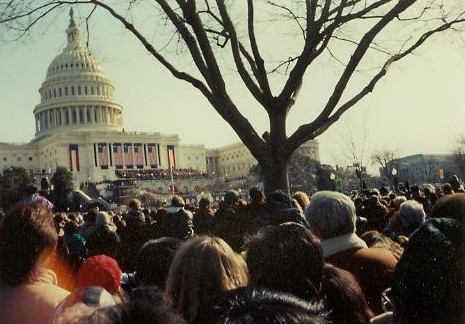
inaugural2

Clinton’s there, almost dead center of the photo, on that lower tier in front of the gray stone archways of the Capitol Building.  And that was my view from the exclusive ticketed area!

So here’s my advice, then, for those who are coming to our fair city for the inauguration:  please manage your expectations.  It’s going to be packed here.  If you’re in the city, you are a part of history, a part of the unique Obama story.  You may not be able to see the man — though there will be video screens propped up around the Mall so that you might be able to catch a glimpse of the proceedings even if you’re jammed onto Fifteenth Street NW, well away from the Mall.  Or maybe you’ll be standing at the foot of the Washington Monument — or near the Smithsonian Castle, or the Vietnam Veterans Memorial —  watching Obama take the oath of office on a huge video screen, but you can tell your children and grandchildren that you were there.

Also, give yourself time to get . . . well, anywhere.  Parking will be nonexistent, the Metro will be slow, and the sidewalks will be packed. Plus, while DC can often be confusing enough to navigate if you’ve never visited before, now add 1 million other confused folks, going down the wrong streets, the wrong escalators, the wrong way.

It’ll be a mess.  And while the travel planner in me might want to urge you to stay away, I can’t help but tell you to enjoy yourself, and relish your part in history, no matter where you’re standing — even if it’s in your own living room half a continent, or half a world, away.  This is you, and your government, at its finest.

Testing, 1, 2, 3 . . .

. . . and hello there!

If you’re coming in from Literary Conceits, then reset your bookmarks or links — this is its new home base.  Working with Me Bruddah the Webmaster — who convinced me to make the transition over to WordPress for better and easier page management (for I am a notoriously lazy html coder, and keep away from the stuff as much as I can….) — we’ve incorporated the blog into the main content of brianjayjonesDOTcom.  So you not only get your daily dose of Literary Conceits, you can also poke around and read about Washington Irving, or watch a video of me at the New York Society Library, or whatever.  Come on, you know you want to.

All previous blog entries, and your comments, are here — and comments are open for business again, so post away.

Poke around and let me know if everything’s working — and if there’s something broken, let me know and I’ll sock my webmaster on the arm.  There may still be some bugs in the system, and there are some other things I’m still trying to get used to (the inability to embed video with WordPress is going to be a sticking point with me, I think) but we’ll do our best to make things as seamless, and as simple to use, as we can.

Thanks For The Kind Words…

During the final week of 2008, Friend o’ the Blog and Feared Book Reviewer Josephine Damian spent several days over on her blog discussing what she considered the Best Books She Read During 2008. And what do you think was her pick for the best non-fiction book of the year?

Well, it was Gabriel Garcia Marquez’s News of a Kidnapping. But to my delight — and complete surprise — Washington Irving: An American Original was a close second. Hey, runner up to a Nobel Prize winner? I’ll take that any day, thanks.

And to Josie: a big mea culpa for not posting this earlier. I e-mailed her to thank her for the kind words, then didn’t get back here to post it.

Thanks again, JD. I truly appreciate it.

A Moment of (Stunned) Silence at Arcade

Last night, I was alerted by Casey, my editor at Arcade, that Richard Seaver — founder and president of Arcade Publishing — passed away unexpectedly on January 5. He was 82.

The obituary from today’s New York Times is here.

I never had the pleasure of meeting Richard personally, but I knew of his reputation and commitment to making Arcade a top-notch publisher that played with the big boys, despite its smaller size. Richard was highly-selective about the kinds of books Arcade published — “elegant” was the one word my agent could come up with to describe their output — and I’ll be forever grateful to him for taking a chance on me and my first book.

Stephen Weissman — whose book Chaplin: A Life was one of the last books Seaver edited — calls Seaver “a great editor I was lucky to know.” My own editor — who has worked with Richard and his partner (and wife) Jeannette for years now — was understandably emotional. “I can’t believe he’s really gone,” she told me, “and that I’ll never see him again, in his purple shirt and hand-painted necktie, or hear him crack his sometimes truly corny jokes. A light has gone out, and the world is poorer for having lost the brilliant Dick Seaver.

“In the meantime,” she added, “we carry on in his memory.”

A memorial service will be announced shortly, Meanwhile, his family has requested that, in lieu of flowers, a contribution may be made in his name  to PEN American Center, 588 Broadway, Suite 303, New York, New York 10012.

As just one of countless members of the extended Arcade family, my thoughts and deepest sympathy go out to Richard’s wife, Jeannette, and their family and friends.

Ringing In The New

Happy New Year! And it’s good to be back after . . . yeeks, was it really nearly a week? Well, I missed you, at any rate.

Nothing terribly interesting to note or report at the moment, but here’s what’s on my mind:

. . . The ice storm that was threatening the DC region passed us by with a only drizzle of rain and a scrim of ice on the windshields this morning. This was much to my daughter’s chagrin, who went to bed convinced she would awaken this morning to notices that school had been cancelled. And this is a kid who likes school. She just likes the idea of snow days even more.

. . . It’s horribly annoying to watch newscasters cover the Very Important Story of Sasha and Malia Obama attending their first day of school . . . and then have those same newscasters moan and wail about the media coverage of what should be a private event. Mika Brzezinski on the increasingly loud Morning Joe practically dressed down their own MSNBC reporter for covering the story for their very own show. Here’s some advice: then don’t cover it. You don’t get to have it both ways.

. . . Rock Band 2 for the XBox kicks serious ass. Madi, Barb and I set up our own virtual band (which I dubbed Blind Gravy, a decision I made by fiat, since no one was home at the time) and we spend a little bit of time each evening with Madi on guitar, Barb on drums, and me on bass, wailing away at Bon Jovi, Duran Duran, Jimmy Eat World, and Lit. Barb has perhaps the most exhausting role as the drummer, but just when we think she’s wearing out — and therefore ready to stop — she suddenly brightens and says, “If we can get through a four-song set in Los Angeles, they’ll give us an airplane!” And off we go again. I love my family.

Under Construction

Welcome to the official website of Brian Jay Jones – that’s me, the writer and biographer and not the dead Rolling Stone. Or the aeronaut, for that matter. But even if you came looking for one of those gentlemen, I’m glad you stumbled in, and I hope you’ll stick around a bit and learn a little about me and my work. And if you’ve dropped by on purpose … well, all the better. Thanks for visiting.

Oh, and if you’re here, then you’ve very cleverly discovered the Work In Progress known as BrianJayJones dot Com, Version 2.0. Pretty much all the content here is the same as over at brianjayjones.com, but we’re playing around with some things before we launch a new look.

Lennon and Laptops

Coming, perhaps appropriately, on the heels of yesterday’s review of John Lennon: The Life, a number of readers have e-mailed to ask my opinion of the recent “One Laptop Per Child” commercial that uses Lennon’s likeness and a digitized “voice.” If you haven’t seen it yet, it’s right here:

My reaction? Meh.

While many of the commenters on YouTube are offended that the highly-selective Yoko Ono would sanction the use of John’s image for a charity that hands out laptops — and there’s a lot of chatter on whether that’s a charity Lennon himself would have embraced — it’s not really the kind of thing that bothers me. Yoko is famously careful and tight-fisted when it comes to John’s name and reputation — even going so far as to stiff-arm Paul McCartney when he recently suggested that “Yesterday” be credited to McCartney-Lennon, rather than the more familiar Lennon-McCartney — so I wouldn’t presume to second-guess her assent for this particular organization.

For my part, I’m just not that impressed with the ad. Given that Yoko so rarely allows for John’s name and image to be used, I expected something a little more spectacular or moving. The brief and grainy glimpse we get of John in the final few seconds — with the Forrest Gump digitizing of the mouth — doesn’t really work. And the voiceover, while it very well may have been put together using actual Lennon clips, sounds to me like the cartoon version of Lennon from Yellow Submarine — or, better yet, like Paul Rudd doing his deadpan Lennon in Walk Hard: The Dewey Cox Story (NSFW, due to naughty language and drug humor…):

The heart is probably in the right place, but the ad just doesn’t do much for me.

Reviews in Brief: John Lennon: The Life (Philip Norman)

“In September 2003, I suggested to John’s widow, Yoko Ono, that I should become his biographer,” writes Philip Norman in the Acknowledgements section of John Lennon: The Life. However, after reading the final manuscript, “Yoko Ono was upset by the book,” Norman tells us, “and would not endorse it . . . [saying] I had been ‘mean to John.'”

I actually don’t think Yoko’s got anything to worry about; Norman’s book is both clear-eyed and appropriately sympathetic as it traces the arc of Lennon’s all-too-brief life and career. While there’s much in here that’s familiar, Norman uses both old and new sources to revisit apocryphal or second-hand stories — most of which are familiar to Beatle fans — and determine their veracity. He puts to rest, for example, the Did they or didn’t they? question that has surrounded Lennon’s vacation in Spain with manager Brian Epstein (they didn’t), and accepts as fact many of the stories that expose John’s darker side, such as his brutal beating of Cavern DJ Bob Wooler, or the lurid sexual fantasies involving his own mother.

There’s also quite a bit that’s new in here, too — or, at least, was unfamiliar to me. Norman explores, for example, exactly what “business” Yoko was doing during Lennon’s househusband years — she was dealing mostly in mundane real estate transactions, but is also given full credit for shrewdly negotiating music contracts that maximized John’s profits and protected his copyrights. He also examines some of the theater pieces that were based on Lennon’s writings in the 1960s — a hidden gem in the literate Beatle’s career — exposes a charming addiction to board games, and explains about as well as one can the complicated legal wranglings that finally dissolved the band and led to years of hard feelings.

For perhaps the first time, too, some of the supporting characters in Lennon’s story finally come into their own. John’s Aunt Mimi — who can often come off as a bit of a shrew — gets a bit of her own narrative, as Norman uses letters Mimi wrote regularly to a young female fan named Jane Wirgman to reveal just how thoughtful and protective of John Mimi could be, even as she continued to be embarrassed by his antics or appearance. You’ll also have a better understanding of Freddie Lennon, John’s seaman father who abandoned his wife and son, then rematerialized after John made it big. Freddie has his own reasons — excuses — for his actions, but for the first time, you’ll have his own words and private correspondence to help you decide whether you buy it or not.

If there’s a complaint I have about this otherwise thorough biography, it lies in Norman’s narrative voice. Norman’s prose isn’t ever stilted — he’s too good a journalist for that — but it can be somewhat stodgy (he calls the lyrics to “Twist and Shout,” for example, “dippy”). He also inserts way too many clunky moments of foreshadowing of Lennon’s fate, often resorting to eye-rollingly lame declarations of irony that are a stretch, at best.

For example, as the Beatles frolic for a photo session in New York during their first American tour in 1964, Norman can’t help but indulge in dramatic voiceover. “Hindsight gives this routine scene a horrible irony,” he writes. “Just across the park lies a craggy Gothic pile known as the Dakota Building” where John would be shot to death in 1980. Later, Norman tell us that for the 1972 U.S. Presidential campaign, “John pinned high hopes on the Democratic candidate, George McGovern, senator for South Dakota — an omen if ever there was one . . . ” It took me a moment to figure out why this was “an omen” — until I realized it was the use of the word “Dakota” in the sentence that was supposed to be so ominous.

Perhaps even more annoying — especially to the biographer in me — there’s no sign of a bibliography, sources, or endnotes, only an index. There were several times in Norman’s book when I found myself saying “Where’d you get that?” and turned to the back looking for his source, only to come up blank. Perhaps, at 851 pages, there simply wasn’t enough room left. But I’m sure I’m not the only one missing it.

Christmas Dinner

Happy Holidays! As promised, here are some highlights from Washington Irving’s 1820 short story “Christmas Dinner.” Enjoy.

The dinner was served up in the great hall, where the squire always held his Christmas banquet. A blazing crackling fire of logs had been heaped on to warm the spacious apartment, and the flame went sparkling and wreathing up the wide-mouthed chimney. The great picture of the crusader and his white horse had been profusely decorated with greens for the occasion, and holly and ivy had like-wise been wreathed round the helmet and weapons on the opposite wall, which I understood were the arms of the same warrior . . . A sideboard was set out just under this chivalric trophy, on which was a display of plate that might have vied (at least in variety) with Belshazzar’s parade of the vessels of the temple: “flagons, cans, cups, beakers, goblets, basins, and ewers,” the gorgeous utensils of good companionship that had gradually accumulated through many generations of jovial housekeepers. Before these stood the two Yule candles, beaming like two stars of the first magnitude; other lights were distributed in branches, and the whole array glittered like a firmament of silver.

We were ushered into this banqueting scene with the sound of minstrelsy, the old harper being seated on a stool beside the fireplace and twanging, his instrument with a vast deal more power than melody. Never did Christmas board display a more goodly and gracious assemblage of countenances; those who were not handsome were at least happy, and happiness is a rare improver of your hard-favored visage. . . .

The parson said grace, which was not a short familiar one, such as is commonly addressed to the Deity in these unceremonious days, but a long, courtly, well-worded one of the ancient school. There was now a pause, as if something was expected, when suddenly the butler entered the hall with some degree of bustle: he was attended by a servant on each side with a large wax-light, and bore a silver dish on which was an enormous pig’s head decorated with rosemary, with a lemon in its mouth, which was placed with great formality at the head of the table. The moment this pageant made its appearance the harper struck up a flourish; at the conclusion of which the young Oxonian, on receiving a hint from the squire, gave, with an air of the most comic gravity, an old carol, the first verse of which was as follows

Caput apri defero
Reddens laudes Domino.
The boar’s head in hand bring I,
With garlands gay and rosemary.
I pray you all synge merily
Qui estis in convivio.

Though prepared to witness many of these little eccentricities, from being apprised of the peculiar hobby of mine host, yet I confess the parade with which so odd a dish was introduced somewhat perplexed me, until I gathered from the conversation of the squire and the parson that it was meant to represent the bringing in of the boar’s head, a dish formerly served up with much ceremony and the sound of minstrelsy and song at great tables on Christmas Day. “I like the old custom,” said the squire, “not merely because it is stately and pleasing in itself, but because it was observed at the college at Oxford at which I was educated. When I hear the old song chanted it brings to mind the time when I was young and gamesome, and the noble old college hall, and my fellow-students loitering about in their black gowns; many of whom, poor lads! are now in their graves.”

The parson, however, whose mind was not haunted by such associations, and who was always more taken up with the text than the sentiment, objected to the Oxonian’s version of the carol, which he affirmed was different from that sung at college. He went on, with the dry perseverance of a commentator, to give the college reading, accompanied by sundry annotations, addressing himself at first to the company at large; but, finding their attention gradually diverted to other talk and other objects, he lowered his tone as his number of auditors diminished, until he concluded his remarks in an under voice to a fat-headed old gentleman next him who was silently engaged in the discussion of a huge plateful of turkey.

The old ceremony of serving up the boar’s head on Christmas Day is still observed in the hall of Queen’s College, Oxford. I was favored by the parson with a copy of the carol as now sung, and as it may be acceptable to such of my readers as are curious in these grave and learned matters, I give it entire:

The boar’s head in hand bear I, Bodeck’d with bays and rosemary

The table was literally loaded with good cheer, and presented an epitome of country abundance in this season of overflowing larders. A distinguished post was allotted to “ancient sirloin,” as mine host termed it, being, as he added, “the standard of old English hospitality, and a joint of goodly presence, and full of expectation.” There were several dishes quaintly decorated, and which had evidently something traditional in their embellishments, but about which, as I did not like to appear overcurious, I asked no questions.

[…]

When the cloth was removed the butler brought in a huge silver vessel of rare and curious workmanship, which he placed before the squire. Its appearance was hailed with acclamation, being the Wassail Bowl, so renowned in Christmas festivity. The contents had been prepared by the squire himself; for it was a beverage in the skilful mixture of which he particularly prided himself, alleging that it was too abstruse and complex for the comprehension of an ordinary servant. It was a potation, indeed, that might well make the heart of a toper leap within him, being composed of the richest and raciest wines, highly spiced and sweetened, with roasted apples bobbing about the surface.

The old gentleman’s whole countenance beamed with a serene look of indwelling delight as he stirred this mighty bowl. Having raised it to his lips, with a hearty wish of a merry Christmas to all present, he sent it brimming round the board, for every one to follow his example, according to the primitive style, pronouncing it “the ancient fountain of good feeling, where all hearts met together.”

[…]

Here’s “The Christmas Dinner” in its entirety. Interestingly, when Irving reprinted his Christmas stories nearly forty years later, he added the following postscript:

At the time of the first publication of this paper the picture of an old-fashioned Christmas in the country was pronounced by some as out of date. The author had afterwards an opportunity of witnessing almost all the customs above described, existing in unexpected vigor in the skirts of Derbvshire and Yorkshire, where he passed the Christmas holidays. The reader will find some notice of them in the author’s account of his sojourn at Newstead Abbey.

But enough of Christmas and its gambols; it is time for me to pause in this garrulity. Methinks I hear the questions asked by my graver readers, “To what purpose is all this? how is the world to be made wiser by this talk?” Alas! is there not wisdom enough extant for the instruction of the world? And if not, are there not thousands of abler pens laboring for its improvement? It is so much pleasanter to please than to instruct–to play the companion rather than the preceptor.

What, after all, is the mite of wisdom that I could throw into the mass of knowledge! or how am I sure that my sagest deductions may be safe guides for the opinions of others? But in writing to amuse, if I fail the only evil is in my own disappointment. If, however, I can by any lucky chance, in these days of evil, rub out one wrinkle from the brow of care or beguile the heavy heart of one moment of sorrow; if I can now and then penetrate through the gathering film of misanthropy, prompt a benevolent view of human nature, and make my reader more in good-humor with his fellow-beings and himself — surely, surely, I shall not then have written entirely in vain.

At this time of year, we couldn’t ask for much more than to “rub out one wrinkle from the brow of care.”

Merry Christmas. Take care of each other.

Christmas Eve

For your holiday reading, here’s an excerpt from Washington Irving’s 1820 short story “Christmas Eve,” lifted from the pages of The Sketch Book of Geoffrey Crayon, Gent.

And remember what I told you here yesterday: when Irving tells you something is “ancient custom,” he is not to be trusted. The rogue.

Anyway. Here we go:

The grate had been removed from the wide overwhelming fireplace to make way for a fire of wood, in the midst of which was an enormous log glowing and blazing, and sending forth a vast volume of light and heat: this, I understood, was the Yule-clog, which the squire was particular in having brought in and illumined on a Christmas Eve, according to ancient custom.

The Yule-clog is a great log of wood, sometimes the root of a tree, brought into the house with great ceremony on Christmas Eve, laid in the fireplace, and lighted with the brand of last year’s clog. While it lasted there was great drinking, singing, and telling of tales. Sometimes it was accompanied by Christmas candles; but in the cottages the only light was from the ruddy blaze of the great wood fire. The Yule-clog was to burn all night; if it went out, it was considered a sign of ill luck.

Herrick mentions it in one of his songs:

Come, bring with a noise, My metric, merrie boys,
The Christmas Log to the firing;
While my good dame, she Bids ye all be free,
And drink to your hearts’ desiring.

The Yule-clog is still burnt in many farm-houses and kitchens in England, particularly in the north, and there are several superstitions connected with it among the peasantry. If a squinting person come to the house while it is burning, or a person barefooted, it is considered an ill omen. The brand remaining from the Yule-clog is carefully put away to light the next year’s Christmas fire.

[…]

Supper was announced shortly after our arrival. It was served up in a spacious oaken chamber, the panels of which shone with wax, and around which were several family portraits decorated with holly and ivy. Besides the accustomed lights, two great wax tapers, called Christmas candles, wreathed with greens, were placed on a highly polished beaufet among the family plate. The table was abundantly spread with substantial fare; but the squire made his supper of frumenty, a dish made of wheat cakes boiled in milk with rich spices, being a standing dish in old times for Christmas Eve. I was happy to find my old friend, minced pie, in the retinue of the feast and, finding him to be perfectly orthodox, and that I need not be ashamed of my predilection, I greeted him with all the warmth wherewith we usually greet an old and very genteel acquaintance.

. . . no sooner was supper removed and spiced wines and other beverages peculiar to the season introduced, than Master Simon was called on for a good old Christmas song. He bethought himself for a moment, and then, with a sparkle of the eye and a voice that was by no means bad, excepting that it ran occasionally into a falsetto like the notes of a split reed, he quavered forth a quaint old ditty:

Now Christmas is come,
Let us beat up the drum,
And call all our neighbors together;
And when they appear,
Let us make them such cheer,
As will keep out the wind and the weather, &c.

The supper had disposed every one to gayety, and an old harper was summoned from the servants’ hall, where he had been strumming all the evening, and to all appearance comforting himself with some of the squire’s home-brewed. He was a kind of hanger-on, I was told, of the establishment, and, though ostensibly a resident of the village, was oftener to be found in the squire’s kitchen than his own home, the old gentleman being fond of the sound of “harp in hall.”

The dance, like most dances after supper, was a merry one: some of the older folks joined in it, and the squire himself figured down several couple with a partner with whom he affirmed he had danced at every Christmas for nearly half a century. . . .

[…]

The party now broke up for the night with the kind-hearted old custom of shaking hands. As I passed through the hall on my way to my chamber, the dying embers of the Yule-clog still sent forth a dusky glow, and had it not been the season when “no spirit dares stir abroad,” I should have been half tempted to steal from my room at midnight and peep whether the fairies might not be at their revels about the hearth.

My chamber was in the old part of the mansion, the ponderous furniture of which might have been fabricated in the days of the giants. The room was panelled, with cornices of heavy carved work, in which flowers and grotesque faces were strangely intermingled, and a row of black-looking portraits stared mournfully at me from the walls. The bed was of rich thought faded damask, with a lofty tester, and stood in a niche opposite a bow window. I had scarcely got into bed when a strain of music seemed to break forth in the air just below the window. I listened, and found it proceeded from a band which I concluded to be the Waits from some neighboring village. They went round the house, playing under the windows. I drew aside the curtains to hear them more distinctly. The moonbeams fell through the upper part of the casement; partially lighting up the antiquated apartment. The sounds, as they receded, became more soft and aerial, and seemed to accord with the quiet and moonlight. I listened and listened–they became more and more tender and remote, and, as they gradually died away, my head sunk upon the pillow and I fell asleep.

Tomorrow: Irving’s “Christmas Dinner.” Meanwhile, here’s “Christmas Eve” in its entirety. Go read it. It’ll make your day.