
File this under Things I Thought I’d Posted Already About and Then Found Out I Didn’t: Over the past few years, I’ve made a number of appearances on the improv talk show The George Lucas Talk Show, brought to you by the brilliant and hilarious team of Connor Ratliff, Griffin Newman, and Patrick Cotnoir. If you’ve somehow managed to miss seeing it come across your social media feed, the show features Ratliff convincingly playing “filmmaker George Lucas” interviewing very real celebrities, while Newman chimes in as a dead-on Watto and producer Cotnoir provides all other necessary support. It’s been going on since 2014, and the celebrity guest list just gets better and better with each passing episode.
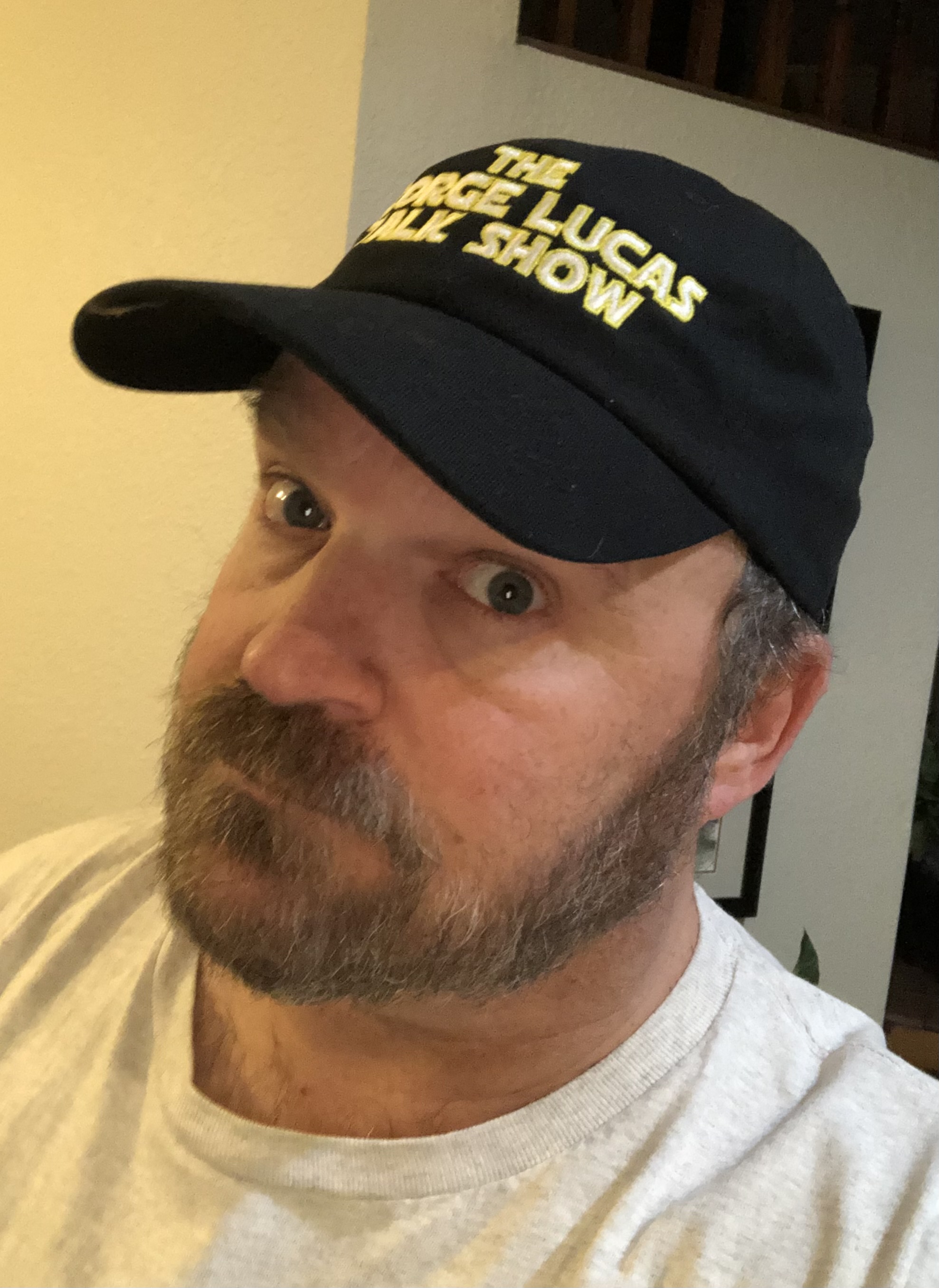
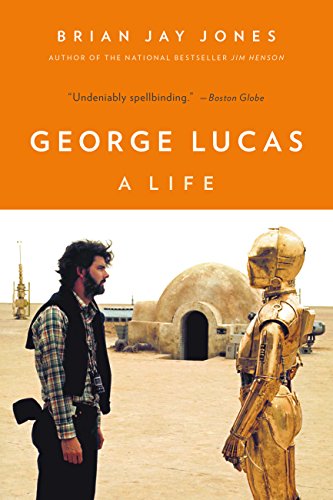
Sometimes, however–and this is all part of the fun–he has on fans and other types of non-celebrities . . . like me. Ratliff told me that he uses my 2016 biography of George Lucas as part of his “show Bible” and from time to time, while in character, he’ll mention “my biographer Brian Jay Jones,” which makes me both incredibly happy and weirdly giddy at the same time. And so, I’ve been delighted to jump into the fray the several times I’ve been asked, as the show is an absolute blast and I hope they keep doing it forever.
That’s all preface to telling you that in 2024, a team of documentarians released a really terrific film about the show, and Connor, called I’m George Lucas: The Connor Ratliff Story. At the moment, it’s available for download and streaming–but I’d really encourage you to invest in the 2-disc Blu-Ray from Kino Lorber which gives you not only the documentary, but tons and tons of extra features. Among those bonus features is more audio commentary tracks than you’ve ever seen anywhere else–Patrick Cotnoir actually wanted to set an official Guinness Book of World’s Records record for most commentary tracks, and I’m pretty sure he did so, since there are fifty-seven audio commentaries on this thing.
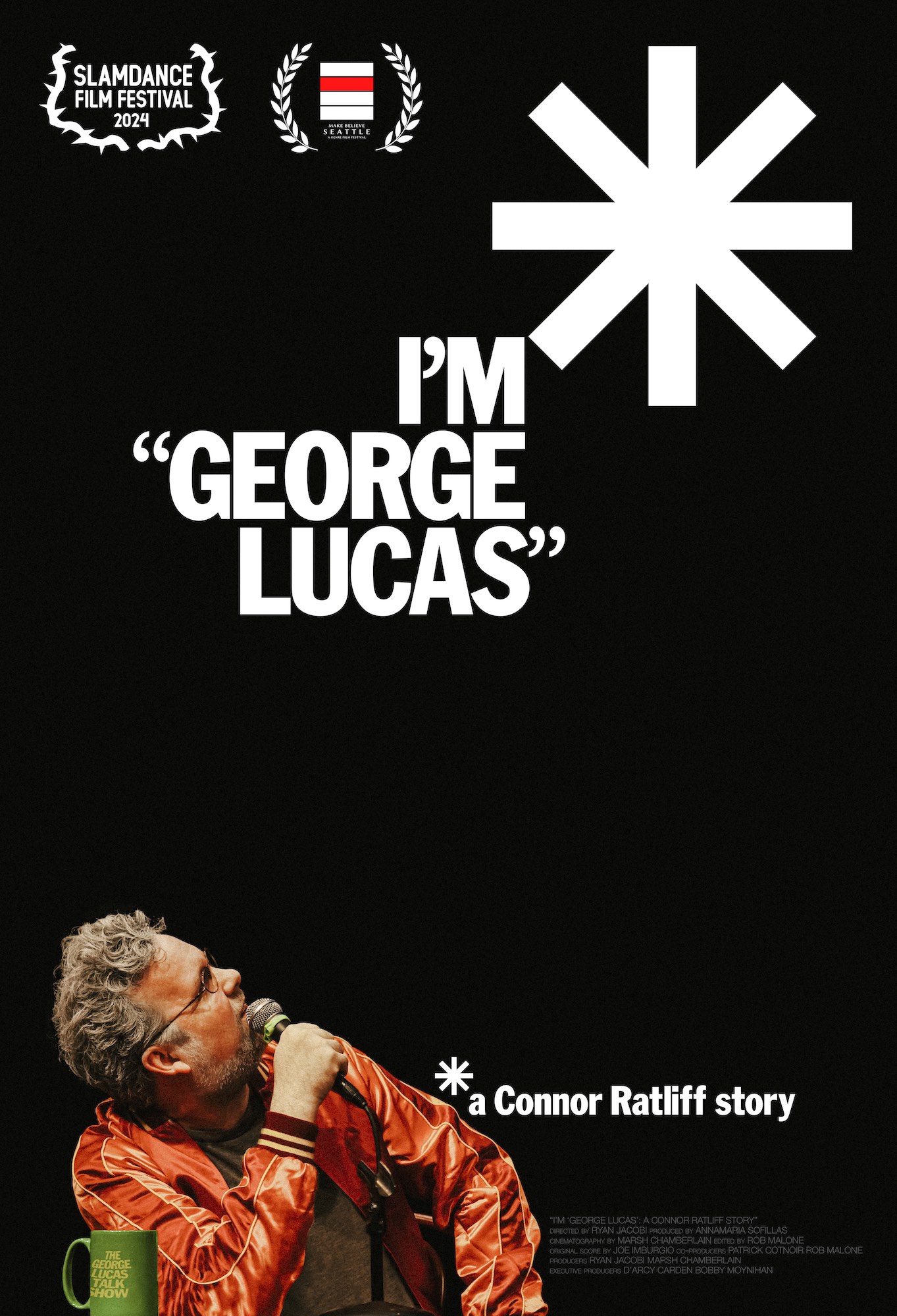
One of them is even by me. When Patrick asked me last year if I wanted to participate, my answer was, of course, um, yes, and I had a great time doing it. It’s the first and probably only time I will ever get to do a movie audio commentary–and as someone who has watched a lot of films with commentary, I didn’t want to disappoint. So I tried to tell stories about the real George Lucas that were relevant to what was being talked about on screen–including similarities between Connor’s story and Lucas’s own–as well as giving my impressions of having been on The George Lucas Talk Show.
And here’s one of the first things I talked about when it comes to being on the show: Connor Ratliff is absolutely committed to the bit. If you’re waiting for him to break character or even to wink knowingly at the audience, it’s not going to happen. He’s terrifyingly good; when he started giving me hell about writing in my biography about Lucas’s alleged lack of . . . er, enthusiasm in the bedroom, I stammered apologetically like I was being interrogated by the real George Lucas.
I also quickly learned to leave the funny to the professionals. I tried for a bit to be clever but quickly found I was in over my head. These guys are good at this stuff. They’ve got the funny under control; my job was to be the straight man.
Anyway, all this and more can be found in my commentary track–but there are plenty of others to choose from, too, including tracks from actual comedians like Chris Gethard, Bill Corbett, and Lane Moore. And for Muppet fans, you’ll also find a track by Craig Shemin and Stephanie D’Abruzzo.
I’m really proud to have been part of this in even a small way, and I’m delighted for the team at TGLTS, who keep right on regularly bringing you the funny. Check out the documentary, catch it live in New York if you can, or spend some time on the show’s YouTube Channel. You’re gonna love it.
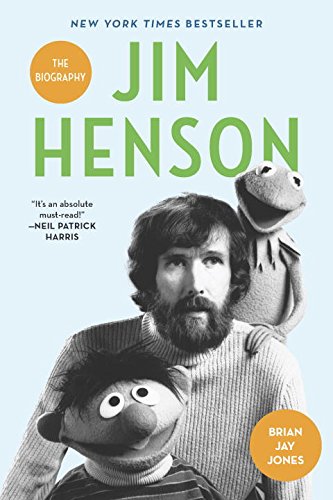
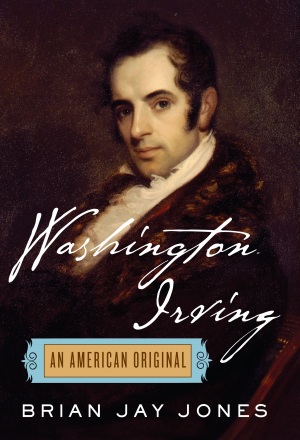
 This is kinda fun: on a bookshelf in my office — it’s actually a wooden crate at the base of my desk — I like to keep every edition of the three books I’ve had published over the last decade. For Washington Irving, that meant I had it in hardcover and softcover. For Jim Henson, apart from the U.S. hardcover and paperback, there was a UK edition, a Polish edition, and an audiobook — the first time I have ever had an audiobook of my work, and I gotta admit, I still get a bit weepy listening to Kirby Hayborne read the heck out of it.
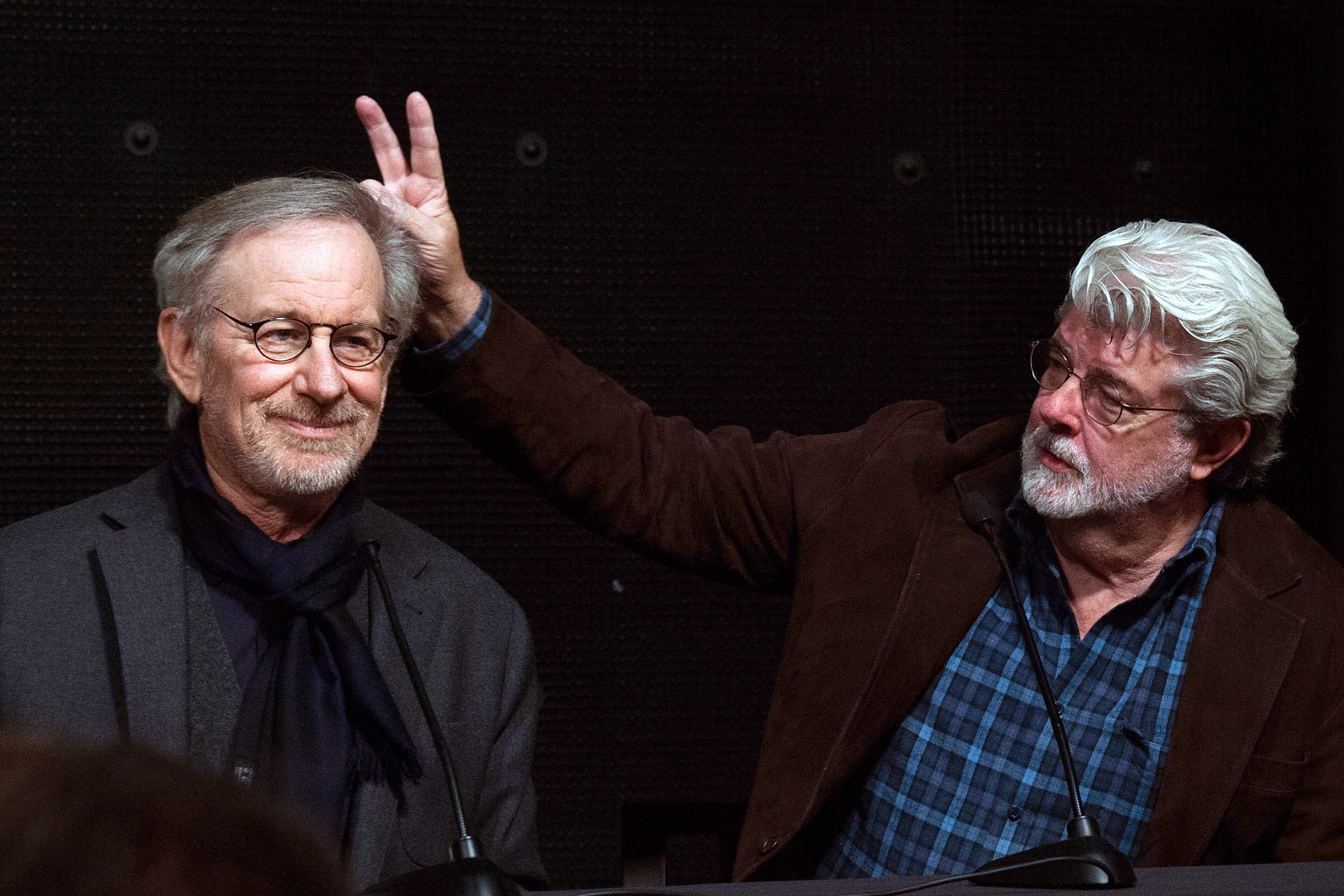 Lucas and Spielberg have one of those wonderful fraternal relationships where, as brothers do, they both admire and compete with each other. Would Spielberg ever make such a joke to Lucas? I don’t think so – that one might be a little raw; you can see it in Lucas’s face when Charlie Rose mistakenly says that Lucas has won an Oscar, and Lucas says with a slight grimace, “No, I’m too popular for that…”
 Do people forget that Lucas was involved with those movies? Maybe for Willow, though I think people now remember it more as a George Lucas film than Ron Howard one! I think the point, anyway, is that Lucas had a great knack for story concept – or, at least, how that story should look at 20,000 feet. In the best instances – Star Wars, Raiders – it then took some really great writers (Willard Huyck, Gloria Katz, Lawrence Kasdan) to pull the final story and script together. The main ideas – the characters, the concepts – behind Willow and at least some of the Indiana Jones movies are really good ones, but the execution can be tricky. With Raiders, I think, it’s done about as well as it has ever been – that’s one where Lucas is content to light fuse and stand back and let Spielberg put Kasdan’s script to work.
 Finally, it’s ultimately a great story about being absolutely true to yourself and committed one thousand percent to your own vision. Lucas constantly invested his own money in his company and in his films, even as his accountants fretted. Lucas was and is absolutely committed to getting the vision of the artist up on the screen in its purest form, and has worked his entire career to give them the tools to do that, whether it’s developing the gold-standard in special effects with ILM, creating groundbreaking digital technology (part of which became Pixar), or encouraging theaters to install earth-rumbling sound systems – like THX – to ensure a movie sounded in the theater the way it did in the editing room. The word ‘no’ isn’t in his vocabulary. If you’re a creative person – or a businessperson! — looking for a bit of inspiration, I think you’ll find that in George Lucas’s story as well.
 Back in the 1980s, it was definitely too much for him. He stopped directing right after Star Wars, for example, because it actually took a physical toll on his health. He had little patience with actors, and the daily grind of being on-set really kind of annoyed him. He was much better suited to producing, where he could still oversee and control everything without having to actually run the set – though with Empire and Jedi, he still practically parked himself on the shoulders of his hand-picked directors anyway. Lucas can really never not be involved.
 Absolutely. Lucas is fascinated by man’s relationship with machines – it informs his work all the way back to college in films like THX-1138 4EB or 1:42:08, which features race car driver Allen Grant putting a racecar through its paces. His own experiences as a gear head and a cruiser in high school are up there on the screen in full force in American Graffiti. And in Star Wars, his ships tend to move and dive and scream by like cars at a race track. Heck, the podracing scene in Episode I is practically the drag race in American Graffiti! Even a ship like the Millennium Falcon is really just a spaceship hotrod, souped up for speed and with a lot of special modifications that the driver made himself. Even Darth Vader himself is a man struggling with machine – “he’s more machine than man now” Obi-Wan tells Luke.
 Forty years ago this week — Sunday, May 1, 1977, to be specific — George Lucas screened the premiere of Star Wars at the Northpoint Theater in San Francisco , the very same theater where he’d triumphantly (though not perfectly) debuted American Graffiti in 1973. Lucas was bracing for the worst; previous showings of the film, even as a work-in-progress, had been met with indifference, confusion, and sometimes anger, even from some of his closest friends (“What’s all this Force shit?” Brian DePalma had thundered at Lucas after a private showing in February).


 One of the really great joys of being the biographer of Jim Henson was having the opportunity to know the legion of devoted Jim Henson/Muppet fans. And it’s exactly the same way with George Lucas. Whether it’s discussing the prequels, arguing whether Han shot first, exploring Lucas’s influences, or debating the merits of CGI, George Lucas has one of the most active, vocal — and, frankly, fun — fanbases. It’s been a true pleasure appearing on so many podcasts and having the chance to converse with so many well-informed fans on pretty much everything.


 Brian Jay Jones