Tag Archives: Washington Irving

Trip Report, Part 2: Hi, Society!

When I last left you — at least for the purposes of this particular narrative — I was in the lobby of the Roosevelt hotel, monitoring text messages from Barb and Madi as they made their way up from Maryland on the train.  They were running only slightly behind schedule (as I said earlier, “on time” for the Northeast Regional seems to mean about ten minutes late), so I arrived in plenty of time to meet them, even after walking the mile or so to Penn Station.  A short cab ride back to the hotel (when did New York cabs start taking debit cards? Brilliant) and we went into a bit of decompression mode until it was time to leave for the St. Nicholas Society Event at 6:30.
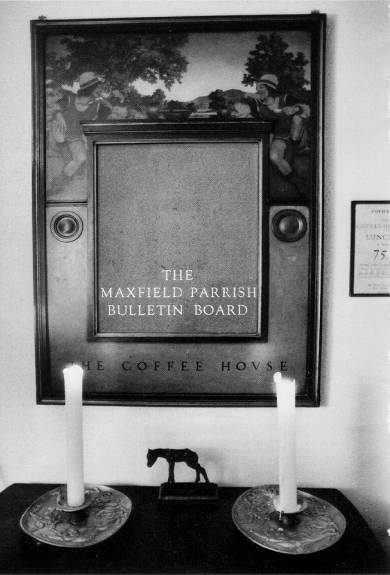
The Maxfield Parrish bulletin board at the Coffee House Club.

The dinner was being held at the Coffee House Club over on West 44th, only a block or so from the hotel, and an easy walk in the brisk February air.  The Coffee House Club is considered a private New York club, but it’s got  an irreverent, tongue-in-cheek outlook that I love. (Its Constitution consists of a half-dozen “commandments”: “No officers, no charge accounts, no liveries, no tips, no set speeches, no rules.”)  It’s also a comfortably unassuming place, just two large rooms — one a reception area, the other a cozy dining hall.

Just inside the door, I met Jill Spiller, the Executive Director of the St. Nicholas Society, who worked hard over the past few months leading up to the evening to take good care of me. True to form, she escorted us into the reception room and put off to one side a nice gift from the St. Nicolas Society, a set of glasses etched with their logo.  Very nice.

The reception was a very classy affair, yet also laid back — St. Nicholas members are genuinely interested in telling and listening to stories, and a well-told story will usually cause an eruption of laughter.  And people had so many different interests that moving from one small circle to another was like entering a live encyclopedia.  Over here, you could talk about astronauts and one man’s collection of space memorabilia.  In this corner, it was about children’s songs.  Over here, people chatted about medicine.  I even found one gentleman who had in his private collection one of my Holy Grails of Washington Irving portraits: a photograph of a painting of Irving’s best friend, Henry Brevoort.  I had scoured the planet looking for a portrait of Brevoort back when I was working on Irving and had no luck — and now here was someone who had one.  It’s wonderful when things like that happen.

After an hour or so at the reception (the hosts had done a good job taking care of Madi, ensuring there was plenty of teen-friendly food and drink), we were gently herded into the main dining hall.  The President of the St. Nicholas Society, Dr. Billick — who is class and charm personified — had gone to great lengths to seat Madi on his left, with me on his right, and Barb right across from us at the horseshoe of tables.  I smiled as Dr. Billick made certain to engage Madi in conversation throughout the meal, offering up history questions, chatting about the European Union (!) and generally making her feel at ease as the only young person in the room.  Not that Madi can’t hold her own in almost any conversation (at one point, someone came up to me, laughing, and said, “After talking with your daughter, I asked her  what she was majoring in.  She told me ‘eighth grade’!”), but it was a lovely gesture on his part, and I so appreciated his effort.

We were still enjoying our dinners when it was time to conduct some business.  Two new members of the St. Nicholas Society were introduced and initiated to much applause.  I was then introduced by longtime member (and fellow New Mexican!) Mr. Hilliard, with Dr. Billick at his side, who stepped to the mike and presented me with their award.

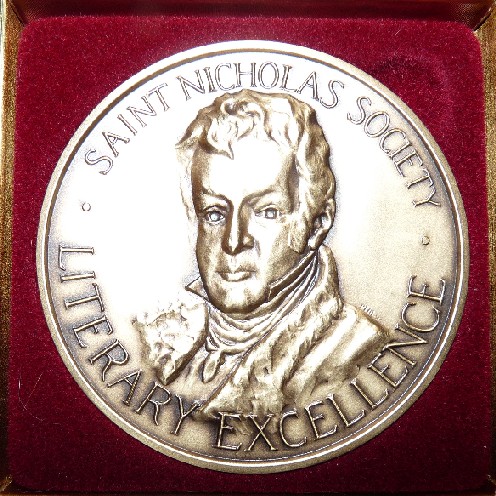
I promised everyone who wrote to me with their good wishes that I would put up a picture of the medal.  Here it is — and it’s a beauty:
I spoke for about twenty minutes, telling one of my all-time favorite Irving stories: the hoax that Irving pulled off to launch his mock history of New York City, and the Dutch reaction to it (someone threatened to horsewhip him). Given the St. Nicholas Society’s mission to preserve and perpetuate New York’s history, I thought such a talk would be appropriate — and I was delighted that it went over so well.  I took questions for about twenty more minutes, then spent the rest of the evening signing books, talking with members, and generally having a terrific time. It was one of the nicest evenings I’ve ever had — and having Barb and Madi there with me to share in it made it that much more special.

It was cold as we stepped out onto 44th for the walk back to our hotel — we had already changed our travel plans to leave early the next morning, in hopes of getting back to Maryland in front of the advancing snowstorm — but we walked slowly, trying to make the evening last even longer.  Our thanks to the St. Nicholas Society for such a remarkable night.

December 1, 1859: An Icon Is Laid To Rest

One hundred and fifty years ago today, American writer Washington Irving was laid to rest at Sleepy Hollow Cemetery in New York. 

Irving had died at his home at Sunnyside three days earlier, felled by a heart attack on the evening of November 28, 1859, at the age of  76. News of his death traveled rapidly down the Hudson River, and was carried by the newly installed telegraph to newspapers across the country.  “Washington Irving is dead!” wrote the editors of the Milwaukee Sentinel. “Who is there that the tidings did not touch with profound sorrow?”

While it is difficult to appreciate Irving’s place in literature and popular culture today, in 1859, Irving embodied both.  As the Father of the American Bestseller, and the creator of literary icons like Ichabod Crane and Rip Van Winkle, Irving was the nation’s most familiar author.  A friend to presidents, kings, artists, and writers, his death was felt, and noted, around the world.

And his funeral?  It was officially An Event. On December 1, 1859, Tarrytown and Sleepy Hollow were swathed in black. Mourners stepped off the train platform at Irvington — formerly the town of Dearman, but renamed years earlier in Irving’s honor — under a black-draped sign.  Businesses in Tarrytown shuttered their windows for the day. The courts in New York City closed deferentially, allowing government officials to attend Irving’s funeral.

At 12:30 p.m., as church bells gonged in New York City, a line of carriages — containing Irving’s body, his family, his doctor, and pallbearers — pulled away from Irving’s home and headed slowly up the road to the Old Dutch Church at Tarrytown.  At the conclusion of the services, Irving lay, as he had requested, in an open casket, allowing more than a thousand mourners to file past and pay their respects.

Irving’s casket was then placed in a coach at the head of a procession of 150 carriages, which slowly made its way up the sloping hill adjacent to the church, toward the Sleepy Hollow Cemetery. “It is a thing that lies near my heart,” Irving had once said of the cemetery. “I hope, some day or other, to sleep my last sleep in that favorite resort of my boyhood.”

The weather that afternoon was, perhaps fittingly, “exquisite.” As hundreds of mourners surged upagainst the iron fence surrounding the gravesite, hoping for a good look, Irving was lowered into the ground, in the spot he had so carefully chosen next to his mother.

Irving was buried beneath a simple headstone, engraved only with his name and dates of birth and death. There is no epitaph.  As I always tell audiences, he has left it for you to discuss and decide his legacy.

In a December 15 speech before the Massachusetts Historical Society, Irving’s friend Henry Wadsworth Longfellow urged his audience to “rejoice in the completeness” of Irving’s life and work, “which, closing together, have left behind them so sweet a fame, and a memory so precious.”

“We feel a just pride in his renown as an author,” continued Longfellow, “not forgetting that, to his other claims upon our gratitude, he adds also that of having been the first to win for our country an honourable name and position in the History of Letters.”

Not bad for the dreamy son of a middle class merchant.

Washington Irving, C Blocker?

Rebecca Gratz

Claire Salisbury — who’s doing terrific work bringing to light the life and letters of the 19th century philanthropist Rebecca Gratz over on her blog,  Rebecca Gratz and 19th Century Americahas two fun entries this week on a a good friend of Rebecca’s . . . an aspiring young writer named Washington Irving.

Irving and Gratz had an interesting and decidedly non-romantic relationship — one based on mutual respect, good conversation, and similar senses of humor.  In fact, there were times when Rebecca used Irving as a willing tool in thwarting the advances of suitors, much to the delight of both.

I’ll let Claire serve as your tour guide for these particular stories (she is, after all, a docent for the Rosenbach Museum and Library in Philadelphia, so you’re in good hands).  The two entries are here and here, and her full blog is here.  Over to you, Claire . . .

Off to Sleepy Hollow…

We’re getting ready to get in the car and head to Sleepy Hollow for the weekend, where the weather forecast for tomorrow is calling for  snow.  But I’ll be at Sunnyside come rain or shine or, er, snow on Saturday.  Come on out and chuck a snowball at me.  Or something.

In the meantime, here’s a short interview with me over at the Hudson Valley blog, where you can hear me talk about Irving as the 19th century Elvis, and who I think would win in a fight between Batman and Spider-Man.

I’ll be back here on Monday with plenty of pictures, I hope.  The Blaze should look particularly creepy in the mist and snow….

“…A Small Elderly Gentleman By the Name of Knickerbocker.”

In her book Knickerbocker: The Myth behind New York — now available from Rutgers Univerity Press — author Elizabeth L. Bradley traces the use of Washington Irving’s fictional historian Diedrich Knickerbocker — the crusty narrator of his 1809 satire A History of New York — as the embodiment of All Things New York.  Here’s Bradley, in a recent piece in the New York Times:

Manhattanites knew little of their Dutch founding fathers, and Irving took advantage of that to create a past that interwove fact and fable; one that presented an appealing portrait of the Dutch colonists as pleasure-loving, pipe-smoking burghers who introduced Santa Claus, doughnuts and diplomacy to America, and let their meandering cows give shape to the streets of Lower Manhattan . . . What Irving did not anticipate was that in the ensuing 200 years, New Yorkers would adopt his imaginary character as an emblem of all that was authentically, emphatically New York . . . generations of New Yorkers recast the Dutchman according to their needs and their times: he became a symbol of nativism and patriotism, of high society and of five-borough consolidation, and he was seized upon to market everything from beer to basketball.

Spot on.  At the time, Irving had no idea he had just created an advertising juggernaut.  But New Yorkers were quick to embrace Knickerbocker — with his unshakable, unimpressed, irreverent attitude — as the ultimate New Yorker, and even in Irving’s lifetime, Diedrich was already a go-to icon for companies seeking to brand themselves and their products as distinctly New York.

In his introduction to the 1848 author’s revised edition, Irving wrote of his amazement at finding his crotchety narrator had “become a ‘household word,’ and used to give the home stamp to every thing recommended for popular acceptation, such as . . . Knickerbocker insurance companies, Knickerbocker bread and Knickerbocker ice.”  Today the name is still used by the city’s professional basketball team, albeit in its more familiar abbreviated form, reading simply KNICKS.

There’s a fun slide show over at the New York Times where Bradley provides a peek at the use of the Knickerbocker name in and around New York, sometimes visible in faded painted lettering for defunct companies, other times still blazing in bright neon letters on restaurants and clubs.  The slide show starts right here, and you can order Bradley’s book here.

Irving, Key, and the National Anthem

In last Friday’s Washington Post, columnist Michael Kinsley grumbled a bit about “The Star-Spangled Banner,” deriding it not only for being unsingable, but too full of warfare and unwarranted jingoism:

The melody is lifted from an old English drinking song. The lyrics are all about bombs and war and bloodshed — and not in a good way. By the penultimate verse, the song has turned really nasty: “No refuge could save the hireling and slave/From the terror of flight or the gloom of the grave.” In the first verse — the one we generally sing — there is only one reference to any value commonly associated with America: “land of the free.” By contrast, “home of the brave” is empty bravado. There is nothing in the American myth (let alone reality) to suggest that we are braver than anyone else.

The entire piece is right here.

Apart from stridently disagreeing with his last sentence, I’ve got a bit of a soft spot for “The Star-Spangled Banner” myself.  For one thing, I share a birthday with its lyricist, Francis Scott Key, one of only two really cool people — Herman Melville being the other — with whom I share a birthday.  When I was about six or seven years old, my Mom ordered for my brother and me one of those “Read About Me” books — where your parents would send information about you to a sort of print-on-demand operation, which would then incorporate all the information about you into an otherwise generic story — and when it got to the page where the narrator discussed famous people with whom you share a birthday, I was stuck with Francis Scott Key.  My brother, meanwhile, got Groucho Marx, a tidbit I was always somewhat jealous of.

Anyway, that’s one of the reasons — although a silly one — that I’ve always admired Baltimore’s unlucky lawyer, caught behind the lines when the shelling started at Fort McHenry.  He may have written a song few people can sing, but at least he had the good taste to be born on August 1.

To my later surprise and delight, however,  I learned there’s also a Washington Irving connection to Key’s poem.  In 1814, Irving was two years into his term as editor of Analectic Magazine. It was a job he was growing increasingly weary of — he particularly hated being a literary critic — but despite his lack of confidence in his abilities, Irving had remarkably good taste when it came to finding new work to publish in his magazine.  And in the December 1814 issue, only three short months after the bombardment of Fort McHenry,  Irving reprinted Key’s lyrics — a four-stanza poem he had titled “Defense of Fort McHenry” — in their entirety.

Irving was not only delighted with Key’s lyrics, he thought they were a fine example of one of his own pet causes: Americans writing their own patriotic poetry, rather than merely rewriting or adapting British poems, as had been the habit.  While Key set his poem to the tune of a popular British drinking song, “Anacreon in Heaven,” the lyrics themselves were new and uniquely American. And as Irving presciently noted in his introduction to Key’s lyrics, “we think that their merit entitles them to preservation in some more permanent form than the columns of a daily paper.”

How right he was.  Key’s lyrics — and the drinking tune to which they were set — officially became our National Anthem in 1931.  Hard to sing?  Sure — but listen how glorious it can sound when done right.  Here’s Whitney Houston kicking off the 1991 Super Bowl, at the height of the Persian Gulf War:

Have a good weekend!

The Sagging Book Market (of 1819)

Think the beating the book market is taking by a slumping economy is a new phenomenon?  Think again. 

Writing in the latest issue of the journal Common-Place, Fordham University professor Edward Cahill discusses how the rise of easy credit in the early nineteenth century led to a devaluing not only of paper money, but eventually of literary currency as well — culminating in the financial panic of 1819 and the collapse of countless booksellers.  Left standing among the debris was Washington Irving’s Sketch Book of Geoffrey Crayon. “But if the appearance of the Sketch Book marked the economic development of American literary culture,” Cahill says, “it was also haunted by widespread economic unrest.” 

Cahill goes on to explain why The Sketch Book was not only a survivor, but also provided elegant commentary on — and a bit of a eulogy for — the early 19th century publishing industry. Eventually, Cahill concludes, “elite literary culture would be inextricably tied to popular culture, despite many protests to the contrary.”   Well put.  Once again, almost in spite of himself, Washington Irving shaped our perceptions of popular culture.

Professor Cahill’s article,  “The Other Panic of 1819: Irving’s Sketch Book, Literary Overproduction, and the Politics of the ‘Purely Literary,'” can be found right here.  Go get it.

Washington Irving, Cultural Continuity, and Iconoclasm

First Things magazine — a magazine and blogging site which calls itself the “Journal of Religion, Culture, and Public Life” — has a really thoughtful piece on Washington Irving, and how Americans would do well not only to re-embrace the man, but to learn from the lessons he taught us:

Washington Irving is of particular importance, especially now that so many of those who howled at the specter of a systemically evil nation are silent at the election of Barack Obama. What will many faculties do, now that their view has been thus radically altered or at least thrown into question? The culture of iconoclasm can only endure so long as one wants to smash an icon. Once one reveres the icon, an inevitable conservatism sets in—there is a natural desire to preserve memories and eventually even the traditions and institutions recognized as having been virtuous.

Intrigued?  You should be.  You can get the rest of it right here.  And my thanks to Eric Seddon at First Things for his column — and for the very kind tip of the hat in the first paragraph.  I’m delighted to be considered one of the “saner minds.”

Cold Hands, Good Company

It’s been a cold and windy week here in Maryland — made even colder by the little tease of Spring weather we’ve had over the past few weeks, where you can walk the dog, run to the store, or get the mail without needing your coat.  This week, though, just running from the house to the car makes your cheeks sting and your fingertips burn.  Each evening I build a fire in the living room fireplace and press my nose against the front window, staring at the dead flowerbeds and counting the weeks until I can go out and start playing in the mud again.

The crafty Aaron Burr.

The crafty Aaron Burr.

Meanwhile, I’m having lunch today with David O. Stewart, whose book The Summer of 1787 made the proceedings of the Constitutional Convention read like a great suspense novel.  David’s presently hard at work on a book about Aaron Burr and the comedy of errors that was the Burr Conspiracy, and he’s being either kind enough or crazy enough to ask me to blather on at length about Washington Irving and his relationship with Burr, and Irving’s observations as a semi-official correspondent at Burr’s trial in 1807.  Plus, David’s just plain good company, so it’s pretty much a double bonus for me.

Oh, and I’d be remiss if I didn’t mention that David’s latest book, Impeached: The Trial of President Andrew Johnson and the Fight for Lincoln’s Legacy hits bookstores on May 12.  You can advance order a copy here.

Celebrating a Dark Genius

poeJanuary 19, 2009, marks the 200th anniversary of the birth of Edgar Allan Poe, one of America’s most celebrated authors, poets, essayists, and editors.  I’m lucky enough to be in Richmond, Virginia, today — which, along with Baltimore, serves as Poe Central — and while I’m here for my daughter’s volleyball tournament, I’m hoping our schedule will allow a bit of time for us to catch some of the Poe celebration and a trip to the Poe Museum.  (And if you happen to be in the area and are looking for things to do, the State of Virginia has a special website commemorating all things Poe.  Or, at least, All Things Poe in Virginia.)
While I’m not what you’d call a Poe Scholar, I’m a huge Poe Fan.   His short story “The Black Cat” was the first Poe story I ever read — I think I was 12 — and it scared the daylights out of me.  With its unstable narrator — who gouges out the cat’s eye with a pen-knife, then later hangs it from a tree — images of a hanged cat etched into the plaster in the remains of the narrator’s burnt house, and the narrator suddenly burying an axe in his wife’s skull,  there’s enough going on to keep you huddled under the covers for weeks.  But then add to that Poe’s  punchline, the last line of the story — “I had walled the monster up within the tomb!” — and . . . well, it’s a moment in American literature that leaves you feeling deliciously cold, as if you’ve just swallowed an entire Slurpee in one gulp.  The brain freeze is totally worth it.

One of the great thrills of Washington Irving was writing those moments when the ambitious and somewhat crafty Edgar Allan Poe entered Irving’s story.  Sure it’s non-fiction — but just as fiction writers love to play with great characters, so, too, do we Nonfictionalists.  And really, you’d be hard pressed to find a more compelling real-life character to write than Poe.

Irving had actually met Poe in London in 1819, when the ten-year-old Poe was travelling in Europe with his foster father, John Allan, and Irving — basking in the early glow of the success of The Sketch Book but hungry for the company of fellow Americans — dined with Allan and his ward at the York Chop House. 

Poe remained an admirer of Irving’s writings — at least for a while — and as a writer for the Southern Literary Messenger, inked one of the many glowing reviews of Irving’s 1835 work, The Crayon Miscellany.  As an up-and-coming new writer, Poe was also shrewd enough to recognize that Irving’s endorsement of his work would give him credibility with editors and reviewers, many of whom were baffled by Poe’s markedly dark voice and tone.

In October 1839, Poe — behind flattering cover letters — sent Irving copies of two of his latest stories, “The Fall of the House of Usher” and “William Wilson,” hoping for a kind word — a usable “cover blurb,” to put it in today’s terms.  Though the tone and content of both stories wasn’t really Irving’s cup of tea, he nonetheless read both tales, and wrote Poe with his comments.

Of the two stories, Irving preferred “William Wilson.” “It is managed in a highly picturesque Style and the Singular and Mysterious interest is well sustained throughout,” he told Poe. “Usher,” however, he thought was a bit of a mess.  It might be improved, he told Poe, “by relieving the style from some of the epithets.”

Not exactly a ringing endorsement, but it was enough for the shrewd Poe. “I am sure you will be pleased to hear that Washington Irving has addressed me 2 letters, abounding in high passages of compliment in regard to my Tales—passages which he desires me to make public—if I think benefit may be derived,” Poe wrote to one colleague. “Irving’s name,” he continued, in tones suitable for a Marvel Comics Super Villain, “will afford me a complete triumph over those little critics who would endeavor to put me down by raising hue and cry of exaggeration in style, of Germanism & such twaddle.”

Clearly Poe was not above publicly exploiting Irving’s reputation to further his own career.  Privately, though, Poe considered Irving “overrated” and argued that much of his reputation was based solely on the fact that Irving was the first American writer to earn international fame and praise.  “A nice distinction might be drawn,” Poe wrote, “between [Irving’s] just and surreptitious and adventitious reputation—between what is due to the pioneer solely, and what to the writer.”

Take a moment today to celebrate the life of America’s first, and still favorite, dark and crafty genius.  Despite everything, Washington Irving wouldn’t mind a bit.