Tag Archives: Washington Irving

Thanks For The Kind Words…

During the final week of 2008, Friend o’ the Blog and Feared Book Reviewer Josephine Damian spent several days over on her blog discussing what she considered the Best Books She Read During 2008. And what do you think was her pick for the best non-fiction book of the year?

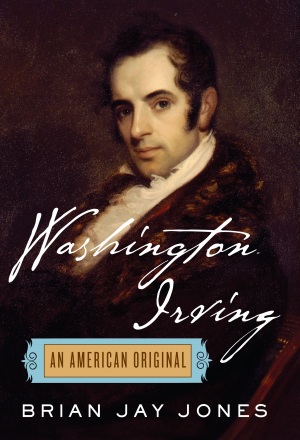
Well, it was Gabriel Garcia Marquez’s News of a Kidnapping. But to my delight — and complete surprise — Washington Irving: An American Original was a close second. Hey, runner up to a Nobel Prize winner? I’ll take that any day, thanks.

And to Josie: a big mea culpa for not posting this earlier. I e-mailed her to thank her for the kind words, then didn’t get back here to post it.

Thanks again, JD. I truly appreciate it.

Christmas Dinner

Happy Holidays! As promised, here are some highlights from Washington Irving’s 1820 short story “Christmas Dinner.” Enjoy.

The dinner was served up in the great hall, where the squire always held his Christmas banquet. A blazing crackling fire of logs had been heaped on to warm the spacious apartment, and the flame went sparkling and wreathing up the wide-mouthed chimney. The great picture of the crusader and his white horse had been profusely decorated with greens for the occasion, and holly and ivy had like-wise been wreathed round the helmet and weapons on the opposite wall, which I understood were the arms of the same warrior . . . A sideboard was set out just under this chivalric trophy, on which was a display of plate that might have vied (at least in variety) with Belshazzar’s parade of the vessels of the temple: “flagons, cans, cups, beakers, goblets, basins, and ewers,” the gorgeous utensils of good companionship that had gradually accumulated through many generations of jovial housekeepers. Before these stood the two Yule candles, beaming like two stars of the first magnitude; other lights were distributed in branches, and the whole array glittered like a firmament of silver.

We were ushered into this banqueting scene with the sound of minstrelsy, the old harper being seated on a stool beside the fireplace and twanging, his instrument with a vast deal more power than melody. Never did Christmas board display a more goodly and gracious assemblage of countenances; those who were not handsome were at least happy, and happiness is a rare improver of your hard-favored visage. . . .

The parson said grace, which was not a short familiar one, such as is commonly addressed to the Deity in these unceremonious days, but a long, courtly, well-worded one of the ancient school. There was now a pause, as if something was expected, when suddenly the butler entered the hall with some degree of bustle: he was attended by a servant on each side with a large wax-light, and bore a silver dish on which was an enormous pig’s head decorated with rosemary, with a lemon in its mouth, which was placed with great formality at the head of the table. The moment this pageant made its appearance the harper struck up a flourish; at the conclusion of which the young Oxonian, on receiving a hint from the squire, gave, with an air of the most comic gravity, an old carol, the first verse of which was as follows

Caput apri defero
Reddens laudes Domino.
The boar’s head in hand bring I,
With garlands gay and rosemary.
I pray you all synge merily
Qui estis in convivio.

Though prepared to witness many of these little eccentricities, from being apprised of the peculiar hobby of mine host, yet I confess the parade with which so odd a dish was introduced somewhat perplexed me, until I gathered from the conversation of the squire and the parson that it was meant to represent the bringing in of the boar’s head, a dish formerly served up with much ceremony and the sound of minstrelsy and song at great tables on Christmas Day. “I like the old custom,” said the squire, “not merely because it is stately and pleasing in itself, but because it was observed at the college at Oxford at which I was educated. When I hear the old song chanted it brings to mind the time when I was young and gamesome, and the noble old college hall, and my fellow-students loitering about in their black gowns; many of whom, poor lads! are now in their graves.”

The parson, however, whose mind was not haunted by such associations, and who was always more taken up with the text than the sentiment, objected to the Oxonian’s version of the carol, which he affirmed was different from that sung at college. He went on, with the dry perseverance of a commentator, to give the college reading, accompanied by sundry annotations, addressing himself at first to the company at large; but, finding their attention gradually diverted to other talk and other objects, he lowered his tone as his number of auditors diminished, until he concluded his remarks in an under voice to a fat-headed old gentleman next him who was silently engaged in the discussion of a huge plateful of turkey.

The old ceremony of serving up the boar’s head on Christmas Day is still observed in the hall of Queen’s College, Oxford. I was favored by the parson with a copy of the carol as now sung, and as it may be acceptable to such of my readers as are curious in these grave and learned matters, I give it entire:

The boar’s head in hand bear I, Bodeck’d with bays and rosemary

The table was literally loaded with good cheer, and presented an epitome of country abundance in this season of overflowing larders. A distinguished post was allotted to “ancient sirloin,” as mine host termed it, being, as he added, “the standard of old English hospitality, and a joint of goodly presence, and full of expectation.” There were several dishes quaintly decorated, and which had evidently something traditional in their embellishments, but about which, as I did not like to appear overcurious, I asked no questions.

[…]

When the cloth was removed the butler brought in a huge silver vessel of rare and curious workmanship, which he placed before the squire. Its appearance was hailed with acclamation, being the Wassail Bowl, so renowned in Christmas festivity. The contents had been prepared by the squire himself; for it was a beverage in the skilful mixture of which he particularly prided himself, alleging that it was too abstruse and complex for the comprehension of an ordinary servant. It was a potation, indeed, that might well make the heart of a toper leap within him, being composed of the richest and raciest wines, highly spiced and sweetened, with roasted apples bobbing about the surface.

The old gentleman’s whole countenance beamed with a serene look of indwelling delight as he stirred this mighty bowl. Having raised it to his lips, with a hearty wish of a merry Christmas to all present, he sent it brimming round the board, for every one to follow his example, according to the primitive style, pronouncing it “the ancient fountain of good feeling, where all hearts met together.”

[…]

Here’s “The Christmas Dinner” in its entirety. Interestingly, when Irving reprinted his Christmas stories nearly forty years later, he added the following postscript:

At the time of the first publication of this paper the picture of an old-fashioned Christmas in the country was pronounced by some as out of date. The author had afterwards an opportunity of witnessing almost all the customs above described, existing in unexpected vigor in the skirts of Derbvshire and Yorkshire, where he passed the Christmas holidays. The reader will find some notice of them in the author’s account of his sojourn at Newstead Abbey.

But enough of Christmas and its gambols; it is time for me to pause in this garrulity. Methinks I hear the questions asked by my graver readers, “To what purpose is all this? how is the world to be made wiser by this talk?” Alas! is there not wisdom enough extant for the instruction of the world? And if not, are there not thousands of abler pens laboring for its improvement? It is so much pleasanter to please than to instruct–to play the companion rather than the preceptor.

What, after all, is the mite of wisdom that I could throw into the mass of knowledge! or how am I sure that my sagest deductions may be safe guides for the opinions of others? But in writing to amuse, if I fail the only evil is in my own disappointment. If, however, I can by any lucky chance, in these days of evil, rub out one wrinkle from the brow of care or beguile the heavy heart of one moment of sorrow; if I can now and then penetrate through the gathering film of misanthropy, prompt a benevolent view of human nature, and make my reader more in good-humor with his fellow-beings and himself — surely, surely, I shall not then have written entirely in vain.

At this time of year, we couldn’t ask for much more than to “rub out one wrinkle from the brow of care.”

Merry Christmas. Take care of each other.

Christmas Eve

For your holiday reading, here’s an excerpt from Washington Irving’s 1820 short story “Christmas Eve,” lifted from the pages of The Sketch Book of Geoffrey Crayon, Gent.

And remember what I told you here yesterday: when Irving tells you something is “ancient custom,” he is not to be trusted. The rogue.

Anyway. Here we go:

The grate had been removed from the wide overwhelming fireplace to make way for a fire of wood, in the midst of which was an enormous log glowing and blazing, and sending forth a vast volume of light and heat: this, I understood, was the Yule-clog, which the squire was particular in having brought in and illumined on a Christmas Eve, according to ancient custom.

The Yule-clog is a great log of wood, sometimes the root of a tree, brought into the house with great ceremony on Christmas Eve, laid in the fireplace, and lighted with the brand of last year’s clog. While it lasted there was great drinking, singing, and telling of tales. Sometimes it was accompanied by Christmas candles; but in the cottages the only light was from the ruddy blaze of the great wood fire. The Yule-clog was to burn all night; if it went out, it was considered a sign of ill luck.

Herrick mentions it in one of his songs:

Come, bring with a noise, My metric, merrie boys,
The Christmas Log to the firing;
While my good dame, she Bids ye all be free,
And drink to your hearts’ desiring.

The Yule-clog is still burnt in many farm-houses and kitchens in England, particularly in the north, and there are several superstitions connected with it among the peasantry. If a squinting person come to the house while it is burning, or a person barefooted, it is considered an ill omen. The brand remaining from the Yule-clog is carefully put away to light the next year’s Christmas fire.

[…]

Supper was announced shortly after our arrival. It was served up in a spacious oaken chamber, the panels of which shone with wax, and around which were several family portraits decorated with holly and ivy. Besides the accustomed lights, two great wax tapers, called Christmas candles, wreathed with greens, were placed on a highly polished beaufet among the family plate. The table was abundantly spread with substantial fare; but the squire made his supper of frumenty, a dish made of wheat cakes boiled in milk with rich spices, being a standing dish in old times for Christmas Eve. I was happy to find my old friend, minced pie, in the retinue of the feast and, finding him to be perfectly orthodox, and that I need not be ashamed of my predilection, I greeted him with all the warmth wherewith we usually greet an old and very genteel acquaintance.

. . . no sooner was supper removed and spiced wines and other beverages peculiar to the season introduced, than Master Simon was called on for a good old Christmas song. He bethought himself for a moment, and then, with a sparkle of the eye and a voice that was by no means bad, excepting that it ran occasionally into a falsetto like the notes of a split reed, he quavered forth a quaint old ditty:

Now Christmas is come,
Let us beat up the drum,
And call all our neighbors together;
And when they appear,
Let us make them such cheer,
As will keep out the wind and the weather, &c.

The supper had disposed every one to gayety, and an old harper was summoned from the servants’ hall, where he had been strumming all the evening, and to all appearance comforting himself with some of the squire’s home-brewed. He was a kind of hanger-on, I was told, of the establishment, and, though ostensibly a resident of the village, was oftener to be found in the squire’s kitchen than his own home, the old gentleman being fond of the sound of “harp in hall.”

The dance, like most dances after supper, was a merry one: some of the older folks joined in it, and the squire himself figured down several couple with a partner with whom he affirmed he had danced at every Christmas for nearly half a century. . . .

[…]

The party now broke up for the night with the kind-hearted old custom of shaking hands. As I passed through the hall on my way to my chamber, the dying embers of the Yule-clog still sent forth a dusky glow, and had it not been the season when “no spirit dares stir abroad,” I should have been half tempted to steal from my room at midnight and peep whether the fairies might not be at their revels about the hearth.

My chamber was in the old part of the mansion, the ponderous furniture of which might have been fabricated in the days of the giants. The room was panelled, with cornices of heavy carved work, in which flowers and grotesque faces were strangely intermingled, and a row of black-looking portraits stared mournfully at me from the walls. The bed was of rich thought faded damask, with a lofty tester, and stood in a niche opposite a bow window. I had scarcely got into bed when a strain of music seemed to break forth in the air just below the window. I listened, and found it proceeded from a band which I concluded to be the Waits from some neighboring village. They went round the house, playing under the windows. I drew aside the curtains to hear them more distinctly. The moonbeams fell through the upper part of the casement; partially lighting up the antiquated apartment. The sounds, as they receded, became more soft and aerial, and seemed to accord with the quiet and moonlight. I listened and listened–they became more and more tender and remote, and, as they gradually died away, my head sunk upon the pillow and I fell asleep.

Tomorrow: Irving’s “Christmas Dinner.” Meanwhile, here’s “Christmas Eve” in its entirety. Go read it. It’ll make your day.

Father Christmas and Secret Origins

When I give talks about Washington Irving, inevitably, one of the first questions I get is, “Why did you choose Irving as your subject?” And my answer is, “Because I’m a Christmas junkie.”

About ten years ago, while browsing the paperbacks table at Trover Books on Capitol Hill, I came across Stephen Nissenbaum’s The Battle for Christmas, a book that — according to its back cover — “charts the invention of our current yuletide traditions, from St. Nicholas to the Christmas tree and, perhaps most radically, the practice of giving gifts to children.” That was enough for me. I paid at the register and it was mine.

Niseenbaum’s book is terrific for a number of reasons — if you’re even remotely interested in folklore, early American culture, or Christmas, I strongly encourage you to read it — and it goes a long way toward debunking some of the common mis-perceptions about my favorite holiday. For example, you’ll read how Christmas was actually outlawed in the United States until the early 19th century, mainly because Americans used the day as an opportunity to eat and drink to excess, then would go out and sing loudly, demanding food and drink of neighbors — and any neighbor who failed to deliver the goods risked being dragged out of the house and beaten up. Hence the lines in “We Wish You A Merry Christmas” in which carolers demand figgy pudding (“Bring some out here!”) and then declare that they “won’t go until we get some!”

But where the book really shines, however, is in its discussion of the dewy-eyed images of Christmas we Americans have conjured up and embraced as our own. All those Currier & Ives images, Nissenbaum tells us — sleigh rides over icy ponds, Yule logs burning in the fireplace, Santa Claus soaring over the treetops, children waking early and eagerly Christmas morning, and rambunctious Christmas dinner parties — never existed. They weren’t part of old English tradition, they were simply made up by an American writer named . . . Washington Irving.

Well. That was news to me, so I went out and looked for Irving’s Christmas stories. As it turns out, most of them are hiding in plain sight, right smack in the middle of The Sketch Book of Geoffrey Crayon, Gent., Irving’s collection of short stories and essays that’s remembered for “Rip Van Winkle” and “The Legend of Sleepy Hollow,” and, alas, not much else. But never mind.

In that section — five short stories in which Irving’s narrator, Geoffrey Crayon, experiences Christmas Eve and day in the home of Squire Bracebridge — Irving all but creates our modern day Christmas. Yule logs crackle in the fireplace, children sing carols on Christmas morning, good looking couples dance in old houses crammed with antique furniture, and on Christmas Day, the extended family surrounds an enormous table groaning under roast beef and turkey, puddings, and foaming tankards of beer. Squire Bracebridge, we’re told, celebrates Christmas in the old style — except it’s also made clear, through winks and a sly gesture that involves laying one’s finger on the side of one’s nose — that the Squire hasn’t quite got his facts right. But all is still right with the world.

I read Irving’s Christmas stories — which I’ll tell you more about — and loved them. Then I read some more Irving, and loved that, too. What surprised me most was his voice: this was no stilted, Puritan, 19th century prose; it was chatty, charming, and completely relaxed. And the more I read, the more I wanted to know about this guy. So I looked, and looked, and looked . . . and there wasn’t a thing available.

Finally, I found what was considered to be the last word on Irving, a 1935, two-volume biography by Yale English professor Stanley Williams. While the Williams biography is thorough, it’s clear that the more Williams wrote, the more he decided he didn’t like Irving very much. He regarded him as lazy, dopey, a hack, and mostly lucky — a writer who only succeeded when the competition was sparse. It wasn’t really the book I wanted to read.

So, borrowing a lesson from David McCullough — who, I think, borrowed it from Thorton Wilder — I decided to write the book I wanted to read — one that looked at Irving with a more modern eye, was more understanding and forgiving of his flaws, and which appreciated just how hard the guy had to work to succeed in a time when, yes, there was no competition, but there were also very few role models.

And it all started because of my love of Christmas. Really.

Topping It Off at the Pasatiempo

My pal Brian D. informed me that there’s an interview with me in Pasatiempo, the arts magazine of the Santa Fe New Mexican. It’s actually the transcript of a conversation I had over the phone with reporter Craig Smith about ten months ago, as I was stuck in traffic. It’s also one of the first interviews I ever did — at least sitting on the business end of the microphone — and I think the jitters show, since I tend to ramble a bit from each question.

There’s one funny moment, though, right at the end of the discussion, where a misheard, mis-transcribed word, makes things sound rather dirty:

The other thing I would really hope comes through in the book is how hard this guy really had to work. If you see his letters, he didn’t spell very well; it’s why I wanted to print his letters as they are. He had to work hard to make his writing work. He took it very seriously.

While people thought he was writing this elegant prose and topping it off, he was humping.

Actually, what I said was “tossing it off,” not “topping.” But paired with the term “humping,” it probably sounds more interesting that way.

Here’s the link to Pasatiempo, but it’s a bit of a mess navigating the pages. If you’re so inclined, I’m on pages 32-34. At some point, I’ll put a (corrected) transcript up on my main website.

The Real “Legend of Sleepy Hollow”

As I discussed here yesterday, Washington Irving’s tale “The Legend of Sleepy Hollow” is one of those true rarities in American literature — a tale nearly all of us can summarize, even if we’ve never read the original story.

Or can we?

Most of us recall Irving’s tale mainly through a series of strong visual images: Ichabod Crane on horseback, looking like a scarecrow on a hobby horse. Ichabod Crane dancing gawkily with Katrina Van Tassel. Crane spurring his horse Gunpowder through darkened woods, with the Headless Horseman in hot pursuit. And, perhaps the sharpest picture — thanks largely to Walt Disney — a pumpkin hurled straight at Ichabod Crane’s own head.

Irving — who called his tale merely a band connecting a series of “descriptions of scenery, customs, manners, etc.” — would likely be delighted that so many of his mere “descriptions” have been burnt into our brains. But what we’ve buried among those strong visuals is the tale itself, which unfolds in a slightly different manner than we may remember, and ends with a bit of a twist and a flourish.

Let’s revisit Irving’s “Legend” — or maybe you’ll be visiting it for the first time — and experience his tale as Irving really wrote it. I think you’ll find it’s just as good, if not better, than the way we think we remember it.

Much of “Sleepy Hollow” is actually set-up for the climactic chase, and Irving devotes pages to descriptions of his characters — especially Ichabod Crane — and their motivations. Here’s Irving describing the physical traits of his gawky school teacher — and you can see why this was a no-brainer for a Disney animator:

He was tall, but exceedingly lank, with narrow shoulders, long arms and legs, hands that dangled a mile out of his sleeves, feet that might have served for shovels, and his whole frame most loosely hung together. His head was small, and flat at top, with huge ears, large green glassy eyes, and a long snipe nose, so that it looked like a weather-cock perched upon his spindle neck to tell which way the wind blew. To see him striding along the profile of a hill on a windy day, with his clothes bagging and fluttering about him, one might have mistaken him for the genius of famine descending upon the earth, or some scarecrow eloped from a cornfield.

Next, Irving makes certain we understand that Crane is easily spooked and has a whiff of nervous-nelly about him, information we need for later:

…as he wended his way by swamp and stream and awful woodland, to the farmhouse where he happened to be quartered, every sound of nature, at that witching hour, fluttered his excited imagination . . . and if, by chance, a huge blockhead of a beetle came winging his blundering flight against him, the poor varlet was ready to give up the ghost, with the idea that he was struck with a witch’s token….

…How often was he appalled by some shrub covered with snow, which, like a sheeted spectre, beset his very path! How often did he shrink with curdling awe at the sound of his own steps on the frosty crust beneath his feet; and dread to look over his shoulder, lest he should behold some uncouth being tramping close behind him! And how often was he thrown into complete dismay by some rushing blast, howling among the trees, in the idea that it was the Galloping Hessian on one of his nightly scourings!

Now enters the love interest of the tale, Katrina Van Tassel, “a blooming lass of fresh eighteen,” Irving says, “plump as a partridge; ripe and melting and rosy-cheeked as one of her father’s peaches, and universally famed, not merely for her beauty, but her vast expectations.” Not quite a “huge tracts of land” joke, but close. Anyway, Irving then establishes that Ichabod Crane’s interests toward Katrina aren’t based purely on the power of her looks or personality:

…as he rolled his great green eyes over the fat meadow lands, the rich fields of wheat, of rye, of buckwheat, and Indian corn, and the orchards burdened with ruddy fruit, which surrounded the warm tenement of Van Tassel, his heart yearned after the damsel who was to inherit these domains, and his imagination expanded with the idea, how they might be readily turned into cash, and the money invested in immense tracts of wild land, and shingle palaces in the wilderness.

Vying for Katrina’s hand — and making up the third point in the tale’s love triangle — is the brash Brom Bones. While we likely remember Brom as either the bullying blowhard from the Disney cartoon, or the sulky Captain of the Football Team from the Tim Burton film, in Irving’s original tale, Brom is actually a rather likeable rogue:

He was always ready for either a fight or a frolic; but had more mischief than ill-will in his composition; and with all his overbearing roughness, there was a strong dash of waggish good humor at bottom . . . The neighbors looked upon him with a mixture of awe, admiration, and good-will; and, when any madcap prank or rustic brawl occurred in the vicinity, always shook their heads, and warranted Brom Bones was at the bottom of it.

Irving has neatly set up the two rivals competing for the hand of the love interest — now it’s time to bring them together. In “Sleepy Hollow,” Irving brings Ichabod and Brom to the Van Tassel home for an evening dinner and dance — and where Ichabod listens to some of Sleepy Hollow’s “sager folks” telling ghost stories. Here’s Irving setting up the appearance of the Headless Horseman, as well as the rules of the coming chase. And you might want to check the doors and windows before you read it:

The chief part of the stories, however, turned upon the favorite spectre of Sleepy Hollow, the Headless Horseman, who had been heard several times of late, patrolling the country; and, it was said, tethered his horse nightly among the graves in the churchyard.

The sequestered situation of this church seems always to have made it a favorite haunt of troubled spirits. It stands on a knoll, surrounded by locust-trees and lofty elms, from among which its decent, whitewashed walls shine modestly forth, like Christian purity beaming through the shades of retirement. A gentle slope descends from it to a silver sheet of water, bordered by high trees, between which, peeps may be caught at the blue hills of the Hudson. To look upon its grass-grown yard, where the sunbeams seem to sleep so quietly, one would think that there at least the dead might rest in peace. On one side of the church extends a wide woody dell, along which raves a large brook among broken rocks and trunks of fallen trees. Over a deep black part of the stream, not far from the church, was formerly thrown a wooden bridge; the road that led to it, and the bridge itself, were thickly shaded by overhanging trees, which cast a gloom about it, even in the daytime; but occasioned a fearful darkness at night. Such was one of the favorite haunts of the Headless Horseman, and the place where he was most frequently encountered. The tale was told of old Brouwer, a most heretical disbeliever in ghosts, how he met the Horseman returning from his foray into Sleepy Hollow, and was obliged to get up behind him; how they galloped over bush and brake, over hill and swamp, until they reached the bridge; when the Horseman suddenly turned into a skeleton, threw old Brouwer into the brook, and sprang away over the tree-tops with a clap of thunder.

We’re approaching the climax. With the party over, Ichabod Crane — who we’ve already seen is a nervous wreck about the dark — rides away on his horse, Gunpowder. Here’s how Irving describes the night, so effectively that you can practically feel the chill and hear the sounds. If this isn’t a Halloween night, I don’t know what is:

It was the very witching time of night that Ichabod, heavy-hearted and crestfallen, pursued his travels homewards, along the sides of the lofty hills which rise above Tarry Town, and which he had traversed so cheerily in the afternoon. The hour was as dismal as himself. Far below him the Tappan Zee spread its dusky and indistinct waste of waters, with here and there the tall mast of a sloop, riding quietly at anchor under the land. In the dead hush of midnight, he could even hear the barking of the watchdog from the opposite shore of the Hudson; but it was so vague and faint as only to give an idea of his distance from this faithful companion of man. Now and then, too, the long-drawn crowing of a cock, accidentally awakened, would sound far, far off, from some farmhouse away among the hills—but it was like a dreaming sound in his ear. No signs of life occurred near him, but occasionally the melancholy chirp of a cricket, or perhaps the guttural twang of a bullfrog from a neighboring marsh, as if sleeping uncomfortably and turning suddenly in his bed.

[. . .]

He was, moreover, approaching the very place where many of the scenes of the ghost stories had been laid. In the centre of the road stood an enormous tulip-tree, which towered like a giant above all the other trees of the neighborhood, and formed a kind of landmark. Its limbs were gnarled and fantastic, large enough to form trunks for ordinary trees, twisting down almost to the earth, and rising again into the air . . . As he approached a little nearer, he thought he saw something white, hanging in the midst of the tree: he paused and ceased whistling but, on looking more narrowly, perceived that it was a place where the tree had been scathed by lightning, and the white wood laid bare. Suddenly he heard a groan — his teeth chattered, and his knees smote against the saddle: it was but the rubbing of one huge bough upon another, as they were swayed about by the breeze. He passed the tree in safety, but new perils lay before him.

As a famous television ghost hunter might say: Zoinks! And now, Irving unveils his ghost, giving him a casual entrance that may leave readers feeling as if they’ve just swallowed a whole snow cone:

In the dark shadow of the grove, on the margin of the brook, he beheld something huge, misshapen and towering. It stirred not, but seemed gathered up in the gloom, like some gigantic monster ready to spring upon the traveller.

. . . Though the night was dark and dismal, yet the form of the unknown might now in some degree be ascertained. He appeared to be a horseman of large dimensions, and mounted on a black horse of powerful frame.

… On mounting a rising ground, which brought the figure of his fellow-traveller in relief against the sky, gigantic in height, and muffled in a cloak, Ichabod was horror-struck on perceiving that he was headless! —- but his horror was still more increased on observing that the head, which should have rested on his shoulders, was carried before him on the pommel of his saddle!

And away we go, in the mad dash through the woods, as Ichabod sprints for the church bridge — which, you remember, it was established the Horseman cannot cross! — and nearly falls off his horse in the process:

His terror rose to desperation; he rained a shower of kicks and blows upon Gunpowder, hoping by a sudden movement to give his companion the slip; but the spectre started full jump with him. Away, then, they dashed through thick and thin; stones flying and sparks flashing at every bound. Ichabod’s flimsy garments fluttered in the air, as he stretched his long lank body away over his horse’s head, in the eagerness of his flight.

As yet the panic of the steed had given his unskilful rider an apparent advantage in the chase, but just as he had got half way through the hollow, the girths of the saddle gave way, and he felt it slipping from under him. He seized it by the pommel, and endeavored to hold it firm, but in vain; and had just time to save himself by clasping old Gunpowder round the neck, when the saddle fell to the earth, and he heard it trampled under foot by his pursuer…

An opening in the trees now cheered him with the hopes that the church bridge was at hand . . . “If I can but reach that bridge,” thought Ichabod, “I am safe.” Just then he heard the black steed panting and blowing close behind him; he even fancied that he felt his hot breath . . .

Ichabod and Gunpowder finally make the church bridge . . . only to discover that the Horseman isn’t about to play by the rules — and provides poor Ichabod, and readers, with one of the most memorable departing gifts in literature:

Gunpowder sprang upon the bridge; he thundered over the resounding planks; he gained the opposite side; and now Ichabod cast a look behind to see if his pursuer should vanish, according to rule, in a flash of fire and brimstone. Just then he saw the goblin rising in his stirrups, and in the very act of hurling his head at him. Ichabod endeavored to dodge the horrible missile, but too late. It encountered his cranium with a tremendous crash,—he was tumbled headlong into the dust, and Gunpowder, the black steed, and the goblin rider, passed by like a whirlwind.

End of story? Not quite — and here’s the part most of us don’t remember. Irving actually gives us three denouements to choose from — the first of which is the creepier, Hammer horror film ending:

The next morning the old horse was found without his saddle, and with the bridle under his feet, soberly cropping the grass at his master’s gate…In one part of the road leading to the church was found the saddle trampled in the dirt; the tracks of horses’ hoofs deeply dented in the road, and evidently at furious speed, were traced to the bridge, beyond which, on the bank of a broad part of the brook, where the water ran deep and black, was found the hat of the unfortunate Ichabod, and close beside it a shattered pumpkin.

The brook was searched, but the body of the schoolmaster was not to be discovered . . .

Don’t like that one? Here’s the second:

It is true, an old farmer, who had been down to New York on a visit several years after, and from whom this account of the ghostly adventure was received, brought home the intelligence that Ichabod Crane was still alive; that he had left the neighborhood partly through fear of the goblin and … that he had changed his quarters to a distant part of the country; had kept school and studied law at the same time; had been admitted to the bar; turned politician; electioneered; written for the newspapers; and finally had been made a justice of the Ten Pound Court.

Did Ichabod Crane really survive his midnight ride through Sleepy Hollow, then? If so, was there really a Headless Horseman? And what became of Brom Bones and Katrina Van Tassel? Irving answers our questions in the story’s true payoff:

Brom Bones, too, who, shortly after his rival’s disappearance conducted the blooming Katrina in triumph to the altar, was observed to look exceedingly knowing whenever the story of Ichabod was related, and always burst into a hearty laugh at the mention of the pumpkin; which led some to suspect that he knew more about the matter than he chose to tell.

Despite the punchline, Irving can’t resist wrapping up his story with a creepy flourish, swirling his cloak about him as he ends his tale and disappears into the fog:

The old country wives, however, who are the best judges of these matters, maintain to this day that Ichabod was spirited away by supernatural means; and it is a favorite story often told about the neighborhood round the winter evening fire. The bridge became more than ever an object of superstitious awe; and that may be the reason why the road has been altered of late years, so as to approach the church by the border of the millpond. The schoolhouse being deserted soon fell to decay, and was reported to be haunted by the ghost of the unfortunate pedagogue and the plowboy, loitering homeward of a still summer evening, has often fancied his voice at a distance, chanting a melancholy psalm tune among the tranquil solitudes of Sleepy Hollow.

You can read “The Legend of Sleepy Hollow” in its entirety by clicking here. And please do.

Have a happy Halloween.
A Spooky Sleeper of a Tale…

Tomorrow is Halloween, which means it’s time to re-read one of the classics of American literature, “The Legend of Sleepy Hollow.” Pull your copy down off the shelf, and turn to pa . . . what’s that? You don’t own a copy? You’ve never even read it?

It’s okay.

Washington Irving’s “The Legend of Sleepy Hollow” is one of the great sleeper hits in American literature, a story whose elements stay in our collective American consciousness even as the book itself fades from college and high school syllabi or other reading lists. As I say often, it’s become such a part of our American DNA that most of us can summarize the story even if we’ve never read it.

“The Legend of Sleepy Hollow” made its first appearance on March 15, 1820, as the third and final story in the sixth installment of The Sketch Book of Geoffrey Crayon, Gent., a collection of short stories and essays that Irving had been publishing at irregular intervals since June 1819. “It is a random thing,” Irving said of his tale of Ichabod Crane, “suggested by recollections and scenes and stories about [Tarrytown, New York]. The story is a mere whimsical band to connect descriptions of scenery, customs, manners, etc.”

While “Sleepy Hollow” takes most of its basic plot elements from Dutch and German folklore, it can rightly be called our first true American ghost story. Irving not only gives his tale a unique American setting, with distinctly American references (he mentions, for example, the tree where the spy John Andre was hanged during the American Revolution, and Ichabod Crane is said to be from Connecticut), but he tells the tale in a uniquely American voice — funny, self-confident, and with just a touch of self-deprecating cockiness. It also contains all the elements we expect of a good Halloween story: a cold autumn night, a spooky bridge, a shimmering apparition, a clattering chase, and yes, there’s even a pumpkin.

Irving’s ghost story was an immediate hit. “In my opinion [it] is one of the best articles you have written,” Irving’s best friend, Henry Brevoort, wrote to him in April 1820. The critics agreed, even as they only somewhat joked that Irving was the finest British writer America had ever produced. “[Irving] seems to have studied our language where alone it can be studied in all its strength and perfection,” wrote a reviewer in the English Quarterly Review, “and in working these precious mines of literature he has refined for himself the ore which there so richly abounds.”

“Sleepy Hollow” remains perhaps the most memorable item in Irving’s large oeuvre, his perpetual crowdpleaser. So popular was the story in Irving’s lifetime that when he prepared an Author’s Revised Edition of his works late in life, Irving slightly reordered the essays in The Sketch Book to end the volume with “Sleepy Hollow” as its exclamation point.

Thanks in part to two movies — the 1958 Disney short, and the 1999 Tim Burton film — “Sleepy Hollow” remains as popular today as it did in Irving’s time. And thanks to those movies, if I were to ask you to summarize Irving’s tale, you’d probably come up with a series of images rather than the actual plot: Ichabod Crane sitting gawkily on his horse Gunpowder. Crane dancing goofily with Katrina Van Tassel. Ichabod Crane riding Gunpowder for all his might, as the Headless Horseman gains on him. A flaming pumpkin hurled through a covered bridge, straight at the viewer.

That’s all fair enough — the story probably is more about mood than plot, and as Irving himself noted, the tale was simply a “whimsical band” to connect various “descriptions of scenery, customs, [and] manners.” But there’s still a bit more to it than that — including an ending that no one seems to remember.

And tomorrow, I’ll talk about it.

1492

Happy Columbus Day!

“They continued on their course until two in the morning, when a gun from the Pinta gave the joyful signal of land . . .

“It was on Friday morning, the 12th of October, that Columbus first beheld the new world. As the day dawned he saw before him a level island several leagues in extent and covered with trees like a continual orchard. Though apparently uncultivated it was populous, for the inhabitants were seen issuing from all parts of the woods and running to the shore . . . Columbus made signal for the ships to cast anchor, and the boats to be manned and armed. He entered his own boat, richly attired in scarlet, and holding the royal standard; whilst Martin Alonzo Pinzon, and Vincent Yanez his brother, put off in company in their boats….

“As he approached the shore, Columbus, who was disposed for all kinds of agreeable impressions, was delighted with the purity and suavity of the atmosphere; the crystal transparency of the sea, and the extraordinary beauty of the vegetation . . . On landing he threw himself on his knees, kissed the earth, and returned thanks to God with tears of joy….”

— Washington Irving,
Life and Voyages of Christopher Columbus (1828)

Enjoy your autumn.