It’s Shat-tacular!

I’m intentionally avoiding any discussions about health care today, for fear of blowing a gasket (for the record, I’m for it, and no, I don’t really want to argue about it because, trust me, neither of us is going to be rational about it.)  Instead, I’m gleefully celebrating the Second Annual Talk. Like. William Shatner . . . Day.  

Join me, won’t you, in a round of “Rocket Man.” Thank you.

Easy As Pi

Late last week, I received the transcript of my recorded interview.  It took exactly two days to complete, and after finishing reading through the transcript last night, I can officially vouch for and recommend the services of Production Transcripts out in California.  They charge at a per-minute-of-tape rate, and I couldn’t be happier with their work.  They provide both electronic and hard copies of their transcription as part of their basic cost for services.

In other news, I’m flattered to have been asked by the University of New Mexico to speak at the annual meeting for the Alumni Association this weekend down in DC.  The scheduled speaker — a former professor of mine and now a friend — was unable to make it, and I’m delighted she recommended me as a pinch hitter.

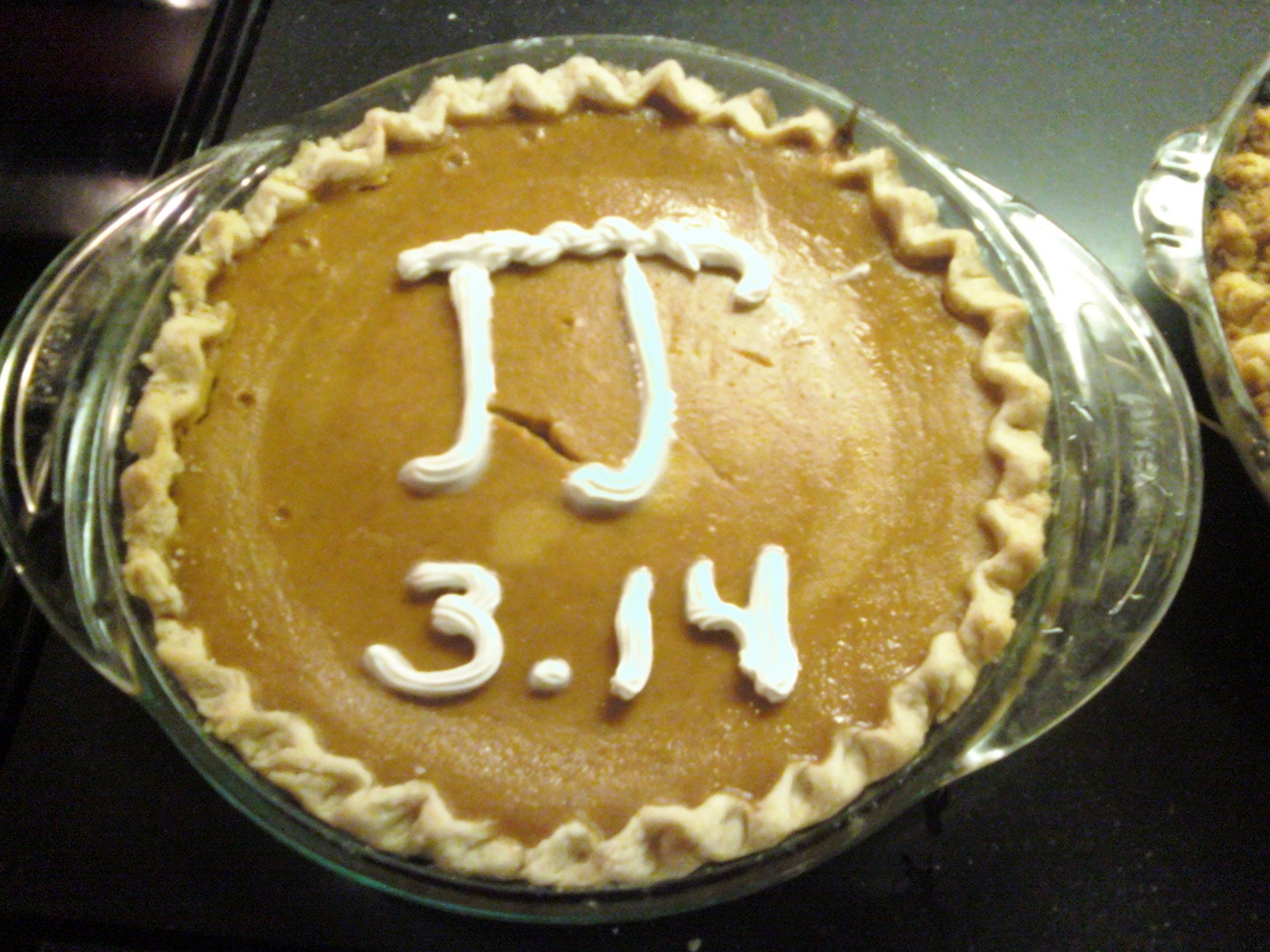
Finally, just to give you an idea of the kind of house I live in: late last week, our matehmatically-inclined daughter Madi pointed out that Sunday, March 14 was officially Pi Day (3/14).  To mark the occasion, then, Barb made three pies — apple, pumpkin, and chocolate pecan — and decorated them accordingly.  Here’s the pumpkin pie, for example, just before we tore into it:

And yes, we rounded off to eight digits beyond the decimal across the tops of the other two pies.

My family rules.

Irving the Ivy Leaguer. Sort Of.

My pal Rob Schweitzer over at Historic Hudson Valley snuck this up on the HVBlog a while back, and I only just caught it:  a photo of Washington Irving’s 1832 honorary law degree from Harvard University. Very nice.  And not a bad accomplishment for someone who might fairly be considered a candidate for New York’s Worst Attorney — after all, Irving allegedly abandoned the only client he ever had!

Nice find, Rob.

The Next Voice You Hear Will…Oh, Forget It.

My plans for voice recognition software were thwarted.

As Jane Smith —  from How Publishing Really Works — pointed out in the comments section, voice recognition software is fairly voice specific.  You have to “train” it to recognize your own voice, at which point you can play your own recorded voice back to it (or speak through a microphone) and the program will recognize your own words well enough to come up with a reasonable transcription.

My problem, however, is that that’s not really what I needed.  I wanted to be able to play back an interview between two people, and have the VRS system be able to transcribe it.  That, alas, is beyond the capability of most VRS systems.

The literature for MacSpeech didn’t really make that clear — I thought it was going to be a technological wunderkind, capable of transcribing whatever I might play through it (“Revolution 9” from The Beatles might have been fun), no questions asked.  That wasn’t the case — and since I don’t work by dictating into the computer, Scribe is pretty much a useless program for me.

Unfortunately, when I called customer service at MacSpeech to see if I could get a refund on the program — since it really didn’t do what I needed it to do — they told me no dice, since the program “was working as it was supposed to.”  Rats.

So I’ve gone back to Plan B — having the conversation transcribed.  I did learn, however, that if your transcription doesn’t have to carry a standard of  “legal weight” — meaning it won’t be scrutinized in a courtroom — you can have things transcribed for a much more reasonable rate.  I’m supposed to have my transcript back soon.  I’ll let you know how they did — and if it looks good, I’ll let you know who I used.

Sleep, Pretty Darling, Do Not Cry

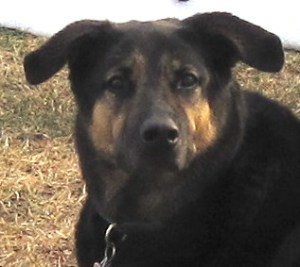
Back in late January, Barb and I took our dog Abbey to a specialist to see if they could determine what was causing the rapid deterioration of her back legs.  Initially, we thought she had developed hip dysplasia — a bane to large dog owners everywhere — but Abbey seemed to be getting more and more hobbled as the weeks went on.  She went from dragging her left leg last June, to teetering on her feet by Thanksgiving, to barely walking by Christmas.  Clearly, something else was going on.

Back in January, I promised to give you the rest of the story, once we knew what was happening.  Here’s the rest of the story.

Abbey was subjected to several X-rays and MRIs to see if, perhaps, she had a tumor on her spine that was causing paralysis.  Both the X-rays and the MRIs came back clean — no sign of any trouble — and the vet put Abbey on prednisone as a preemptive strike, just to see if the drug might have any effect on whatever was going on in her system.  But there was one other thing he wanted to check out.

Abbey was showing textbook signs of a new but relatively rare genetic disorder, a disease known as degenerative myelopathy (DM), a progressive and always fatal disease of the spinal cord.  In general, a dog can begin showing signs of the disease anywhere from eight to fifteen years old.  That put Abbey on the left end of the bell curve — she’s only barely eight — but her symptoms were shudderingly precise: dragging of the rear legs, lack of balance, and incontinence.  While the disease can only be definitively confirmed by an autopsy, the vet wanted us to submit saliva samples to the University of Missouri, where most of the leading research has been undertaken, to see if she was, indeed, genetically predisposed to the disorder.

While we waited for the results, Abbey continued to grow increasingly worse.  The prednisone had no effect, apart from making her horribly thirsty — which made her drink more and, in her condition, wet herself without realizing it — so we took her off the drug altogether.  Moving became difficult, and she was eventually confined to our living room, where its concrete floor and easy access to the backyard made it easier for us to clean up after her and help her outside.  But soon, she could only walk with the help of a sling under her back end — I would walk her outside the way a parent plays wheelbarrow with a child — holding her back legs slightly off the ground while she pulled herself with her front legs.

Despite her deteriorating physical condition, she was as spirited, social, and loving as ever.  When we sat in the living room to watch television or read, she would drag herself across the floor so she could lay in the middle of things.  When the enormous snowstorm crashed through the area, she would lay for hours in the spot we had cleared in the back yard, eating snow and watching the birds dive at the birdseed we had thrown out.  As the sun melted the snow and warmed the ground, we would look out the kitchen window and see her sleeping contentedly in the sun, sprawled out full length.

Still, she was showing signs of unhappiness.  More and more evenings, after the lights were out, she would continue her habit of softly barking until I came downstairs and slept near her on the living room couch.  She was having accidents with greater frequency, which seemed to embarrass her — she would bark until someone came to clean her up, and then would drag herself away from the mess, ears down with humiliation.

Late last week, she began to eat less and less.  It was clear she was continuing to decay — and sure enough, several days ago, we received the test results from the lab in Missouri confirming what we already knew: she has the genetic defect that causes DM on both genes.  She wasn’t just a carrier, she was doomed from the start.

On Monday night, we took Abbey to our wonderful local veterinarian who helped us lovingly and painlessly send our dog onto her next adventure.  She died peacefully as Barb and I patted and spoke to her softly.  One deep breath and she was gone, still looking as if she were sleeping.

And I cried. Oh, how I cried.

The Next Voice You Hear Will Be Your Own

I’m in the process of getting the interview I conducted the last week in February transcribed — or, rather, I’m in the process of trying to get it transcribed.   I’ve got four hours of conversation to convert, and initially, I was planning on doing it myself.  I’ve transcribed interviews before, but nothing quite this long — and after taking 20 minutes or so to transcribe about five minutes of conversation . . . well, that’s an unimpressive effort-to-product ratio.  Clearly, I need another system.

For Plan B, I checked with a few professional transcription services, but the per-page costs of transcribing were a bit jaw-dropping.  Probably nothing your average law firm can’t soak up, but for a company of one, it was gonna leave a mark. 

That left Plan C.  I’m in the process of loading voice-recognition software onto my laptop to see how well it does. I chose the Scribe program from MacSpeech, mainly because it allows you to open a sound file directly through the program.  Now the only problem is the operating system on my MacBook.  It runs Leopard, and I need Snow Leopard.  So I had to order the upgrade from Apple (for some reason, they won’t let you download it from their site) and my package is still enroute with the FedEx man.  Or woman.

Anyhow, I’ll let you know how it works.  Anyone else have experience with a similar program?

The Devil You Say!

Washington Irving — and “The Devil and Tom Walker” — causes heartburn in an Illinois classroom.

(For your reference, here’s Irving’s “The Devil and Tom Walker,” which first appeared in his 1824 book Tales of a Traveller. Go get it.)

Tomorrow Never Knows

I’m heading back to New York tomorrow — armed with my laptop, notes, and tape recorder — to have a chat with Someone Wonderful related to Project Blue Harvest.  It’ll be a quick day — up on the train in the morning, interviewing in the afternoon, then back that evening — but I’m so excited about it that the day will probably seem to go by even faster. I even made sure to book myself a reserved seat on the train on the way home so I’m certain of a spot where I can plug in the computer, plunk on the headphones, and transcribe everything immediately. Yeah, it’s fun — and, I’ll admit, a bit nerve wracking.

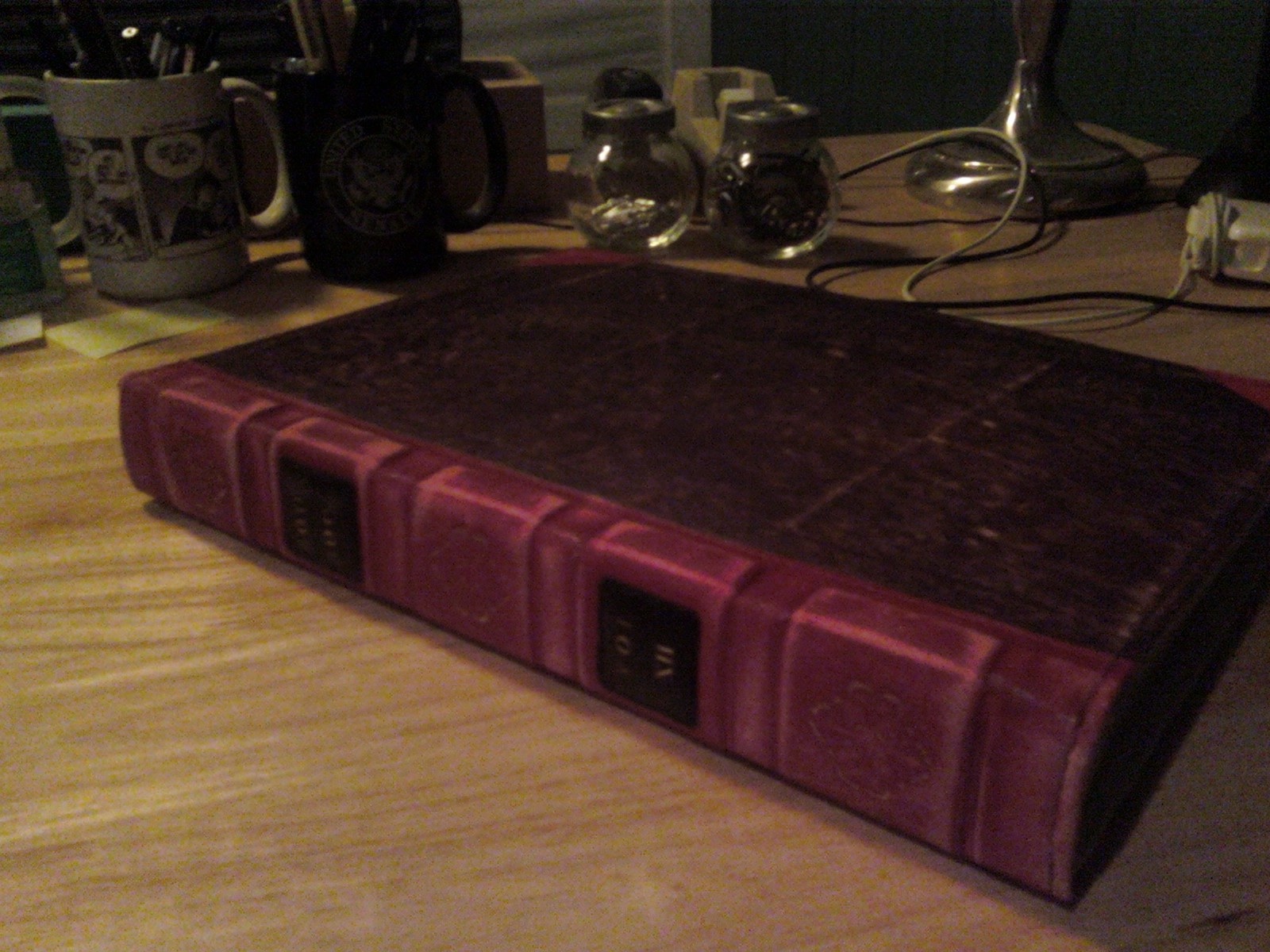
Given my increasingly frequent back and forthing lately, Barb saw fit to give me a good laptop case — something a little unusual that doesn’t look like anything else out there.  So tell me, how cool is this?

Yeah, that’s my MacBook, tucked away inside there between two hardback leather covers. Pretty neat, eh?

A Dose of Reality in High School Reading

Over in The Washington Post, crack education writer Jay Mathews laments the absence of non-fiction on high school “required reading” lists.  “I am not dismissing the delights of Twain, Crane, Buck, Saroyan and Wilder,” Mathews writes. “But I think I would also have enjoyed Theodore H. White, John Hersey, Barbara Tuchman and Bruce Catton if they had been assigned.”

He’s right.  I can’t remember ever being assigned any non-fiction in high school, apart from in a journalism class where a wise teacher made us read any number of books of our choice by journalists (I chose Harry Reasoner’s Before The Colors Fade and Barbara Walters’s How To Talk With Practically Anybody About Practically Anything, both of which are long out of print.)

Independently, I read my share of non-fiction — usually books on pop culture, such as the history of films, television, theater, or comics (I remember drawing audible laughter from a biology teacher of mine when he turned over the book I had laid face-down on my desk to reveal The History of Little Orphan Annie) — but as far as required reading went . . . not so much.

Mathews isn’t certain what to make of this. Perhaps, he offers

…high school English departments’ allegiance to novels leads impressionable students to think, incorrectly, that non-fiction is a bore. That in turn makes them prefer fiction writing assignments to anything that could be described by that dreaded word “research.”

Could be.  Non-fiction, on the face of it, seems a bit too much like doing research for a term paper — which is about the only time students are required to pick up anything beyond the fiction shelves. Non-fiction seems intimidating, academic, and boring.  (True, sometimes it is — except most of the time, when it isn’t.)

Mathews closes by asking for suggestions on non-fiction books that high school students might like.  I think I’d try to keep things short — John Adams, for example, is one of the finest books out there, but at 750 pages, its length probably makes it unwieldly for your average class — and point students toward books like Jon Krakauer’s Into the Wild or Stephen King’s On Writing.

What books would you recommend?

Pulitzer Priceless

Joseph Pulitzer

Last night, I had the great pleasure of attending a reception and book talk for James McGrath Morris’s Pulitzer: A Life in Politics, Print, and Power down at American University (which, as it turns out, is also McGrath’s alma mater).

If you have the opportunity to see Jamie talk about Pulitzer, jump at it.  Last night, he gave a presentation that encompassed his research (which included the kind of tale biographers love — that of finding The Source That No One Else Has), Pulitzer’s longtime feud with Teddy Roosevelt, his treatment in and by the very press he had created, and the challenges of dealing with that early 20th century e-mail device known as the telegraph. Jamie puts on a show, working without notes, and talking so animatedly that it’s impossible not to get caught up in his excitement for his subject.

Jamie’s on a bit of a whirlwind tour right now (last night, even as he was finishing signing books, he was already getting ready to make the sprint to the airport to get to Connecticut), but there are plenty of places you can catch him.  If you’re interested in learning more about an icon whose name is more familiar that his face or life story — and hearing the story told well — go see James McGrath Morris. His tour schedule is right here.