Washington Irving — and “The Devil and Tom Walker” — causes heartburn in an Illinois classroom.
(For your reference, here’s Irving’s “The Devil and Tom Walker,” which first appeared in his 1824 book Tales of a Traveller. Go get it.)
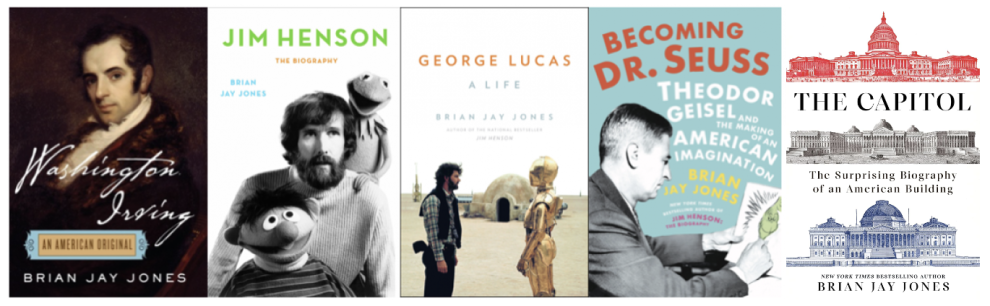
Washington Irving — and “The Devil and Tom Walker” — causes heartburn in an Illinois classroom.
(For your reference, here’s Irving’s “The Devil and Tom Walker,” which first appeared in his 1824 book Tales of a Traveller. Go get it.)
I’m heading back to New York tomorrow — armed with my laptop, notes, and tape recorder — to have a chat with Someone Wonderful related to Project Blue Harvest. It’ll be a quick day — up on the train in the morning, interviewing in the afternoon, then back that evening — but I’m so excited about it that the day will probably seem to go by even faster. I even made sure to book myself a reserved seat on the train on the way home so I’m certain of a spot where I can plug in the computer, plunk on the headphones, and transcribe everything immediately. Yeah, it’s fun — and, I’ll admit, a bit nerve wracking.
Given my increasingly frequent back and forthing lately, Barb saw fit to give me a good laptop case — something a little unusual that doesn’t look like anything else out there. So tell me, how cool is this?
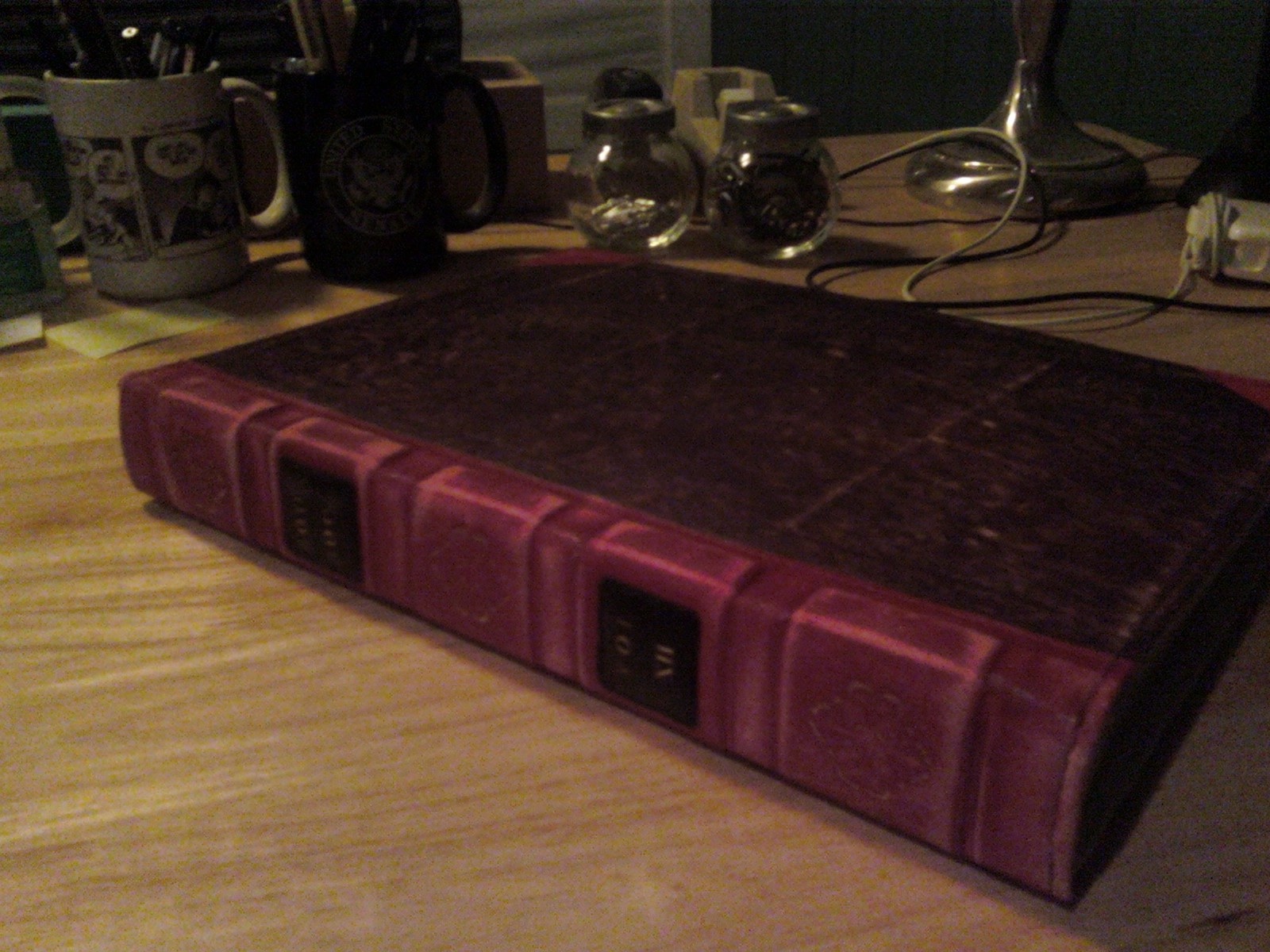
Yeah, that’s my MacBook, tucked away inside there between two hardback leather covers. Pretty neat, eh?
Posted in laptops, Project Blue Harvest, stuff i dig
Over in The Washington Post, crack education writer Jay Mathews laments the absence of non-fiction on high school “required reading” lists. “I am not dismissing the delights of Twain, Crane, Buck, Saroyan and Wilder,” Mathews writes. “But I think I would also have enjoyed Theodore H. White, John Hersey, Barbara Tuchman and Bruce Catton if they had been assigned.”
He’s right. I can’t remember ever being assigned any non-fiction in high school, apart from in a journalism class where a wise teacher made us read any number of books of our choice by journalists (I chose Harry Reasoner’s Before The Colors Fade and Barbara Walters’s How To Talk With Practically Anybody About Practically Anything, both of which are long out of print.)
Independently, I read my share of non-fiction — usually books on pop culture, such as the history of films, television, theater, or comics (I remember drawing audible laughter from a biology teacher of mine when he turned over the book I had laid face-down on my desk to reveal The History of Little Orphan Annie) — but as far as required reading went . . . not so much.
Mathews isn’t certain what to make of this. Perhaps, he offers
…high school English departments’ allegiance to novels leads impressionable students to think, incorrectly, that non-fiction is a bore. That in turn makes them prefer fiction writing assignments to anything that could be described by that dreaded word “research.”
Could be. Non-fiction, on the face of it, seems a bit too much like doing research for a term paper — which is about the only time students are required to pick up anything beyond the fiction shelves. Non-fiction seems intimidating, academic, and boring. (True, sometimes it is — except most of the time, when it isn’t.)
Mathews closes by asking for suggestions on non-fiction books that high school students might like. I think I’d try to keep things short — John Adams, for example, is one of the finest books out there, but at 750 pages, its length probably makes it unwieldly for your average class — and point students toward books like Jon Krakauer’s Into the Wild or Stephen King’s On Writing.
What books would you recommend?
Posted in books, Washington Post, what do you think

Joseph Pulitzer
Last night, I had the great pleasure of attending a reception and book talk for James McGrath Morris’s Pulitzer: A Life in Politics, Print, and Power
If you have the opportunity to see Jamie talk about Pulitzer, jump at it. Last night, he gave a presentation that encompassed his research (which included the kind of tale biographers love — that of finding The Source That No One Else Has), Pulitzer’s longtime feud with Teddy Roosevelt, his treatment in and by the very press he had created, and the challenges of dealing with that early 20th century e-mail device known as the telegraph. Jamie puts on a show, working without notes, and talking so animatedly that it’s impossible not to get caught up in his excitement for his subject.
Jamie’s on a bit of a whirlwind tour right now (last night, even as he was finishing signing books, he was already getting ready to make the sprint to the airport to get to Connecticut), but there are plenty of places you can catch him. If you’re interested in learning more about an icon whose name is more familiar that his face or life story — and hearing the story told well — go see James McGrath Morris. His tour schedule is right here.
The gynormous Blizzard of 2010 has officially been clear of the region for a little less than a week — gone, but not by a long shot forgotten. Roads are relatively clear — unless you live in the District of Columbia or an isolated cul-de-sac — grocery stores are restocked, and mail delivery has resumed (an overnight mail package I took the Post Office on Tuesday the 9th finally made it to its destination on Friday the 12th — it was stuck on the East Coast for two days while mail delivery ground to a halt). But it’s still a mess, and temperatures in the low 30s are making sure that none of the enormous drifts will thaw until April.
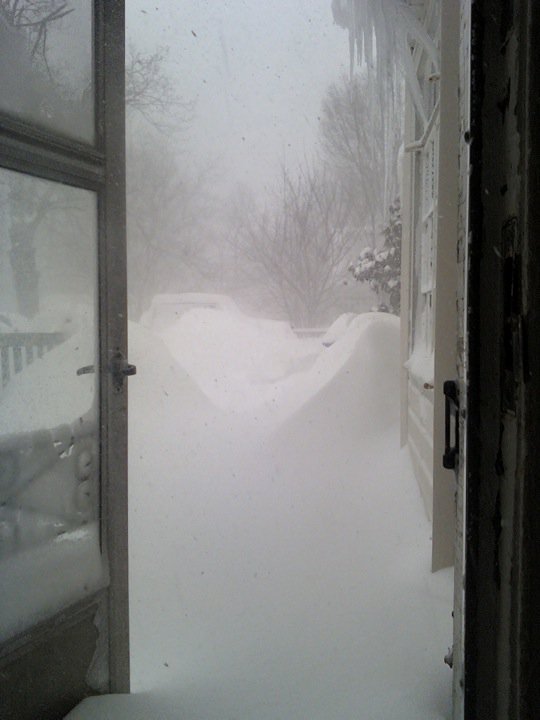
Here’s a quick look at the storm as it moved through our region the week of February 8. First, here’s a look out our back door as the blizzard really started to kick into overdrive (you can juuuust see the Jeep poking up behind a drift in the center of the photo). We deliberately left the storm door open so the drifts wouldn’t pile up against it and make it impossible to open:
Here’s the same view a day or so later, after we spent the better part of the morning shovelling our way out to the Jeep:
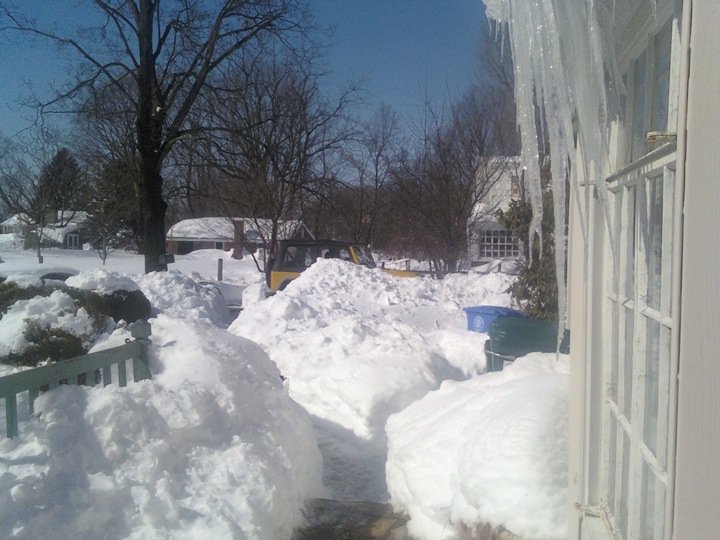
While we got the Jeep uncovered, it wasn’t going anywhere fast. It took us another day to get our long sloping driveway cleared. High winds and drifts as high as eight feet made it difficult to dig into. We eventually settled on a system where Madi climbed the drifts and knocked them down with a shovel while I ran a snowblower right behind her.
Here’s the driveway now — and it’s hard to get a grasp of scale here. The side drifts run from about two to six feet high as you move down toward the street. Steering down our driveway is like making a Death Star trench run in an X-wing fighter:

Here’s a look back the other way, toward the rear of the house, glittering with icicles. Sliding snow and heavy icicles actually tore the gutters right off of one part of the house. Right after we took this, Madi and I spent some time slinging snowballs at the icicles on the upper level, trying to break them off. We mostly just left snowy splatters on the windows and walls:

Finally, I’ve gotta run an Abbey photo (yeah, she’s still hobbling around, but loves the snow). Here she is poking happily around in the dog run we keep digging out just off the back patio:

I love the snow, but even I’m a bit snow-weary.
When I last left you — at least for the purposes of this particular narrative — I was in the lobby of the Roosevelt hotel, monitoring text messages from Barb and Madi as they made their way up from Maryland on the train. They were running only slightly behind schedule (as I said earlier, “on time” for the Northeast Regional seems to mean about ten minutes late), so I arrived in plenty of time to meet them, even after walking the mile or so to Penn Station. A short cab ride back to the hotel (when did New York cabs start taking debit cards? Brilliant) and we went into a bit of decompression mode until it was time to leave for the St. Nicholas Society Event at 6:30.
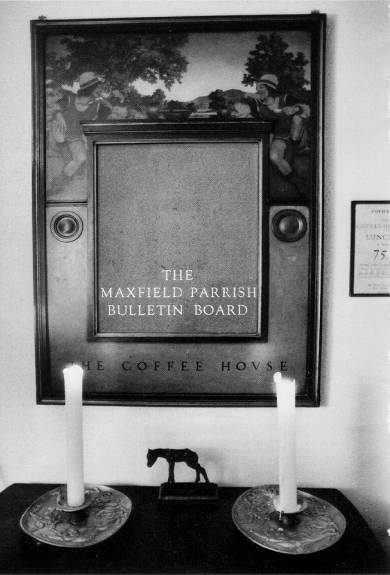
The Maxfield Parrish bulletin board at the Coffee House Club.
The dinner was being held at the Coffee House Club over on West 44th, only a block or so from the hotel, and an easy walk in the brisk February air. The Coffee House Club is considered a private New York club, but it’s got an irreverent, tongue-in-cheek outlook that I love. (Its Constitution consists of a half-dozen “commandments”: “No officers, no charge accounts, no liveries, no tips, no set speeches, no rules.”) It’s also a comfortably unassuming place, just two large rooms — one a reception area, the other a cozy dining hall.
Just inside the door, I met Jill Spiller, the Executive Director of the St. Nicholas Society, who worked hard over the past few months leading up to the evening to take good care of me. True to form, she escorted us into the reception room and put off to one side a nice gift from the St. Nicolas Society, a set of glasses etched with their logo. Very nice.
The reception was a very classy affair, yet also laid back — St. Nicholas members are genuinely interested in telling and listening to stories, and a well-told story will usually cause an eruption of laughter. And people had so many different interests that moving from one small circle to another was like entering a live encyclopedia. Over here, you could talk about astronauts and one man’s collection of space memorabilia. In this corner, it was about children’s songs. Over here, people chatted about medicine. I even found one gentleman who had in his private collection one of my Holy Grails of Washington Irving portraits: a photograph of a painting of Irving’s best friend, Henry Brevoort. I had scoured the planet looking for a portrait of Brevoort back when I was working on Irving and had no luck — and now here was someone who had one. It’s wonderful when things like that happen.
After an hour or so at the reception (the hosts had done a good job taking care of Madi, ensuring there was plenty of teen-friendly food and drink), we were gently herded into the main dining hall. The President of the St. Nicholas Society, Dr. Billick — who is class and charm personified — had gone to great lengths to seat Madi on his left, with me on his right, and Barb right across from us at the horseshoe of tables. I smiled as Dr. Billick made certain to engage Madi in conversation throughout the meal, offering up history questions, chatting about the European Union (!) and generally making her feel at ease as the only young person in the room. Not that Madi can’t hold her own in almost any conversation (at one point, someone came up to me, laughing, and said, “After talking with your daughter, I asked her what she was majoring in. She told me ‘eighth grade’!”), but it was a lovely gesture on his part, and I so appreciated his effort.
We were still enjoying our dinners when it was time to conduct some business. Two new members of the St. Nicholas Society were introduced and initiated to much applause. I was then introduced by longtime member (and fellow New Mexican!) Mr. Hilliard, with Dr. Billick at his side, who stepped to the mike and presented me with their award.
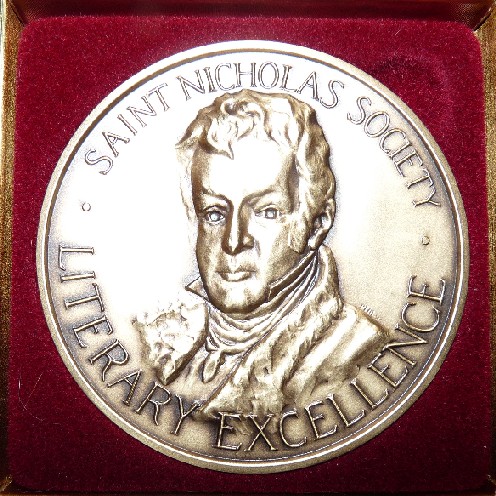
I promised everyone who wrote to me with their good wishes that I would put up a picture of the medal. Here it is — and it’s a beauty:
I spoke for about twenty minutes, telling one of my all-time favorite Irving stories: the hoax that Irving pulled off to launch his mock history of New York City, and the Dutch reaction to it (someone threatened to horsewhip him). Given the St. Nicholas Society’s mission to preserve and perpetuate New York’s history, I thought such a talk would be appropriate — and I was delighted that it went over so well. I took questions for about twenty more minutes, then spent the rest of the evening signing books, talking with members, and generally having a terrific time. It was one of the nicest evenings I’ve ever had — and having Barb and Madi there with me to share in it made it that much more special.
It was cold as we stepped out onto 44th for the walk back to our hotel — we had already changed our travel plans to leave early the next morning, in hopes of getting back to Maryland in front of the advancing snowstorm — but we walked slowly, trying to make the evening last even longer. Our thanks to the St. Nicholas Society for such a remarkable night.
Posted in awards, Lobos, New York, St. Nicholas Society, Washington Irving
Tagged New York, Washington Irving
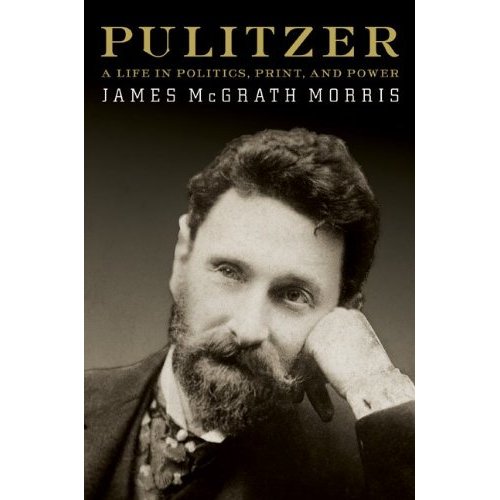 In all the fuss over the major snowstorm here, I nearly forgot to wish a Happy Launch Day to my colleague James McGrath Morris, whose biography of Pulitzer hit bookstores on February 9.
Know Pulitzer only because of the name of the prize? Well, then, this book’s for you. McGrath’s Pulitzer: A Life in Politics, Print and Power
traces the epic story of this Jewish Hungarian immigrant’s rise through American politics and into journalism where he accumulated immense power and wealth, only to fall blind and become a lonely, tormented recluse wandering the globe.
I preordered mine from Amazon ages ago, but with the weather — and the post office officially closed since Friday — my book hasn’t made it here yet. But I’ll be attending Jamie’s book talk and signing at American University on February 16.
You can order Pulitzer: A Life in Politics, Print and Power here
Comments Off on Happy Launch Day! (One Day Late, But What Can You Do…)
Posted in James McGrath Morris, Uncategorized
Tagged James McGrath Morris, Pulitzer
We made it back to Maryland, right in front of the snowstorm. As we made our way south on the train, there was no sign of snow in New Jersey, Pennsylvania, or Delaware. Then, as we crossed into Maryland, it was as if someone flipped a switch and the flurries began. By the time we arrived at the train station, the snow was coming down fairly hard, though the temperatures were still hovering above freezing, keeping the roads in decent shape. We arrived in Damascus just as it was starting to get nasty.
This morning, it’s 28 inches and counting, with the snow still coming down heavily. I went out this morning to shovel a clearing for Abbey — who walked out to the end of the six-foot trench I dug, looked back at me sadly, then slowly walked back into the house.
We were also just informed that the U.S. Postal Service has officially cancelled service for the day, and the National Park Service has closed the monuments in DC. Can’t remember the last time that happened, even during the huge DC Blizzard of 1996.
I’ll continue the trip report here tomorrow — at the moment, we’re getting everything packed up and ready to head over to Penn Station so we can make it back to DC ahead of the snowstorm that’s headed this way. Everyone I’ve talked with in DC tells me the snow is not yet flying, and I’m guessing we’ll make it back well before the mess begins.
I will say, however, that it was an amazing evening last night at the St. Nicholas Society, spent with some really fantastic people — an evening none of us will forget.
Catch you here later. Stay warm!
Comments Off on Back in a Moment…
Posted in snow, St. Nicholas Society
Hello there. I’m presently camped out next to the fireplace in the restaurant of the Roosevelt Hotel in New York, watching as dozens of men and women in dark suits sit huddled in padded chairs at round tables, speaking business-ese in low voices. Even at 10 in the morning, many of them have their jackets off already, slung over the chair as they shuffle through papers with colleagues. I’m not certain exactly what they’re doing, but it makes for great people watching. It’s like a slightly bizarre Agatha Christie novel.
The snow that fell on Tuesday night was more a pretty snow than an inconvenient one — and even with six inches of the stuff on the ground, the roads were clear. Not that it mattered to me that much — taking Barb’s advice, I had stayed at the Microtel near the airport, meaning I only had to make the mile-long sprint to the train station. I headed for the station at 8:15 or so, lugging a full box of books that had been presold for the Thursday night event, and cramming the rest into my suitcase, so that it was more full of books than clothes.
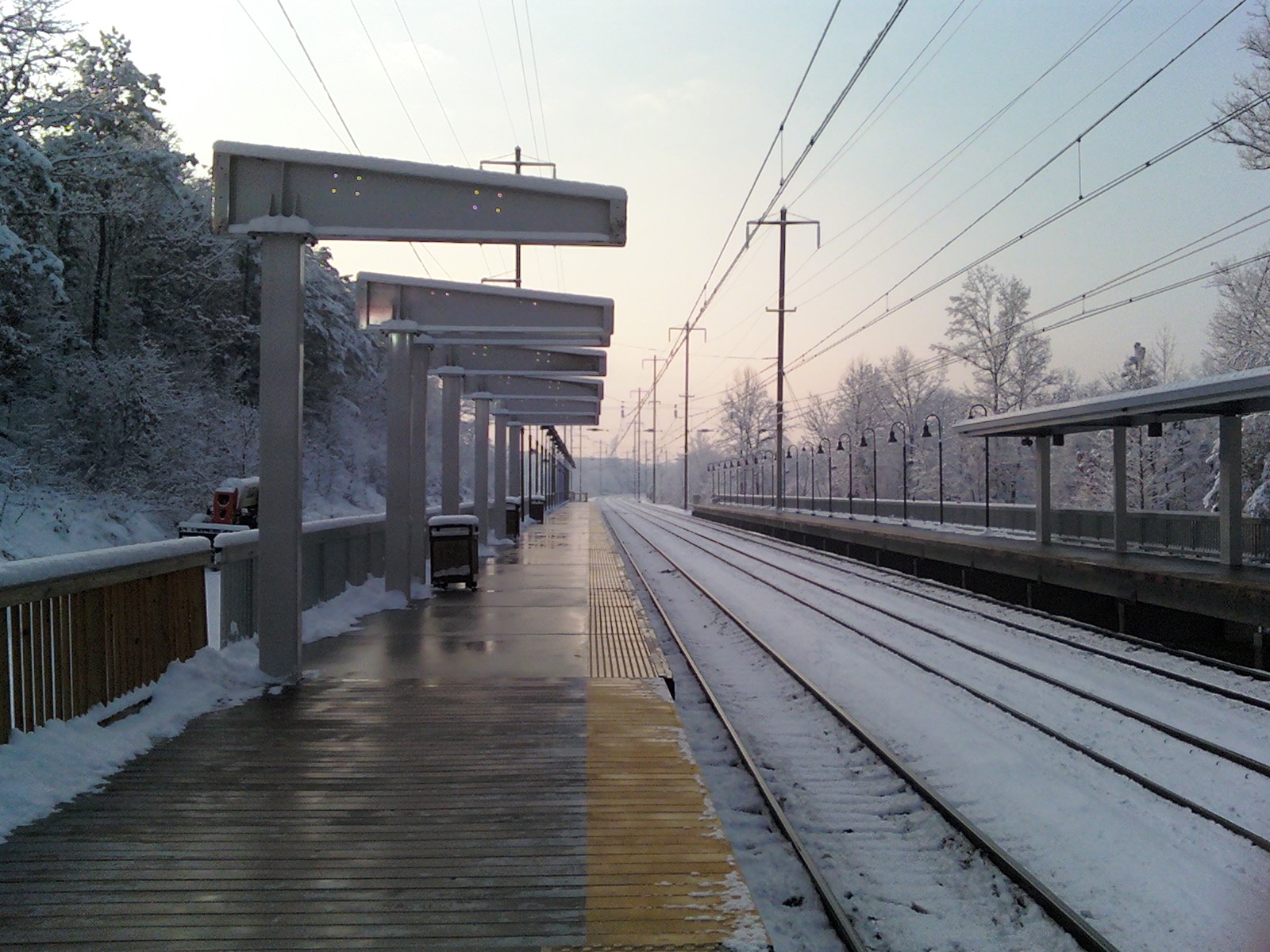
The tracks at BWI station looked good.
The train tracks were clear — though a speeding southbound Acela still kicked up an enormous cloud of snow and ice as it hurled past on its way to Washington, DC — and the Northeast Regional trains were running just as casually on time as ever, which means they were running about five minutes late. As I always do, I headed for the quiet car, threw my suitcase and the box of books in an overhead bin, and slouched down into a window seat on the left side of the train. (I always sit on the left side, because I like the good view I get of the bridge in Trenton, NJ, with the sign declaring that TRENTON MAKES, THE WORLD TAKES). Naturally, it didn’t take long for the quiet car to be infiltrated by loudmouths who had no idea they were in the quiet car — one gentleman perched himself on the back of a seat to engage his two colleagues in a loud conversation, only to be kidney punched by a conductor who shooed them all into a rear car. Apart from that, things went smoothly.
I arrived at Penn Station only 20 minutes late, giving me a bit more than an hour to make it to the 1:30 lunch I’d set up to chat about Project Blue Harvest. It was meant to be a casual lunch — I had e-mailed My Friend last week, mentioning I would be in town and offering to take him to lunch. But he threw me a change up and very generously offered to take me out instead. His restaurant of choice? Morton’s. “I hope you like steak,” he said to me in an e-mail, and was therefore unable to see me wiping drool off the keyboard.
I took a cab to my hotel — the Roosevelt, as I mentioned above, one of New York’s grander of the old hotels, and still oozing with, appropriately enough, Roosevelt-era charm — only to learn that my room was not yet ready. The clerk checked me in anyway and steered me to the bellman’s stand, where I could have my suitcase and box stowed until I returned after lunch. My bags were taken by a stooped Italian bellhop, who winked that he would take special care of my bags and had me follow him downstairs to a storage room that he swore was some sort of secret chamber in the basement that held the bags of only the most special of guests. I swallowed hard as he moved my bags into a cold, garage-like area, uncertain whether I would ever see them again. Not wanting to appear ungrateful, I then tipped him way too well.

The Roosevelt's lobby.
I made my lunch meeting in plenty of time — it was a three-minute walk from my hotel — and actually arrived at the restaurant before My Friend did. I was waiting in the bar, watching New York through an enormous plate glass window, when I suddenly developed one of my Famous Spontaneous Nosebleeds. I ran sniffing to the restroom, where it took about twenty minutes to get the darn thing under control. When I finally emerged and walked back toward the bar, I spotted My Friend sitting at a side table. I slid into a chair across from him, we shook hands warmly, and spent the next two hours talking about politics, television, travel, and debating exactly why cable news sucks. Oh yeah, and we even talked about my project, too.
We also stuffed ourselves to near explosive levels. Steaks, baked potatoes, crab cakes, shrimp cocktails, green beans, carmelized onions (one of My Friend’s favorites), creamed spinach . . . it just seemed to keep coming. Turns out My Friend’s a semi-regular, and the waiters, waitresses and management checked on us regularly, very kindly keeping drinks filled and clearing plates away, sometimes even as we were still taking the last crumbs from them. All in all, it was a terrific time.
I walked back to the Roosevelt, where I claimed my bags (to my relief, they were just fine), picked up my room key, then dropped into an armchair to have a quick chat with Barb, and then with Agent J.
I had a couple of e-mails I needed to send, so I fired up the laptop only to discover that this upscale hotel doesn’t offer free wireless. Really, Roosevelt? Fourteen bucks a day? Yeah, I bit — but aren’t we getting to a point where wireless should be among the basic amenities in a hotel? Most of the cheaper hotels seem to have gotten there (the Microtel in Baltimore, for example, had free wireless, though it was a bit slow). As a pal of mine pointed out, there’s an inverse relationship between the cost of the hotel and the availability of free wireless, because the more upscale the place, the more likely it is that a visit is being expensed. Unfortunately, it’s ME expensing it.
Was that a rant? Sorry.
Anyway, around 5:40, I started the 30-block walk up the island toward the Lexington District, where I was meeting Mark Bartlett, the head librarian for the New York Society Library, for dinner and drinks at an Irish pub. I made it by 6:30, and found Mark already enjoying an adult beverage at a back table, away from the noise of the bar. We talked for 90 minutes about books, college basketball, Peanuts comics, and J.D. Salinger; Mark dined on fish and chips, while I tore into a delicious shepherd’s pie. We had two beers each, and there was much rejoicing.
Yeah, I was stuffed. Again.
Despite my protestations, Mark insisted on picking up the check (I owe you when you come to DC, my friend) and we walked back along 77th until Mark ducked into the subway. I walked the thirty blocks back to the hotel, strolling slowly down Park Avenue, sleepy from good food and beer, but determined to walk all the way back rather than hailing one of the many cabs that seemed to taunt me as they rolled past at each street corner. I finally made it back to the hotel around 9:15, struggled to keep my eyes open for at least another hour and finally failed at about 10:30. A good day.
As I sit here now the next morning — whoops, make that afternoon now! — in the hotel restaurant, I’m texting Barb and Madi, who are coming up for the event at the St. Nicholas Society tonight. I’ll let you know how it goes.
Posted in New York, New York Society Library, peanuts, Project Blue Harvest
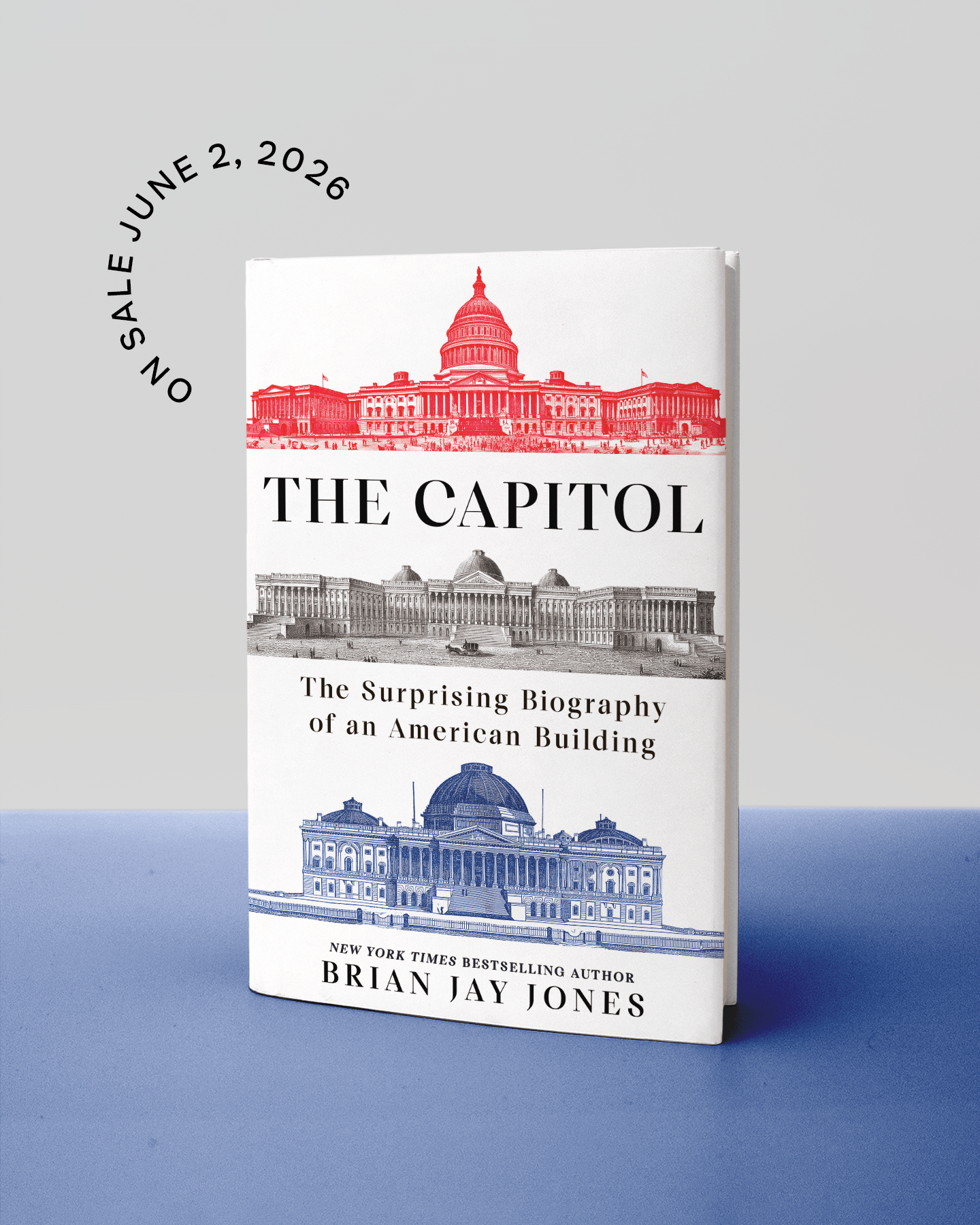
Coming in June from Dutton Books.

Becoming Dr. Seuss is available from fine booksellers everywhere. Click on the cover above for links.
Jim Henson: The Biography is available in paperback from your favorite bookseller.
George Lucas: A Life is available in paperback from booksellers in a galaxy near you.
Washington Irving is available in paperback or for download on your Kindle or other electronic device.

 Brian Jay Jones