Sensational, Inspirational

…and hello again.  I’m back from a week-long visit to New York *, where I spent several days buried in the archives at the Jim Henson Company — and if you’re at all a fan of Jim Henson or the Muppets, then you can imagine just how much fun that is.  (But really,  take the amount of fun that you think it is, then multiply it by ten, and you’ve got a much better idea of the Actual Fun Level.)

The archives themselves are physically located in the company’s new digs out on Long Island — needing more space, they moved from Manhattan a while ago.  As I was staying in Brooklyn, I had to travel to Long Island City by subway every day — and I’ve gotta tell you, even though I’ve taken the subway in several cities around the world, for some reason, I was terrified of taking the New York subway.  I was worried I would have no idea how to purchase tickets or use the system — and meanwhile, in my befuddlement, I would be clogging up the system, blocking the way for New Yorkers trying to commute into the city who would now be late and surely fired because I was costing then two minutes.  Yeah, I’m a mess that way.

Fortunately, Agent J was kind enough to lend a hand and show me that it was actually really easy — and it was — and I’m pleased to say I took the subway regularly with no problems at all except for (1) missing my stop one day when I wasn’t paying attention, and (2) burning several dollars when I mistakenly entered on the wrong side of the platform and had to exit and re-enter (and thus pay again) on the other side of the street.

Each day, then, I would take the R train, as it made its hour-long trip from Brooklyn and boomeranged off Manhattan to curve into Queens.  Here’s my stop each day — 36th Street, near Northern Boulevard:
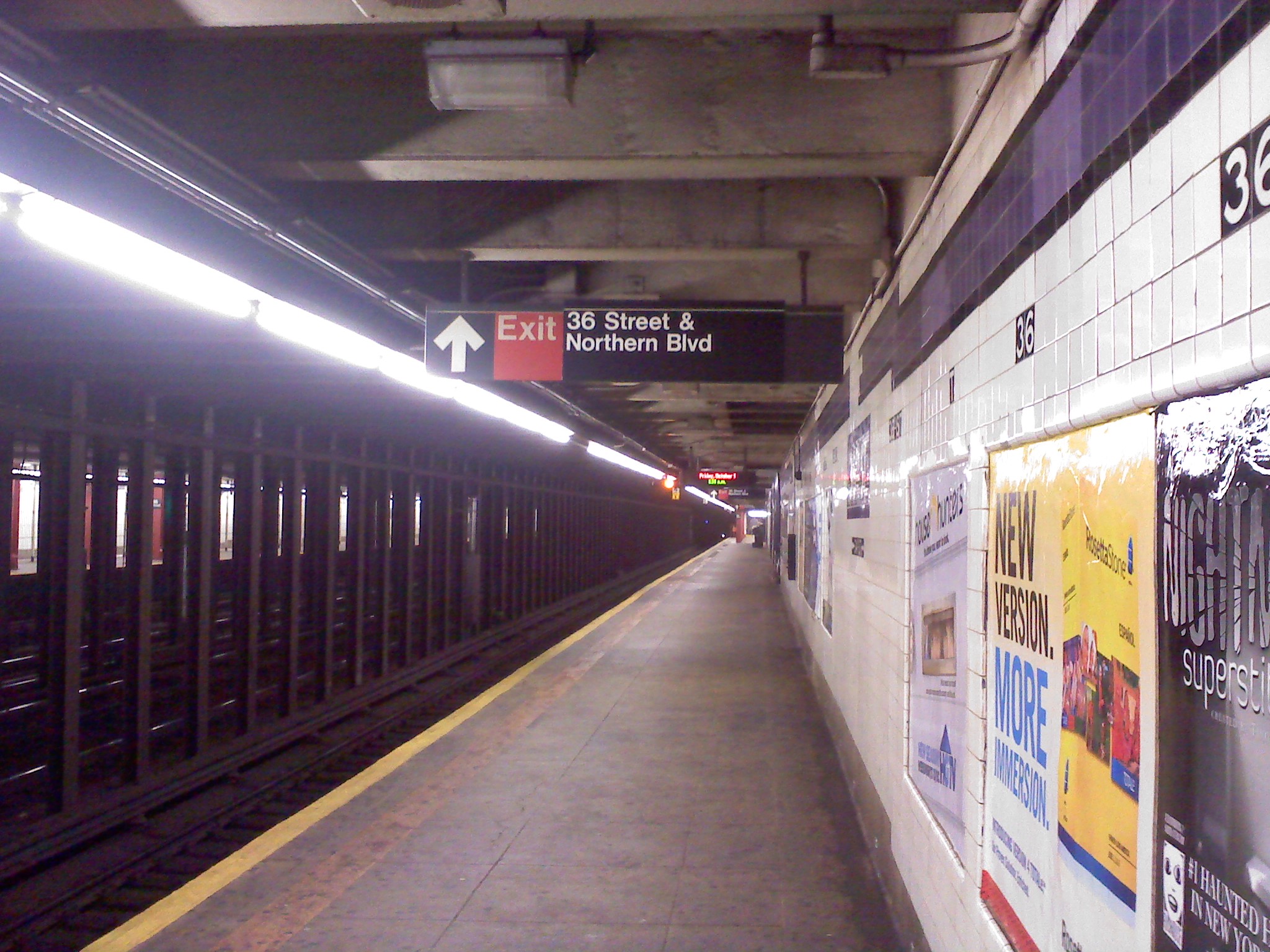
 

The Subway stop near the Jim Henson Company. Yes, it really was that quiet.


After exiting the subway, it’s just a brief walk up the street toward the Jim Henson Company — which is located in this unassuming white building right here:
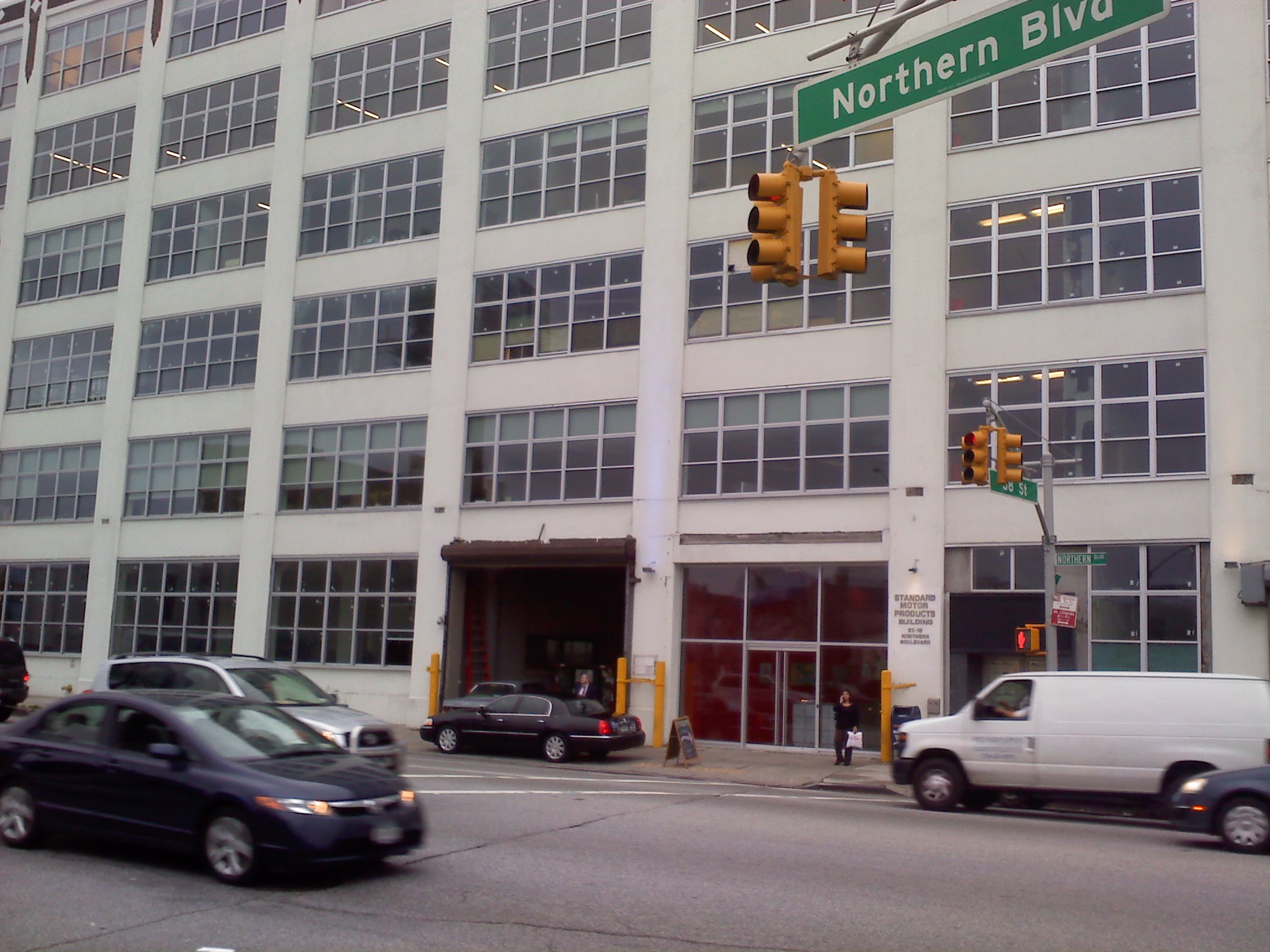
Now, don’t be fooled by this building’s rather industrial facade.  It’s like Clark Kent: behind the plain blue suit and nerdy glasses lies something wonderful.  Go through these doors, take the freight elevator up several floors, and when the door comes rumbling open, you’ll see a simple white sign (among a sea of similar square signs) that lets you know you’re in the right place:

The Jim Henson Company takes up a long stretch of space at the end of the fourth floor, wide enough so that both sides of the workshop are lined with windows.  There’s a long wooden meeting table just inside the front door — with a Skeksis throne in one corner — and just behind the ornate reception desk (with a Kermit phone sitting on top of it) is a wonderful, life-size photo of Jim, Frank Oz, Jerry Nelson, Richard Hunt, and Caroll Spinney performing on Sesame Street. Beyond that, the workshop stretches out as far as you can see, weaving its way around large white pillars that march up the center of the space.

And what a space it is.  Several Elmos sit on a table for adjustment.  Miss Piggy waits patiently on another bench as a number of incredibly talented people sew her new costumes. Snuffleupagus hangs from a rack for repair and restoration. A young woman glues feathers to a Muppet arm.  Classic rock vibrates from a boombox on a middle workbench as two craftspeople cut and glue and sew in front of a wall of plastic drawers with labels on them like “Monster Fur” and “Eyes.” The magic you see on the screen of any Jim Henson production is due to the hard work of these master craftsmen, and I’m humbled, and a bit intimidated, at being in their presence.  So I try to stay out of their way.

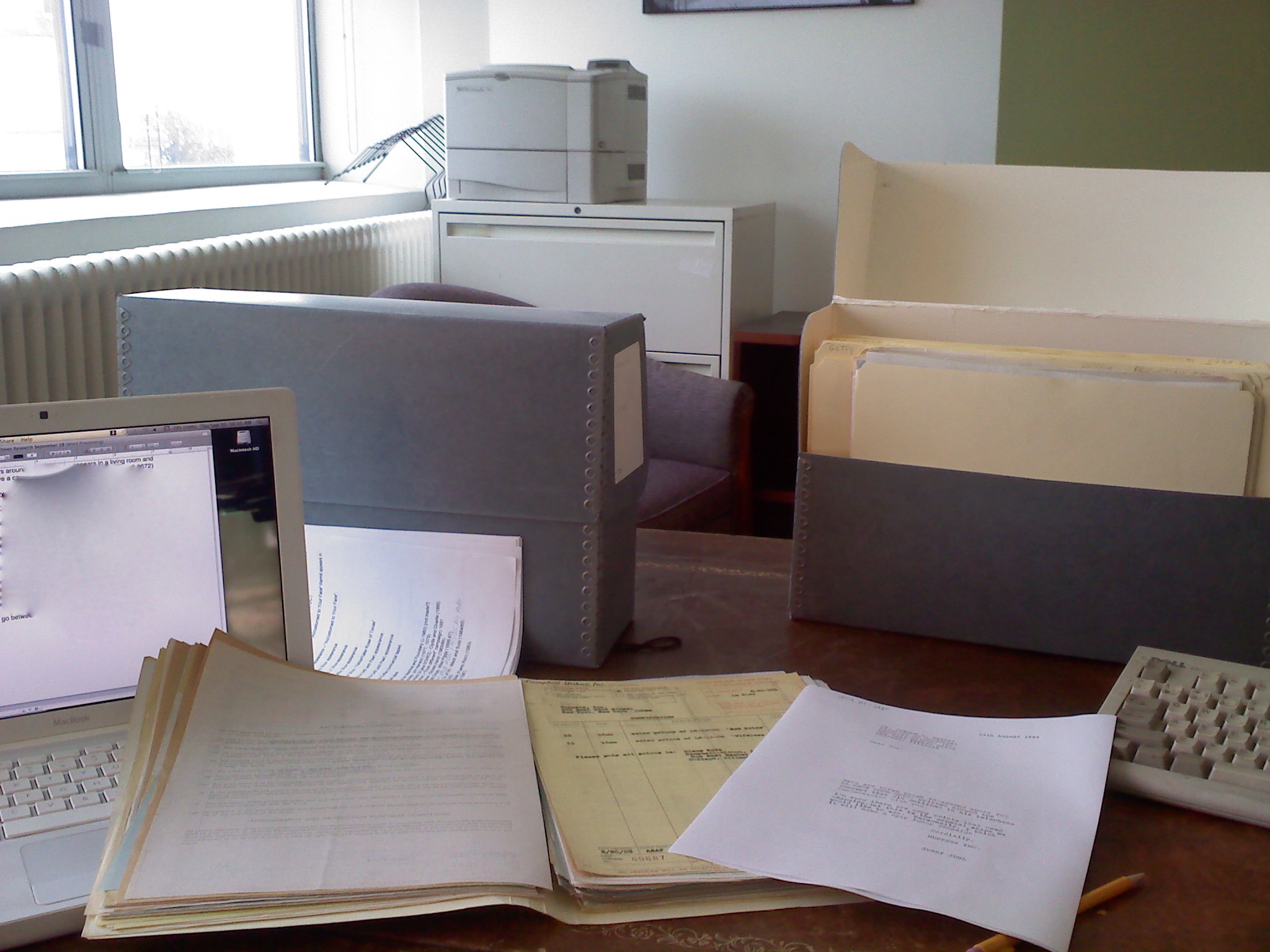
Meanwhile, I’m in good hands as Archivist Karen Falk (and her awesome assistant Crystal) brings me box after box of materials, which I spread out on a desk in the workspace they’ve generously provided for me — a quiet side office, lined with windows overlooking Long Island.  Here’s a bit of my mess as I worked one morning, poring over scripts, receipts and correspondence:
By Friday, like a kid in an amusement park, I was wishing I had just one more minute to keep reading before I had to catch my train back to Maryland.  It may be too ambitious to try to emulate Neal Gabler — who allegedly read every page contained in the Walt Disney archives for his spectacular Walt Disney: The Triumph of the American Imagination — but that doesn’t mean I’m not gonna try.  I’ll be back soon.

* Actually, I was there the week of September 27, but haven’t the chance to blog about it until today…

Happy Birthday, Jim Henson!

Seventy-four years ago, the world became a sillier, brighter, and better place.

“My hope still is to leave the world a bit better than when I got here.” — Jim Henson

Happy Birthday, Jim Henson.

Southern Charm

I’m coming to you today from my hotel room in Greenville, Mississippi, where the view out my window — once you overlook the roof of the casino just below — is of the wonderfully swampy Mississippi delta region.  Over the tops of the cypress trees, I can just see the braces of a brand new bridge spanning the Mississippi River. And while it was a seasonably cool 65 degrees when I left Maryland on Monday, it’s still hovering in the mid-90s, making me wish I’d packed something other than long-sleeves.

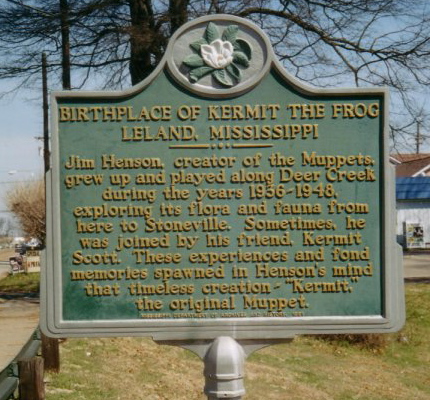
I’ve spent the past few days visiting the locations where Jim Henson was born, and where he and his family lived, on and off, for the first decade of his life. A sense of place is very important to me in biography, and I wanted to make sure I stood where Jim might have stood as  a boy, saw what he might have seen from the front porch of his house, knew where his father worked, and learned how far it was to the local movie theater.

And don’t let anyone tell you that Southern hospitality is a thing of the past. It may be a remnant of a long-gone era, but it’s still very much embedded in the way they do things in the delta region.  I met with town historians and longtime residents who showed me newspaper clippings and photos, steered me through the local elementary school, and who willingly piled into their cars and drove me around.  And every one of them invited me to dinner (or suppuh, as they so wonderfully say it here), extended an invitation to stay with them, asked me to “sit a spell,” and pressed on me personal possessions they thought might help in my research.   All in all, a memorable — and incredibly productive — trip.  I’ll be back.

I’m now getting ready to pack up and make the two-hour drive back to Jackson.  I love long drives, and I love listening to local radio.  To my complete and utter surprise and disappointment, I’ve been unable to locate a blues station anywhere on the radio dial.  Incongruously, then, I drove into the delta region listening to Men and Work and Night Ranger on the local 80s channel.  But I’ll keep trying.

A Hint, and Scent, of Autumn

As I was driving along one of the rural, two-lane state highways that we use to get around in our corner of Maryland, I noticed a few trees starting to change color.  Nothing splashy or flashy yet — no explosive reds or oranges — but some yellowing at the corners, and a bit of browning.  It doesn’t seem like it’s time to make the turn into fall, and yet it really is mid-September.

Apart from the leaves, though, there are several sure signs it’s really autumn — and depending on where you live, there are probably certain smells that let you know that fall is really here.   For some, fall means the smell of hot apple cider or the scent of roasted chestnuts, baking pies, or the sweet smoke of a fire.

For me, though, nothing smells like autumn like the woody smell of roasting green chiles.

Growing up in New Mexico, it was nearly impossible to step outside in September and not smell them .  On practically every street corner, you would find a makeshift stand set up where you could buy green chiles (and if you’re a real New Mexican, you would always ask if they were from Hatch, New Mexico) by the bag or the pound or the bushel.

Yum.

By themselves, green chiles are beautiful: shiny and green, with bent stems, and maybe a hint of red creeping down the sides.  Press your nose to one, and you can smell its potential — a hot, sweet, spicy smell.  But that’s not why we love them so much.

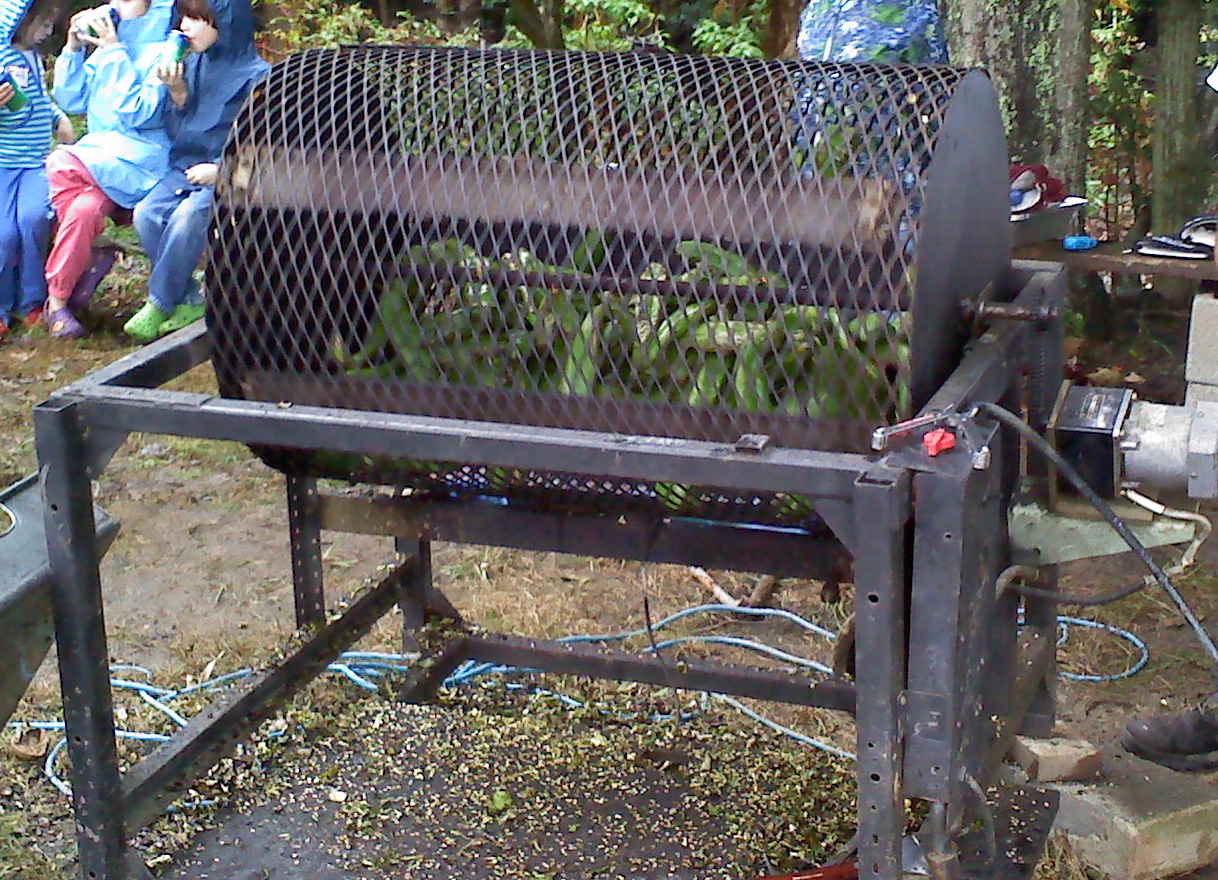
The real magic is in the roasting — and we take roasting very seriously.  While roasters nowadays are a bit fancier and built specifically for chile roasting, back in the 1970s, they were a feat of functional engineering.  As a kid growing up in Albuquerque, I would watch the chile vendors in front of the Eu-Can Bowl bowling alley, who always had the loudest roasters I’d ever heard.  They were made from oil drums, mounted sideways on a metal frame, with a handle welded to one end of the barrel.  Each barrel had an opening cut into it, which was then covered with a mesh-screen door.

Once you bought your chiles, the vendor would open the door, dump in the chiles, then fire up a gas burner directly beneath the barrel.  With the gas flames raging, he would then crank the barrel round and round by the handle, rolling the chiles around in the barrel, roasting them over the flames.

Ask any New Mexican about our weakness for green chiles, and we’ll likely all tell you the same thing: it’s not just the heat — you can get that from a jalapeno, for cryin’ out loud — it’s the flavor.  Green chile has a distinct taste to it, hot, yes, but also slightly sweet, with a smoky tang to it.  When chile is roasting, we’ll stand in the smoke, breathing deeply and letting the aroma soak into our clothes.  It tastes, and smells, like nothing else.

Now that I live in Maryland, green chiles are hard to come by.  You can buy them canned in the store, but,as I’m sure I don’t need to tell you, they really don’t compare. Fortunately, it’s still possible to get fresh roasted chiles — if you know where to look.

Each year, the Washington DC branch of the University of New Mexico Alumni Association hosts its annual chile roast at a farm deep in central Maryland.  They bring in over a ton of fresh green chile — right out of Hatch, New Mexico, naturally — and set up roasters.  Like so:

A chile roaster

I left with four delicious-smelling ten-pound bags, which I put in a large cooler to further stew while I made the 90-minute drive back home (the stewing makes the peels slide easily off the chile) When I got home, Madi and I sat on the back patio and peeled chiles for an hour, wearing gloves to keep the seeds from burning our skin.  The smell permeated our clothes but, to Madi’s disappointment, the rubber gloves kept the scent off our hands.

Our freezer is now crammed with forty pounds of roasted chile.  In keeping with tradition, come early October, I’ll be making an enormous pot of green chile stew, a New Mexico staple — and a sure sign that fall, at last, is officially here.

The Circle of Life

Back in March, when we made the correct but heart-wrenching decision to have our dog Abbey put down, we swore with Scarlett O’Hara-like determination that we would never own another dog again.  Abbey had been too good a dog, and losing her had been so heartbreaking, we felt quite sure we would never be ready to have another canine presence in the house.  Abbey was, we were convinced, the toughest act for any dog to follow, and we thought it would be unfair to any dog to bring him or her into our house where — again, in our view — the prior dog had set the bar almost impossibly high.  More than anything, we just felt the hole Abbey left in the family could never be filled by another dog — so we weren’t even going to try.

And yet, despite our tough talk, every time we passed anyone walking a dog, each of us would catch the other casting a long, lingering, and slightly jealous look at the dogwalker and his or her fuzzy companion.  Eventually none of us tried to hide it; we would just watch longingly as the dog passed by.  Almost always, one of us would make the Universal ‘Isn’t That Dog Cute?’ Sound: “Awwwwww…” Clearly, we were weakening.

Suddenly, and quite independently of each other, Barb, Madi and I began looking for dogs on websites for animal rescues in the Maryland and surrounding area.  We started passing e-mails back and forth to each other with attachments we’d pulled off the web.  “Isn’t this one GREAT?” Barb would enthuse.  “Awwww, I want THIS one!” Madi would gush.  Me, I wanted them all.  We scrolled through what seemed hundreds of entries, each dog practically begging us to take him or her home.  We made inquiries about a few; encouragingly, most of the dogs had been adopted. We were pleased for the rescued dogs, but that still left us dogless.

One night, it seemed our decision had been made for us.  Barb and I were out for our evening walk, heading down the hill on a new road that’s being constructed near our neighborhood, when a black dog came wiggling out of the woods toward us.  “Well, hello!” Barb said, and the dog came running right to her, then rolled over on its back , tongue lolling, tail wagging.  The dog was in decent shape — a bit thin and covered with spots of what looked like paint or tar — but while it had a collar, it had no tags, just a shock-collar sensor.  We thought perhaps it had escaped from a yard with an invisible fence, likely taking advantage of a drained battery or broken connection somewhere. 

It was dark, so we took the dog home, fed it, and put it in a bath.  That night, it started off sleeping on the floor of our upstairs bedroom — but the next morning, we found it curled up happily on the couch, its head resting on a throw pillow.  I took it to the vet to see if perhaps it had an ID chip by which we might identify it, and to get a bit of an idea of how old it might be.  After some poking and looking, our vet guessed the dog was about five — and while it had no ID chip, she did say it appeared to have been well cared for, as it was spayed and had no signs of illness, apart from a bit of an ear infection.

“Well, we’re sort of on the market for a new dog,” I told her, “but what do you normally do in a situation like this?  I mean, this is a really sweet dog, and we want to be sure that there’s not some eight-year-old girl really missing her.”  Our vet said she would call the other three animal hospitals in the area to see if anyone was looking for a dog, and would also check in with the humane society.  In the meantime, she recommended we put up “DOG FOUND” posters to see if anyone would call to claim her. “If no one claims her,” the vet said, “I don’t see why you couldn’t hang on to her.”  She sent us out the door with ear drops for the dog, and didn’t charge us a thing.  I love our vet.

For the next day or so, we worked at getting used to this new dog, in the event we might be able to keep her.  Madi was thrilled to have a dog in the house again, and purchased the leash and the multi-colored collar the dog now wore around its neck. We couldn’t agree on a name for her — Madi called her Lucy, while Barb was calling her Jenny.  I just called her the generic “Here, girl!” — oddly, I was finding it hard to attach myself to this dog; it felt too much like someone else’s pet, and Barb pointed out that it always seemed to be looking for a way out, as if it were saying, “This has been great, and you’re really nice people — but I’m ready to go home now.”

Ultimately, we decided we owed it to both the dog and its owners to do some due diligence, beyond merely putting up posters.  We put the dog in the back seat of the car and drove to the neighborhood that backed onto the construction area where we had found the dog. We waited to see if the dog would give some kind of sign that something, anything, looked familiar.  Mostly it just looked out the window.

Finally, we turned down into a cul-de-sac with no signs of life except for an older gentleman on a riding mower.  Barb pulled up in front of the house and waved him over.  He steered toward us and killed the mower next to the car. “Excuse me,” Barb said, “but do you know whose dog this is?”

The man hauled himself up off the mower. “Yup,” he said casually. “It’s ours.” 

His wife came out of the house and the dog — whose name, we learned, was Jada — sprinted for her.  She was home.

As we drove away, Barb cried a little.  When she heard the news, the corners of Madi’s mouth turned down. “She was so sweet!” she sighed. We were happy the dog was home, yeah . . . but we were, once again, dogless.

That afternoon, the phone rang.  It was Mutts Matter Rescue calling to see if we still wanted one of the dogs that had been up on their website. This particular dog was part of a large litter in North Carolina, one of those Mistake Litters in which purebred dogs mate outside their breed and create those wondrous mixed mutts that lots of us find irresistible, but which many shady breeders find undesirable.  The owner — so we were told — was simply going to shoot all nine of the mixed puppies — a practice that is legal in many states — until Mutts Matter stepped in.

The next morning, I picked up this so-called Mistake — a German Shepherd mix, 15 weeks old, and full of the business.  (And pee.  Lots and lots of pee.)  We named him Grayson, due to the fact that with his markings he looks like he’s wearing Robin’s mask.  (While technically that might make him Ace the Bat-Hound, Grayson is a much better name).

Grayson, the Boy Wonder.

We’ve had him a little over a week now, and he’s already fully housebroken, uses the dog door, walks beautifully on a leash, chews his toys (not the furniture), and responds to his name.  He’s also in the middle of everything, following everyone close at their heels and laying on the floor where he can overhear every conversation.  He is, as far as we can tell, the perfect dog for us.

And somehow, I’m quite certain Abbey has given the fellow her nuzzle of approval.  The circle of life just keeps going gloriously on.

Rolling Stone Picks The Top 100 Beatles Songs

Rolling Stone magazine is at it again.  Last time, it was the Top 500 Rock and Roll Songs of all time; now it’s the Top 100 Beatles songs.   As a fan of All Things Fab, it’s a given that I’ll be picking this issue up and griping about whether a particular song should be higher or lower, or complaining about what’s included and what’s not. Oddly, while RS‘s Top 500 list contained 23 Beatles songs, the highest-rated Beatles tune on the All-Time list — “Hey Jude” — comes in only at number seven on the All-Beatles list.  (I mean, really, if it’s number eight on the all time list, shouldn’t it be number one here?) Meanwhile, “Yesterday,” which  ranked below “Hey Jude” at 13 on the All-Time list, is four spots about “Jude” on the Beatles list at number four.  So much for internal consistencies.

In general, I agree with the overall content of the top ten, though I might slide some of them around a bit (my personal favorite for the Number One spot vacillates between “Hey Jude” and “Something”).   Here, then are Rolling Stone’s Top Ten Beatles songs, with a bit of side commentary:

(10) While My Guitar Gently Weeps

The words and music are George Harrison’s, but the famously weeping guitar solo is all Eric Clapton.  This cut from 1968’s The Beatles (the so-called “White Album”) was originally demoed by George on just an acoustic guitar, with slightly different — and, in the case of one verse, much more depressing — lyrics.  Here’s that demo — and it’s actually a  more haunting performance than the wailing version on the final album:

(9) Come Together

Originally written by John Lennon wrote as the anthem for Timothy Leary’s failed bid for governor of California, “Come Together” features some of Lennon’s most cryptic lyrics (a delight in wordplay in the vein of Edward Lear), a snaky bass line, and some of the best drumming of Ringo Starr’s Beatle career.  (Also of note:  the creepy opening, which sounds like Lennon is stage-whispering “shhhhhook!” It’s actually Lennon saying “shoot me!” as he claps his hands — with the clap reverbed and echoed under the bass line.)

Here’s Lennon performing the song in 1972 at Madison Square Garden (you can get it on his posthumous Live in New York City album):

(8) Let It Be

Rehearsed and recorded during the tumultuous “winter of discontent” that eventually produced their final album, the Beatles shelved the song — and all the tapes from the sessions — until 1970, when they were handed over to master producer Phil Spector to cobble something together. McCartney was never happy with the version Spector put together for the Let It Be album, with its heavy scoring and choir, and preferred something closer to this version, seen in the Let It Be film (look for Billy Preston wailing away on the keyboard):

(7) Hey Jude

As I said above, this one usually gets my vote for number one. It starts simply and, with each chorus, builds in a deceptively dramatic manner. The words are terrific, the sentiment genuine, never cloying, and Lennon and McCartney have never harmonized better.

(6) Something

To me, this is the sleeper on the list — and vies with “Hey Jude” as my pick for number one. It’s about as perfect a song as George Harrison ever composed, but McCartney’s wandering bass line is the icing on the cake. Without it, it would be a very different song indeed.

(5) In My Life

One of John Lennon’s most introspective songs, this is one that usually ends up on the lists that the more hard core Beatles fans put together, while those less familiar with the Beatles usually go, “Huh?” That’s probably because “In My Life” was never released as a single, appearing in the middle of the second side of Rubber Soul (thats track 11 for those of you who don’t remember vinyl. And get offa my lawn.) That makes it a bit of inside baseball, but its appearance in the top ten is well-earned.

(4) Yesterday

While it’s one of the most-recorded songs in history, McCartney — its primary composer — and the Beatles were somewhat nervous about this one, fearing it would ruin their rock and roll cred. For that reason, they refused to release it as a single in the United Kingdom (Capitol, their US record label, had no such qualms, and wisely released it in autumn 1965, where it sprinted to number one.)

Here are the Beatles — mostly McCartney, solo — following a cheeky intro from George Harrison:

(3) Strawberry Fields Forever

In late 1966, the Beatles were considering putting together an album of songs about their respective childhoods, to include a song McCartney had written about a street in Liverpool called “Penny Lane” and Lennon’s surreal nod to a Salvation Army garden near his childhood home. Ultimately — and in a move Beatles producer George Martin regrets to this day — “Penny Lane” and “Strawberrry Fields Forever” were packaged as a single (“Penny Lane” gets the Side 1 bragging rights) and the childhood album was scrapped in favor of the Sgt. Pepper motif.

The best-known story of the song involves George Martin splicing together two different versions of the song — which were also in two different keys — by slightly altering their speeds to put them in the same key. Hence, the rather druggy sounding lyrics. You can hear the splice at the 1:00 mark in the video below:

(2) I Want To Hold Your Hand

While I might argue that “She Loves You” is the better composition, “I Want To Hold Your Hand” was the song that kicked off Beatlemania in the United States in 1964, so it backs into the Top Ten for historical significance. Here are the Boys, performing on Thank Your Lucky Stars in England in 1963. And look! They’re not plugged in!

(1) A Day In The Life

While I like “Hey Jude” better, I can’t argue with this one as the top pick. The final cut on Sgt. Pepper’s Lonely Hearts Club Band is not only a fantastic song, nearly operatic in scope, but it also embodies the working styles and relationship of John Lennon and Paul McCartney. Inspired by a number of newspaper stories, Lennon wrote the opening and closing verses, but lacked a “middle eight.” McCartney, meanwhile, had a snippet of a song — about a man waking up, getting out of bed, and catching a bus to work — that he thought might fit into Lennon’s overall structure. They decided to use a symphonic crescendo between the two pieces and . . . well . . .

It worked. And it still does.

Sam Comes Home

I was hoping to put this up yesterday, but didn’t get the chance — on Wednesday, I had the pleasure of attending the signing ceremony in which Jane Henson formally presented a wonderful gift to the Smithsonian Institution’s National Museum of American History:  the entire Muppet cast of Sam and Friends. 

Sam and Friends went on the air in the Washington, DC area — on WRC, our local NBC station — in May 1955.  It was initially a five-minute performance that aired after the local news, and became so popular that it was eventually given two high-profile spots in the WRC lineup, airing immediately before the highly-rated Huntley-Brinkley Report, and then several hours later before the rapidly-ascending Tonight Show.

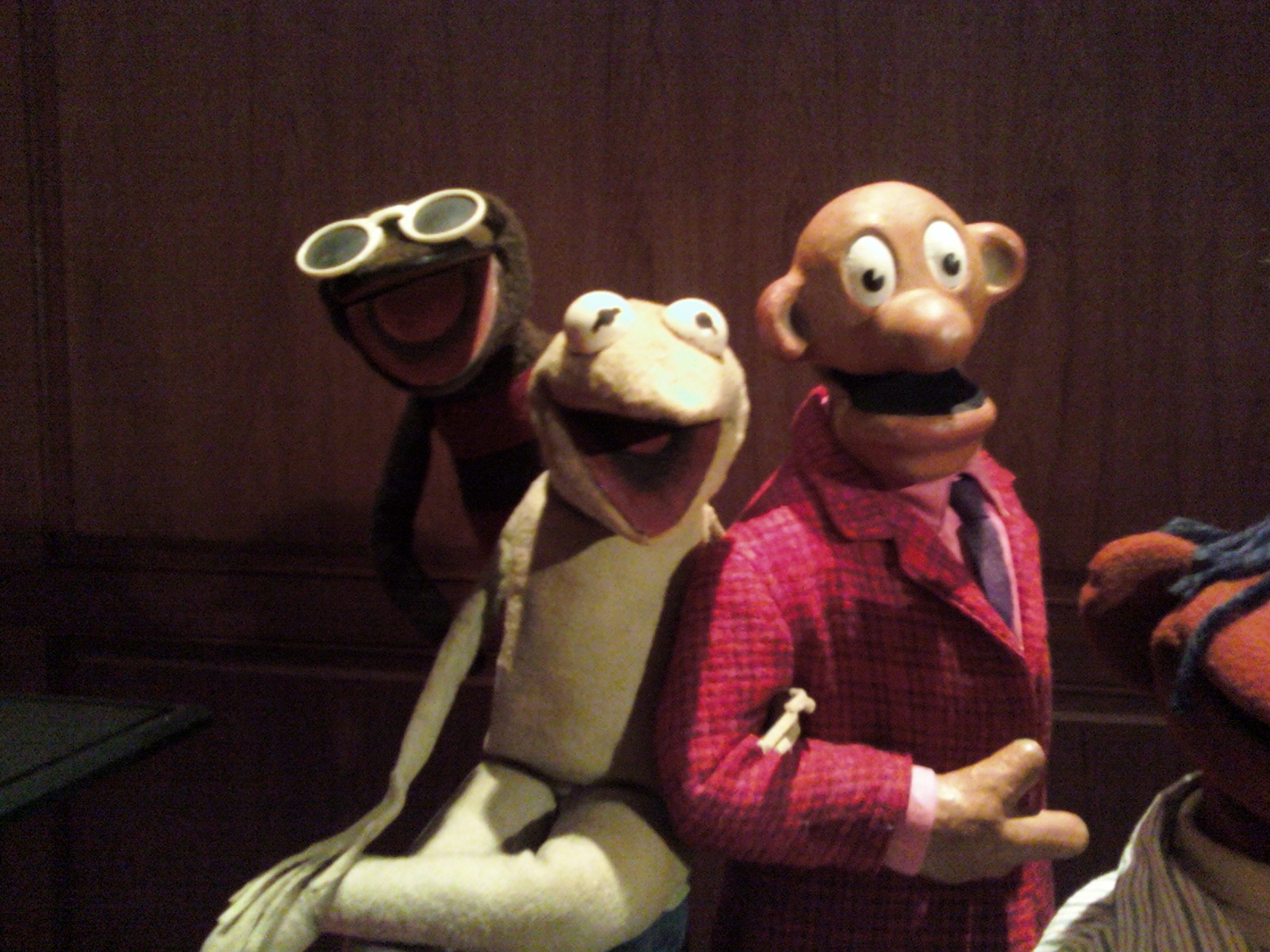
The fact that Sam and Friends was Jim Henson’s springboard onto the national scene already makes it worthy of inclusion in the Smithsonian.  But Sam had more going for it than even that — for among its cast members was a milky-green puppet named Kermit.  He wasn’t a frog then, and wouldn’t be for several years. But his simple design gave him enormous versatility as a puppet, and he quickly became Henson’s go-to character.  Kermit would be revamped and overhauled in the coming years, eventually becoming (in Henson’s words) “frogified,” but the basic design held.  Take a look at him here, posing with Harry the Hipster on the left and Sam on the right (I snapped this with my camera phone, and I apologize in advance for its shakiness):

Harry, Kermit and Sam

Despite their age — included in the collection is one of Henson’s very first puppets dating back to 1954, a rat named Pierre — the puppets are in beautiful shape, due to some careful restoring and first aid.  They’ll be put on display in the American History Museum in November, as part of the revamped (and incredibly popular) exhibit that includes the Ruby Slippers, Fonzie’s jacket, and Archie Bunker’s chair. (Do I have to explain any of those references?  I didn’t think so.) 

Deservedly, there were great gobs of press there.  Here’s a great piece from the Associated Press, and its video piece is just below:

…and here’s a nice piece from NBC news — which, in a way, gets bragging rights.

Have a good weekend!

Under Construction, Sort Of. I Guess.

Hunh. Without my prior knowledge or any sort of heads up, WordPress decommissioned the template I use for my website and substituted it with a different one.  Hence the slightly different look you’re seeing here.

Don’t get me wrong, I like some of the changes — notice, for example, that you’ll see drop down menus when you drag across the tabs above, instead of having the pages listed down the right hand side.  And behind the scenes, they’re allowing a lot more flexibility in formatting that I might play with in the coming months.

But it also arbitrarily shook up the way photos are formatted, which has resulted in some pages (such as Circle of Friends) looking  messy, as the text doesn’t wrap around photos as it used to.  It also benched some of the coding I use to track traffic and search words.  So I’ll have to clean up some of the mess and recommission some of my code.   However, this should not affect your regularly scheduled programming.

Almost Like Being There

As you can imagine, the last week has been fairly crazy — crazy in a good way, natch — and I apologize for not checking in here a bit more quickly.  I appreciate all the kind e-mails and notes — you’re all Good People.  Thanks for all the nice words.  I mean it.

BIO guru Jamie Morris sent out a heads up the other day to note that many of the remarks and sessions from the Compleat Biographers Conference in May have been made available by the University of Massachusetts — our hosts that day — for your viewing pleasure.  And just so you don’t have to go and find them, here they are:

First, here’s the opening session, with welcoming remarks by Ray Sheppard, and the opening address by Pulitzer Prize winner Debby Applegate (The Most Famous Man in America: The Biography of Henry Ward Beecher), who discusses the need for an organization like BIO, where writers can get together to learn from and support each other (Her stunning “I don’t know what to tell you” story comes at about seven minutes in):

Next, here’s a panel on Trends in Biography, where journalist D. Quincy Whitney, Henry Holt senior editor Helen Atsma, and biographers Gayle Feldman and Megan Marshall (The Peabody Sisters) discuss the future of biography — and, at times, publishing in general:

Next , here’s Harriet Reisen (Louisa May Alcott: The Woman Behind Little Women), editor Carole Deboer-Langworthy, Beatrice Mousli (Virginia Woolf), and Steve Weinberg (Armand Hammer: The Untold Story) discussing one of the most surprisingly difficult parts of writing a biography, Selecting A Subject:

Now it’s the keynote speech by Jean Strouse, winner of the first BIO Award (there’s a bit of organizational housekeeping to take care of before Ms. Strouse speaks — her keynote begins at about 17 minutes in):

Next up, biographers Debby Applegate, James Bradley (Flags of Our Fathers), Anne C. Heller (Ayn Rand and the World She Made), and editors Yen Cheong and Lissa Warren head up a lively discussion on Marketing Your Biography. It’s one thing to write it; now how do you ensure it finds readers?

Finally, here’s a fun session — courtesy of Melissa Nathanson (who’s working on a bio of Justice Blackmun), Charles J. Shields (Mockingbird: A Portrait of Harper Lee), Will Swift (The Roosevelts and the Royals), Nancy Kriplen (The Eccentric Billionaire: John D. MacArthur–Empire Builder, Reluctant Philanthropist, Relentless Adversary), and Kitty Kelley (Oprah)on Dealing With The Family of your chosen subject:

Like what you see? C’mon, how could you not? If you’re not a member already, think about joining BIO. Go here.

In Which All Is Revealed…

At last, here’s the answer to the question “Who are you writing about now?”

It’s this wonderful fellow right here.

Here’s the way it was reported on Galleycat:

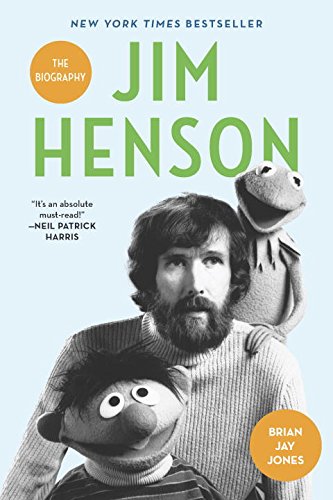
Jim Henson Biography Acquired By Ballantine

Biographer Brian Jay Jones has sold a biography of the late Jim Henson–the genius behind the The Muppet Show and Fraggle Rock. The project is currently untitled.

Jonathan Lyons of Lyons Literary negotiated the deal with senior editor Jill Schwartzman. Jones is the author of Washington Irving: An American Original, and is working with the blessing of Henson’s family.

Here’s more from the release: “The biography begins with Henson’s days as an early TV pioneer, innovative artist and businessman who created a whole new way to present puppetry in a popular art form for television and motion pictures. It will also cover Henson’s famous creations, such as The Muppet Show, Fraggle Rock and his important contribution to the development and success of Sesame Street, and describe his groundbreaking artistic and technological work that continues to this day.”

To say I’m incredibly thrilled, delighted, honored, and humbled to be working on such a project would be a colossal understatement.