One Of Those Faces

I was shopping at Home Depot the other day, looking much as I do on any hot afternoon when I’ve been working in the yard and decide to take “just a moment” to run to the big orange box to pick something up: sunburnt, baseball cap on backwards, sleeveless black t-shirt (this one reading “Some Adult Assistance May Be Required”), workboots and shorts . . . yeah, I’m the very portrait of dashing, I know. 

Anyway,  I was standing in the hardware section, looking like a mess and fiddling with various thicknesses of chains, when a woman walked up to me with a very panicked look on her face.  “Can you help me out here?” she begged, laying her hands on me. “My husband sent me down here for ‘2 standard screws’ and I don’t know what that means.”

Well, I’m hardly mechanically-inclined, but I do know what a standard screw looks like.  So after a few moments of searching, I handed her an 85 cent bag containing exactly two screws.

“Thank you,” she said, beaming. “Now, can you tell me where I can find electrical outlets?”

I stammered something about how I thought they were over on the left side of the building, near the bugspray, but I wasn’t sure.  She gave me a look first of confusion, then of surprise.  “Oh!” she said, an almost visible light bulb coming on over her head. “I’m sorry, I thought you worked here.”

Now, as I mentioned at the outset, I looked nothing like a person who worked at Home Depot.  In fact, I looked like a vagrant.  But that happens to me a lot.  I think I just have One of Those Faces.

I’m also the Guy Who Always Gets Asked For Directions.  If you’ve been reading this blog even casually, you know what a laugh that is — I can get lost walking around the block.  Yet, I can be standing in the middle of a crowded city block in a foreign city, and there’s a one hundred percent chance that a complete stranger will come marching up to me and ask for directions.  Even when I explain that “I’m not from around here,” many will still take out a map, spread it out on the hood of a nearby car, and ask me to help them read it and figure out where they are.  And like an oaf, I’ll lean over the map — which is not only usually in a foreign language, but also looks as if it’s been used to mop up Sunny D — and try to figure out where we are, and how they can get where they need to go.  Usually I end up apologizing to them, feeling guilty that  I was of no assistance whatsoever.  I have no idea why they asked me for directions in the first place; I just have one of those faces.

I once exited an office building amidst a crowd of fifteen coworkers, all of us walking together in one large group to go to lunch two blocks away.  With a committed group mentality, we stepped off the curb against the red light, jaywalking en masse across C Street, one great blob of humanity.  Guess who was the only one to get pulled out of the crowd by a passing police officer and cited for jaywalking?  Yup.  The guy with One of Those Faces. 

Perhaps the my finest hour was in a crowded McDonald’s, just north of D.C.  My pal Mike and I were driving to New York one Memorial Day weekend, and had stopped at Mickey D’s for something to eat — along with, it turns out, a busload of people on their way to the District for the holiday weekend.  As I stood patiently in line amid this enormous sea of people, a longhaired fellow in shredded clothes came staggering in the side door, wove his way through the crowd, steered past several crowded, overflowing tables, and planted himself squarely in front of me and began shouting directly into my face.  This went on for perhaps two minutes, when he suddenly stopped and strode out of the restaurant, ignoring everyone.

Mike shook his head, laughing.  “I know you say that happens all the time,” he said, ” but I’m not sure I would’ve believed that had I not seen it.”

But it does happen to me all the time.  I just have One of Those Faces.
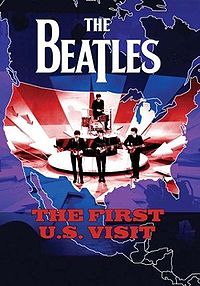
Reviews in Brief: The Beatles: First U.S. Visit (DVD)

beatlesfirstvisitIn February 1964, documentarians Albert and Donald Maysles were given an unprecedented amount of access to film and record a phenomenon that had much of America at first scratching its head in curiosity, and then screaming along with the rest of the world — a cheeky British rock group called The Beatles, who were making their first, short sprint across the eastern seaboard of the United States.

Content to let the camera act as impartial observer and generally stay out of the Fabs’ way, what the Maysles’ capture is nothing short of fascinating — a snapshot of one of the most important moments in rock history:  Tens of thousands of screaming girls. Dopey hangers-on. Baffled reporters. And four extremely talented musicians who seem rather unfazed by it all.

While you may likely have seen some of this footage in Anthology or The Compleat Beatles, seeing it for the first time in its complete, raw context is an eye-opener for even the most world-weary Beatles fan.   It’s not quite the Beatles “with their trousers off” (as John Lennon once described Let It Be), but it’s definitely the Beatles with their guards down — and we’re all the better for it.

The Maysles’ footage was eventually shelved by United Artists in favor of the faux documentary A Hard Day’s Night, but comparisons with that film are unavoidable.  As a documentary, it’s the less-idealized version of what ended up in Richard Lester’s jaunty film — but the Beatles in real life aren’t quite the iconic stereotypes that Lester and screenwriter Alun Owen created for the Boys’ on-screen personas (as John Lennon once said derisively of Hard Day’s Night:  “Paul, cute; me, witty…”).  In fact, when you’ve got them in Maysles’ lens, unedited and unscripted, you’ll see that McCartney already looks to be the most business-minded and PR-savvy of the Beatles, while Lennon . . . well, Lennon looks both bored and terrified at the same time, a far cry from the bold, tart-tongued Fab of A Hard Day’s Night.

Just as interesting is seeing the supposedly impartial and skeptical members of the press fall all over themselves, suddenly captivated by the charisma of the four young men they’ve been assigned to tailgate.  The Beatles all but work their wills on the press during the train rides to and from Washington, D.C., while New York deejay Murray the K makes a cringe-worthy spectacle of himself, gushing dopily over the boys even as he tries to paint himself a hipster who truly “gets” the Beatles.

The film cries out for narration at some points (watching it with commentary makes it a completely different and even more entertaining film) but the footage is always clear, and the sound is surprisingly crisp (and Maysles will tell you how he did it in the commentary).  Through it all, what shines through the most is the charm, talent — and, at times, a warm patience — of four young men who were rapidly becoming the most famous band in the world.  Great stuff.

For a taste of what you can expect, here are the opening moments of the Maysles’ film — with the familiar first press conference, some unguarded moments in the car, phone calls to Murray the K to request songs on the radio, and late night hotel chatter:

The Sagging Book Market (of 1819)

Think the beating the book market is taking by a slumping economy is a new phenomenon?  Think again. 

Writing in the latest issue of the journal Common-Place, Fordham University professor Edward Cahill discusses how the rise of easy credit in the early nineteenth century led to a devaluing not only of paper money, but eventually of literary currency as well — culminating in the financial panic of 1819 and the collapse of countless booksellers.  Left standing among the debris was Washington Irving’s Sketch Book of Geoffrey Crayon. “But if the appearance of the Sketch Book marked the economic development of American literary culture,” Cahill says, “it was also haunted by widespread economic unrest.” 

Cahill goes on to explain why The Sketch Book was not only a survivor, but also provided elegant commentary on — and a bit of a eulogy for — the early 19th century publishing industry. Eventually, Cahill concludes, “elite literary culture would be inextricably tied to popular culture, despite many protests to the contrary.”   Well put.  Once again, almost in spite of himself, Washington Irving shaped our perceptions of popular culture.

Professor Cahill’s article,  “The Other Panic of 1819: Irving’s Sketch Book, Literary Overproduction, and the Politics of the ‘Purely Literary,'” can be found right here.  Go get it.

Missed It By That Much…

Well, shoot.  I just found out today — through the marvels of Googlecrawl — that the Biography Group of the Harvard Club of New York was discussing Washington Irving: An American Original at its meeting last Thursday. 

Had I known that, I might have crashed it.  But in a polite way, of course.  It is Harvard, after all.

No (TV) News Is Good News

I’ve had it.  I just can’t watch television news any more. 

I tune in each morning to get the headlines and the weather.  Instead, I get  newspeople who are more consumed with their own fake laughter, dumb banter, less-than-witty repartee, and projecting phony moral outrage than they are in giving me the headlines.  It’s not about news, it’s about events and personalities.  So instead of getting information I can use, I end up shouting at the screen and spilling my coffee.

Like Cardinal Ximinez, I stupidly keep giving the news channels three last chances, hoping I’ll tune in tomorrow and things will be better.  They never are.  It’s too much about ratings and winning time  slots than providing the news; consequently, it’s all about the outrage, not the coverage. And don’t try to talk me down, as I am no longer prepared to be rational about my annoyance.  I’m to the point where everything bugs me.

First up, there’s the new spin on the old “if it bleeds it leads” policy, focusing on some completely random incident and how it might just possibly kill you and everyone you love.  My favorite:  “Coming up, the latest on spontaneous combustion of wood chips at a local playground, and what you can do to keep your family safe.”  This report is immediately followed by incredulous stares and oh-so-objective handwringing from the anchorpeople that the government is doing nothing to regulate the use of wood chips on playgrounds.  And I wish I was making that up.

Next, it’s a panel of “experts” called in to debate the economy, or foreign policy, or health care, with a panel composed wholly of . . .  journalists and other newspeople.  I have nothing against journalists, but just because you’re a reporter who’s beat includes the local police station doesn’t mean you’re an expert on public safety.  I don’t mind having a round-robin discussion in which everyone gives their opinion on the chosen topic, but these talking head sessions are too often presented as providing viewers with the facts — which, to make the circle complete, then get reported by other media outlets as such.

And, of course, there’s the the endless rounds of dumb banter as reporters transition between stories, injecting unfunny commentary in the name of witty repartee, and then laughing waaay too hard at anything anyone says.  Worse, though, is the editorializing that is often almost casually dropped in following a story, as the anchors discuss the issue for just a moment among themselves (why they do this, I have no idea). 

In this department, the last straw for me was a moment on the increasingly vapid Morning Joe on MSNBC (yes, Joe, we know you were a Congressman, and cast LOTS of tough votes, and ran successfully for reelection, and defied your own president and yadda yadda.  And we know so because you tell us at 26 minutes past every hour, every day). 

Immediately following a piece on waterboarding, Scarborough engaged Meet the Press moderator David Gregory in a brief discussion on the letter of the law.  Here’s Scarborough’s outro on the piece:

…history has shown over the past seven years that actually it [waterboarding] is very, very effective. Let’s tell the truth. Let’s talk about what information we got with waterboarding and then we can debate it  . . . It’s effective but is it worth it . . . Maybe it would have been better for a couple of other cities to burn . . . um . . . instead of waterboarding and we can have that debate.  If you’d like Washington DC and Los Angeles to be obliterated by a nuclear blast I certainly respect your opinion and I think we should just talk about it.

(Video of this conversation is here.  Joe’s rant starts at about 3:10.)

Forget the politics of the issue; that was just a plain dumb and irresponsible thing to say. And it’s dumb because Scarborough was just riffing, channeling Michael Scott from The Office and not really thinking about what was coming out his mouth even as he was saying it. 

That sort of casual badinage might be the way things work now, but it’s not working for me any more, any where. 

I’m done.

Back At It

My apologies for the lack of posts here lately — I’ve been hunkered down trying to get some work done on Project Blue Harvest.  It’s been slow going, but that’s mostly my fault, since I preferred spending some time with Madi during her Spring Break, and trying to get some work done in the yard while the weather was pleasant, rather than spending some seat time at my desk.

While I more than managed the first of these two items (quality time with The Kid), I waited too long on the second one.  I opted not to mow on Friday when it was 70 degrees, holding out instead for the promise of some wonderful Easter weekend weather.  Fat chance.  It rained all day Saturday, and Sunday was cold and windy.  I mowed anyway.

Anyway, now that I’m mission accomplished on those two important items, it’s back to the desk.  But I’ll see you back here shortly, I promise.

Spring Break

It’s Spring Break here in the Maryland area, which means clearer roads, crowded museums, and no sign of our daughter until she emerges groggily from her room at 10:30 a.m.  I opted to stay home with Madi for her first day of break yesterday, and we squeezed in exactly seven minutes worth of xBox time before she went off to a friend’s house for the day and night.

But that’s okay; she deserves her fun, and I’ve got some work to do, starting with straightening up my office.

Yeah, I know — I just moved into the new space at the beginning of the winter, but I’ve already cluttered it up with stacks of mail, CDs, and empty amazon.com boxes that I need to flatten and recycle.  Once that’s out of the way, I’ve got some reading to do, likely  followed by several hours of staring into space before I sit down and really try to get some work done.

Fortunately, the weather today is conducive to working inside — it’s a chilly 39 degrees outside, so my urge to mow the rapidly-greening lawn and plant cyclamen is . . . well, not gone, but low. The only real problem I’m having here at the desk is that the windy weather outside is causing the power to flicker — which means I’ve had to restart this blog entry several times.  Fortunately, WordPress saves my drafts, so no real harm done.  But I can’t say the same for the document I was poking at.

Okay, time to get cracking!

Happy Birthday, Washington Irving!

Happy 226th!

Happy 226th!

On the evening of April 3, 1783 — the same week New Yorkers learned of the British ceasefire that effectively ended the American Revolution — Washington Irving was born on William Street in Manhattan.  (If you’re interested in seeing where he was born . . . well, sorry.  There’s a Duane Reade pharmacy on the site today.  Go enjoy Sunnyside instead.)  Today marks his 226th birthday.

Irving was a not a great celebrater of his birthday — or, at least, he doesn’t indicate as much in his personal letters and journals.  Nonetheless, there were times in his life when important events seemed to fortuitously fall on April 3. 

For example, it was on April 3, 1830 — Irving’s 47th birthday — that Irving learned that the Royal Society of Literature, citing his work on The Life and Voyages of Christopher Columbus and Chronicles of the Conquest of Granada, had chosen to award him one of its Gold Medals for “Literary works of eminent merit, or of important Literary Discoveries.”

Three years later, on April 3, 1833, the 50-year-old Irving learned, to his great amusement, that he had been awarded an honorary Doctor of Laws degree by Harvard.  Irving — who could probably fairly vie for the title of New York’s worst attorney ever — was delighted at the irony. “To merit such rewards from my country is the dearest object of my ambition,” Irving wrote to Harvard president Josiah Quincy, “but, conscious as I am of my imperfections, I cannot but feel that my Countrymen are continually overpaying me.”

In 1845, while serving as U.S. Minister to Spain — an appointment cheerily and astutely conveyed upon him by President John Tyler — Irving made a special note of his 62nd birthday.  “I reccollect the time when I did not wish to live to such an age,” he wrote reflectively, “thinking it must be attended with infirmity, apathy of feeling; peevishness of temper, and all the other ills which conspire to ‘render age unlovely.’ ”

Yet, as he wrote to his sister Sarah that same afternoon, with the warm April sunshine streaming into his Spanish salon, he was feeling good, even optimistic:

“Here my Sixty second birthday finds me in fine health; in the full enjoyment of all my faculties; with sensibilities still fresh, and in such buxom activity, that, on my return home yesterday from the Prado, I caught myself bounding up stairs, three steps at a time, to the astonishment of the porter; and checked myself, reccollecting that it was not the pace befitting a Minister and a man of my years.”

The last birthday Irving would celebrate — his 76th, on April 3, 1859 — was a gray, rainy Sunday. As greetings and bouquets arrived at Sunnyside—“beautiful flowers to a withered old man!” he said—Washington and his nephew Pierre Munroe Irving sorted through a number of unpublished manuscripts, mostly Spanish tales, still lying at the bottom of a desk drawer. Washington let them be; he was done writing. “Henceforth,” he vowed, “I give up all further tasking of the pen.”

He was as good as his word, content to live out his remaining days at Sunnyside in the company of friends and family — but always taking to heart his own words of wisdom: “Whenever a man’s friends begin to compliment him about looking young, he may be sure that they think he is growing old.”

Friendly Reminders

Happy Launch Day to Friend o’ the Blog (and fellow member of the Lyons Den) Jaye Wells, whose debut novel Red-Headed Stepchild officially hits the shelves in a bookstore near you today.  Heck, you can even get it on Kindle.  She’s also podcasting over on Fangs, Fur, and Fey this afternoon as well, so go listen.

Also, congratulations to the super-cool Jamie Ford, whose Hotel on the Corner of Bitter and Sweet deservedly pole-vaulted its way onto the New York Times bestseller list this week, showing up at number fifteen.  And I’m sure it’ll make its way even higher.  Maybe now they’ll add the East Coast to his book tour so I can say hello to him over at Politics & Prose.

Meanwhile, you can continue to check out new episodes of Kamen Rider Dragon Knight every Saturday on the CW by my pal Scott Phillips — who’s also preparing a collection of short stories, Tales of Misery and Imagination, as well as working on a collaborative project with sci-fi writer Robert Vardeman.  Scott continues to be one of the most entertaining reads around, so swing by his blog and say hey.

Finally, congratulations to Josephine Damian, whose short story “Finished” was accepted for publication in the October issue of Yellow Mama.  Reserve a copy at your newstand now.  Don’t make JD come after you.

“The Despot’s Heel Is On Thy Shore”

maryland1Maryland State Senate President Mike Miller has asked that a state commission take a look at Maryland’s official state song to determine whether its lyrics should be changed or, more radically, that a new state song be adopted.
Why the fuss?  Well, Maryland’s state song — “Maryland, My Maryland” — while it wasn’t formally adopted as the state song until 1939, was written in 1861 by a loyal Confederate, who called for his home state to rise up and fight the Union.  It was penned by James Ryder Randall, a Baltimore-born journalist who was teaching in Lousiana in April 1861, when he heard the news that the first Union troops had marched through Baltimore on their way to protect Washington, D.C.  During the Civil War, Maryland was a border state, officially loyal to the Union — but in the early years of the Civil War, it was torn between Confederate and Union tendencies.  And no place was more torn than Baltimore, where residents rioted as the Union troops made their way through the city.

Learning of the riots, Randall immediately wrote — by candlelight, so the story goes — a nine-stanza poem, urging his home state to rebel and secede from the Union. “Come!” Randall urges several times, at one point beckoning Maryland to “spurn the Northern scum!”  (Rightly, it is still considered to be the nation’s “most martial poem.”)

With some minor tweaking (mainly by adding “My Maryland” at the refrain), it was quickly set to the tune of “Lauriger Horatius” (the same tune as “O Tannenbaum”) and became a Southern anthem — supposedly, Southern troops played the song as they marched into Maryland to begin their campaign at Antietam.  Given the ultimate turn of events, however, Randall is often called “the Poet Laureate of the Lost Cause.”

Here, then, is the opening stanza of Randall’s poem:

The despot’s heel is on thy shore,
Maryland, My Maryland!
His torch is at thy temple door,
Maryland, My Maryland!
Avenge the patriotic gore
That flecked the streets of Baltimore,
And be the battle queen of yore,
Maryland! My Maryland!

The “despot” in the opening line is, of course, President Abraham Lincoln.  But Randall’s just warming up; by the sixth verse, the Confederacy — especially Maryland’s border state of Virginia — is pleading with its sister state to stand and be counted with the South:

Dear Mother! burst the tyrant’s chain,
Maryland, My Maryland!
Virginia should not call in vain,
Maryland, My Maryland!
She meets her sisters on the plain —
“Sic semper!” ’tis the proud refrain
That baffles minions back amain,
Arise in majesty again,
Maryland! My Maryland!

Randall brings things to a fever pitch by the eighth stanza:

Thou wilt not yield the Vandal toll,
Maryland, My Maryland!
Thou wilt not crook to his control,
Maryland, My Maryland!
Better the fire upon thee roll,
Better the blade, the shot, the bowl,
Than crucifixion of the soul,
Maryland! My Maryland!

You get the idea — and hence Maryland’s dilemma, and Senate President Miller’s request that the song be looked at for modifications.  Some verses — including the fiery eighth stanza — can probably be read broadly, urging, for instance, Maryland to always rise up and overcome any “Vandal toll.”  Other verses, however, with their explicit references to Baltimore, Virginia, and other specific events, are more problematic.  In context, it’s a tough song for Maryland to embrace; Maryland was never a Confederate state, so the song can’t really be said to be memorializing a part of Maryland’s official past. 

In fact, its adoption as the state song, nearly eighty years after the Civil War, seems more a choice of convenience than careful thought — the result of a statehouse discussion that went something like this:

Senator:  We need a good state song.  What should it be?

Delegate: Are there any songs that have the word “Maryland” in the title?

Senator:  There’s “Maryland, My Maryland.”  What about that one?

Delegate:  What’s it about?

Senator:  I don’t know, but, see, it’s got the word “Maryland” in it.

Delegate:  Works for me.  I vote aye.

Many people pointed out a similar problem when Reagan, and other politicians, adopted the song “Born In The USA” as a campaign song:  Apart from the song title and refrain, the song itself — a portrait of the darker side of the American dream — isn’t a terribly appropriate one to be campaigning with.

Ten years ago, Virginia struggled with this issue as well, when they decided that the slave minstrel song “Carry Me Back to Old Virginny” — with its references to “darkeys” and “massa” — wasn’t the kind of image they wanted to project. Virginia shelved the tune, adopting it instead as the “state song emeritus,” and launched a contest to find a new state song. Unfortunately, in 2000, Virginia suspended the contest.  At the moment, then, Virginia has no state song.

Ultimately, I think this is a matter that does deserve some further thought. The hardest part will probably be coming up with words that rhyme with “Maryland.”