Making Magic: Hey Bulldog

As you know, I love looking behind the scenes at how people work.  What you’ll see below isn’t quite a making of video, nor is it a music video per se — but it’s one of the few existing bits of color film showing the Beatles at work.  In this case, they’re recording “Hey Bulldog,” a  1968 song that was scotched as a potential single then shelved for The Beatles before finally appearing on the Yellow Submarine soundtrack in 1969. 

There’s a strong group dynamic at play here– John Lennon and Paul McCartney read off of Lennon’s scrawled lyrics sheet, George Harrison switches guitars for the solo, Ringo makes whooping background noises, and John and Paul finally go a little nuts at the end, barking and hollering.  It’s probably one of the last times the group would have quite so much fun in each other’s company — they would disintigrate into the fractious sessions for The Beatles later in the year — and it remains a fun song.  It’s also one of Madi’s very favorite songs to play on Beatles Rock Band.

Institutional Memories: Robert C. Byrd

Earlier this week, Senator Robert C. Byrd of West Virginia became the all-time longest serving member of Congress, racking up 20,774 days —  that’s 56 years, 320 days — that Byrd has been either a Congressman or Senator.  That makes him the Cal Ripken of Congress, and it’s an impressive record, a testament not only to the 92-year-old Byrd’s stamina and health, but to his unswerving commitment to the people of West Virginia, who thanked him by returning him to the Congress and the Senate again and again and again and . . . well, you get the idea.  He’s served three terms in the House, nine in the Senate, and, I believe, has never lost an election.

I’ve always liked Byrd.  Sure, he could be cantankerous and had — has — a habit of lecturing, but I always found those habits endearing. He belongs to a generation of Senators we don’t see much nowadays, either — he’s a Senator who loves the Senate, respects its traditions, and tries hard to uphold its integrity.  He loves debate and oratory — you could always count on him quoting Shakespeare off the top of his head (“Bring me my robes!”) — and while we often rolled our eyes when he took to the floor with another long speech, he was never dull, whether he was discussing Shay’s Rebellion, civil rights, or the infamous Twinkie defense.

He could also be blistering with members who he believed were not behaving in a manner worthy of the same institution that housed John Adams or Daniel Webster. When Senator Bob Packwood was accused of sexual harassment during the mid-1990s — indulging in activities that seem tame by today’s creepy Larry Craig/David Vitter/John Ensign/ad nauseum standards — Byrd was one of the few who angrily shook his finger at Packwood  on the floor and declared that he should “have the grace to go!” It genuinely pained him to see the Senate disgraced.

He also knows its history backwards and fowards, and had a series of speeches he delivered on its 200th anniversary in 1989 bound into a gorgeous three-volume history of the place, printed almost exclusively for Senators  (I was lucky enough to snag exactly one volume, which I rescued from a recycling bin).  He understands its rules and precedents like no other member, and God help any Senator who tries to outmaneuver Byrd using parliamentary procedure.

And yes, he knows how to bring home the bacon for his home state.  It’s with good reason there are countless structures and stretches of road in West Virginia named for the man; as a long-time member of the Senate Appropriations Committee — and he’s been the Ranking Member or Chairman for as long as I can remember — he’s never been shy about sending dollars back home. Like it or not, it’s all part of the job — and no one does it better than Byrd.

To staffers, he was always more than a little intimidating.  If he was sitting in the chair presiding over the Senate, staffers would try not to set foot in the well of the Senate — the area directly in front of the presiding officer — lest we fall under his withering glare.  To Byrd, the Senate is for Senators, and staff belong squarely behind the railed-off seating area at the back of the room.  My Senator once had an amendment pending, and shortly before its introduction, while it was sitting at the desk, the clerk beckoned me down to the well to help clear up a minor wording error.  Byrd was sitting in the chair at that moment, and I’ll never forget the look on his face as I staggered down to the front desk directly in front of him, my knees knocking.  It was all I could do not to say, “Hey, he ASKED me down here!”

And yet, he could also be incredibly generous to staff.  In my last month on the Hill, Byrd delivered a blistering, and hilarious, floor speech in which he derided what he called “verbal clutter” — the habit we have of using terms like “um,” “you know,” and “like” in our speech.  Byrd tut-tut-tutted and shook his head sadly, but he was clearly enjoying himself.  I thought it was so funny — and spot on — that I sent a short note over to his office telling him how much I had enjoyed the speech. Several days later, I received a thank you note back from the Senator.  At the bottom, in his steady hand, he had written, “How kind of you! Please come by my office so I may thank you in person!”

I’m sorry to say I moved away shortly thereafter and never had the chance to take the Senator up on his offer.  I wish I had.  He’s a good man, a terrific legislator, and a great historian.  I wish him nothing but the best.

Washington Irving, C Blocker?

Rebecca Gratz

Claire Salisbury — who’s doing terrific work bringing to light the life and letters of the 19th century philanthropist Rebecca Gratz over on her blog,  Rebecca Gratz and 19th Century Americahas two fun entries this week on a a good friend of Rebecca’s . . . an aspiring young writer named Washington Irving.

Irving and Gratz had an interesting and decidedly non-romantic relationship — one based on mutual respect, good conversation, and similar senses of humor.  In fact, there were times when Rebecca used Irving as a willing tool in thwarting the advances of suitors, much to the delight of both.

I’ll let Claire serve as your tour guide for these particular stories (she is, after all, a docent for the Rosenbach Museum and Library in Philadelphia, so you’re in good hands).  The two entries are here and here, and her full blog is here.  Over to you, Claire . . .

Quiet As A What?

So, we’ve discovered we have a mouse living on the second floor of our house.

Our first hint was odd sounds in the middle of the night.  The first time we heard the noise–a very faint pit-pat-pit-pat–I made a 3 a.m. tour of the house with a baseball bat in hand, and when I saw the dog was sound asleep on the first floor (since developing hip dysplasia, Abbey has rightly determined, to her disappointment, that she can’t make it up the stairs), I decided that we had likely opened up our house somewhere to a mouse.

We’ve seen him a few times since then; he’s a little grey thing, only about as large as your thumb, and we’ve decided that as long as he doesn’t make a nuisance of himself (or decide to raise a family), we’ll let him be.  We’ve found a few of his hot spots, and we have to admit he’s very clever in a  MacGuyveresque sort of way.  In the corner of a desk drawer, for example, he had arranged a bed from a mortarboard tassle he had dragged out of an open box of knick-knacks, then surrounded it with three Hershey kisses he’d dug out of a bin. I’m all but certain he’s whizzing around the house in a toy car in a Runaway Ralph manner when we’re not home.

He also seems to have figured out that we’re willing to indulge his presence, because he’s getting more and more brazen.  At night, once the house is dark and things have settled down, we’ll hear him bounding around fearlessly, scrambling down the hall then back into our room, where the quiet of the house, and the old wooden floors, make his little steps sound like a horse galloping around the place.

The other night, Barb had left three Nature Valley peanut bars stacked on the long table in our bedroom that we use as a coffee station.  Those proved to be irresistible to our little friend (who we’ve taken to calling Jinx the Mouse).  Starting at 3:30 a.m., we heard wrappers crinkling and a great deal of commotion from the direction of the coffee station.  We flicked on the light — he was gone in a flash — and saw that he had pushed the stack down and had attempted to drag one of the bars away.  I stacked them back up and turned out the light, but in the morning, they were pushed aside again.  He’s a headstrong fellow.

I know, I know — you’re probably shuddering, wondering how we can allow something that’s technically vermin to have free run of our top floor.  But he’s just too interesting to dispose of.  We’ll keep him around for a while.

Where The Air Is Sweet…

Happy 40th Anniversary, Sesame Street! And if there’s one important lesson I learned from the show, it’s this: be careful when you sneeze that you don’t blow your nose off.

Reviews in Brief: The Lennon Prophecy (Joseph Niezgoda)

lennonprophecyOne of the more fun and fascinating bits of Beatles lore has always been the whole “Paul Is Dead” hoax.  The story spun by that particular hoax is that Paul McCartney allegedly died in an automobile accident in 1966 – a “stupid bloody Tuesday” – and the heartbroken Beatles decided to soldier on without him, replacing McCartney with a lookalike, but planting clues of Paul’s demise in Beatles songs and on album covers. Books could be written about the hoax – and, in fact, a few have – but now comes Joseph Niezgoda, in The Lennon Prophecy: A New Examination of the Death Clues of The Beatles to tell us that everyone’s got it wrong.  The clues aren’t there to detail Paul’s demise, Niezgoda says, but rather to foreshadow John Lennon’s violent death in 1980, payment to the Devil for a 20-year pact Lennon made with Satan in 1960.

Yes, really.

According to Niezgoda, at some point in December 1960 — likely between the Beatles’ anticlimactic return from Germany on December 10, when the group seemed on the verge of breaking up, and their triumphant appearance at the Litherland Town Hall concert on December 27, the night it is generally accepted that Beatlemania was born – John Lennon traded his soul to the Devil in exchange for rock and roll fame and fortune. Twenty years later, in December 1980, the Devil called in the debt, using a demonically-possessed Mark David Chapman as his instrument of death.

On that wacky premise, Niezgoda devotes 186 pages to analyzing John Lennon’s behavior, scrutinizing album covers, scrubbing lyrics for hidden meanings, and generally working way too hard to come up with spooky numeric coincidences to support his theory.  Like the Paul is Dead theory, I don’t buy one word of it; unlike the Paul is Dead theory, however, this one is neither fascinating nor even all that convincing.  Niezgoda’s theories and his interpretations of events, lyrics, and images, are almost always eye-rollingly dopey, and ultimately require enormous leaps in logic or imagination to make lyrics, album covers, or anything else fit his theory.

Part of the problem is that Niezgoda is completely humorless.  Sarcasm, satire, puns and plays on words are completely lost on him.  Lennon’s wit—one of his most enduring traits—baffles Niezgoda, as does Lennon’s use of metaphor and delight in wordplay.  And Niezgoda—who calls himself a “life-long Beatles fan, collector, and scholar”—doesn’t seem to be able to put Lennon or his quotes in context.  He can’t tell when Lennon is joking, bragging, or being dismissive.  He’s absolutely tone deaf.

Anyway, to spare you from ever having to read this thing, I’m going to give you a rundown of some of Niezgoda’s claims to give you an idea of just how loopy, and how spurious, Niezgoda and his claims can be.

Early on, in a chapter titled “Bewitchery of the Masses,” Niezgoda asks how to explain the enormous effect the Beatles had on their fans.  How does one account for the swooning, the fainting, the screaming?  Could it perhaps be their undeniable charisma or talent?  Ridiculous, Niezgoda says; those are exactly the kinds of “intangible” and “indescribable” qualities that manager Brian Epstein and producer George Martin ascribed to the band—and they’re indescribable, Niezgoda says, because they were a gift from the Devil. So, Niezgoda’s first “evidence” of demonic influence is Beatlemania itself, in all its inexplicable, unexplainable wonder.

It’s not enough to sell one’s sell to the Devil, though—as Niezgoda explains earnestly, one must also do all he can to actively deride God and religion. Therefore, any time Lennon mentions God, religion, Christ, or his soul, Niezgoda pounces. While he naturally makes hay of the “bigger than Jesus” statement—though not as much as one might expect, giving it only eight pages—any other reference to God is dissected looking for hidden meaning. For example, when John Lennon, following the massive Shea Stadium concert in 1965, remarked that it was “louder than God,” Niezgoda arches an eyebrow curtly. “Why did he chose that analogy?” Niezgoda demands. And when an exhausted Lennon tells childhood friend Pete Shotton at the height of Beatlemania that he often feels he’s sold his soul, the nonplussed Niezgoda can only take the most literate Beatle literally.

Niezgoda is at his most bizarre, though, when analyzing music, lyrics and album covers.  The intricate, interwoven images on the cover of Revolver don’t trouble him all that much—but he’s convinced that the album’s name has to be a foreshadowing of the kind of gun that would be used to kill Lennon fourteen years later. Certainly, the name Revolver has nothing to do with the fact that vinyl records were played by placing them on a turntable that revolved at a certain speed—thus making any record, in a sense, a “revolver,” right? Again, that sort of word play is lost on Niezgoda.

He’s more fascinated by the infamous “butcher cover” for the Yesterday … And Today album—with the Beatles in butcher smocks covered with dismembered dolls and raw meat—which Niezgoda is all but certain is Lennon’s nod to “the most reviling sacrifice to Satan . . . the killing of young innocent children—infanticide.” Niezgoda quotes Lennon’s enthusiasm for the project (“I would say I was a lot of the force behind it going out,” Lennon once said) as the final word on the impetus behind the photo—but either doesn’t seem to realize or completely ignores the fact that both Paul McCartney and photographer Robert Whitaker have claimed credit for the idea, too. Whitaker’s version, in fact, holds up to the most scrutiny, as the photo was actually part of a series of artsy photos Whitaker staged, including one in which George Harrison appears to be driving nails into Lennon’s head. Lord knows how Niezgoda would have interpreted that photo.

Acollectionofbeatlesoldiescover

A harbinger of death?

The real stretch, however, comes in his scouring of the cover of A Collection of Beatles Oldies—a relatively obscure album released in the UK and Australia in late 1966.  While the Paul is Dead crowd point to the drawing of the car getting ready to crash into the lounging figure’s head as a “death clue” for Paul’s alleged death by automobile, Niezgoda’s got something much more clever in mind:  “[The figure’s] right crossed leg, with only slight imagination, can be seen as the letter ‘J,’ and it rests aside the word ‘OLDIES’ . . . [t]ogether, they spell ‘JOLDIES'”—or, as Niezgoda explains, “JOL (John Ono Lennon) DIES.” Cue the thunderclap and opening notes of Toccata and Fugue. And don’t try to tell Niezgoda that Lennon was 16 months away from changing his middle name from Winston to Ono when the album was released—he’s already ahead of you: it’s a “craftily constructed prophecy,” don’t you know?

Sgt. Pepper also falls under a similar scrutiny—although, unlike the Paul Is Dead gang, Niezgoda isn’t as much interested in the front cover as he is the back, where the Beatles, with the album’s lyrics superimposed over them, appear against a blood red background (nothing is ever red in Niezgoda’s book; it’s always blood red!).  McCartney famously stands with his back to the camera—“turning his back on John and what he knew of the fatal pact,” Niezgoda says solemnly—but the real clue lies in the layout of the lyrics from George’s “Within You, Without You”:  the words “lose their soul” are perfectly centered on John’s waistline.  Pretty sinister, huh?
The Devil is a sore winner.

The Devil is a sore winner.

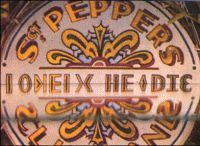
Even sillier is Niezgoda’s discussion of the drumhead on the cover of Pepper, an image already overanalyzed by the Paul Is Dead aficionados. Niezgoda relies on the same parlor trick as the Paul Is Dead gang, using a mirror to bisect the words LONELY HEARTS (which, he points out sinisterly, are in a different font from the rest of the drum!) to reveal a messy I ONE IX HE DIE.  For the Paul Is Dead people, this convoluted hidden message means that Paul died on November 9th (with “I ONE” meaning eleven, and IX meaning 9, for 11/9).  Not for Niezgoda.  Instead, he reads this as a taunt from Satan to John Lennon:  “I won! Nine, he die!”  Nine, Niezgoda explains, is the day Lennon died—because it was already December 9th in Liverpool, you see, when John died in New York on December 8th.

That kind of convoluted numerology, in fact, is where Niezgoda becomes wearying. Lennon himself made much of the number 9 in his life—he was born on the ninth and included the number in the title of several songs—but Niezgoda comes up with some truly inane readings and sleights-of-hand to arrive at his nines.  For example, he points out that if you dial the name JOHNONOLENNON on a push button phone, you get 564666536666 – and wow, look at all those sixes, which are really just nines standing on their heads. And only Niezgoda could read “One After 909” as an omen—it’s waaay too confusing to explain how it predicts Lennon’s death down to the day—all the way down to a reference to Yoko as a his “bag.”

The punch my ticket moment, though—the moment I knew Niezgoda was in way over his head—arrives on page 122, as Niezgoda does some headscratching over the band’s name:

“’The Beatles’ was a curious choice of name for a band, especially because it’s spelled wrong. In 1961, John wistfully explained to Mersey Beat where he got the idea: ‘It came in a vision—a man appeared on a flaming pie and said unto them, ‘From this day on, you are Beatles with an A’”

With an absolutely straight face, Niezgoda explains that Lennon had to spell “beetles” incorrectly so he could use the letters to make an anagram of “seal bet,” hiding in plain sight his pact with the Devil. As for the man on a flaming pie, Niezgoda points out, his gears churning, that “man on a flaming pie” scrambles as “pagan flame minion.”

Apparently, the pun on “beat” in the word “Beatles” seems to never have occurred to the humorless Niezgoda—he’s too busy making scary sounds and tut-tut noises.  (As for the “pagan flame minion,” you can also anagram “man on a flaming pie” to make “film an ape moaning,” but that hardly means Lennon had hidden aspirations of being a voyeuristic zookeeper).  I can’t tell if Niezgoda is being intentionally ridiculous here, or if he’s really that clueless.

Niezgoda’s last chapter contains two incredibly odd bits of contrived thinking and backwards logic. The first is a way-out reading of James Joyce’s Finnegans Wake – a book published a year before Lennon’s birth, but which Niezgoda is nonetheless convinced contains prophecies of Lennon’s life and death. And that’s mostly because, at certain points over its 600 pages, Joyce uses words like “beetle,” “pepper” and “funeral.”

The second is a wacky bit of mathematics in which Niezgoda chooses three songs he believes “place the final moments of John Lennon’s life to music”: “I Am The Walrus,” “Revolution 9,” and “#9 Dream.”  Niezgoda informs us that the total elapsed time from the moment Lennon was shot to the moment he died was 17 minutes—and I think we’re supposed to get chills when he informs us that the total time playing time for those three songs is 17 minutes, 42 seconds. Niezgoda provides us with absolutely no reason why there should or should not be a correlation between the playing time of these songs and Lennon’s last moments. It’s a completely nonsensical premise and farcical train of thought, and we’re supposed to somehow be spooked by it.

But that sort of spurious thinking is the norm for Niezgoda. His premise is a bizarre one to begin with, but The Lennon Prophecy is full of so many thin, lame, and eye-rollingly ridiculous theories that it’s impossible to take seriously.  Yet, Niezgoda does. And “no one,” he writes in his wistful introduction, “is sorrier than I about what is written here.”  Except maybe those of us who’ve read it.
Hello, Goodbye…

Once again, my apologies for neglecting the ol’ blog — it’s been a busy week of editing, express mailing, and phone calls.  None of which means I have any news to report, but things have kicked up a bit on the excitement meter.  Over the falls! as Barb and I often say.

The mercury in central Maryland is beginning to hover in the mid-30s in the mornings now, and the trees have shed most of their leaves, moving from the showy to the mostly skeletal in a matter of days.  I’ll likely make a quick zip around the yard on the riding mower this weekend to mulch everything up for the winter.  It’s not only fun, but it beats raking any day — and I won’t even mention the time I made a turn too quickly and fell off the mower.  The seat was loose, I swear.

Finally, I finished reading The Lennon Prophecy: A New Examination of the Death Clues of the Beatles, truly one of the most bizarre Beatles books I’ve ever read.  I’ll have a review up here on Monday.

Have a good weekend!

This Is Halloween….

I love Halloween — though as I mentioned in my interview with Historic Hudson Valley, I’m more of a Christmas person than a Halloween person, mainly because I’m one of the world’s great chickens. 

Don’t get me wrong — I love horror movies and horror novels.  But I was one of those kids — and I’m now one of those adults — who can’t get my mind to shut off once I go to bed.  I watch a scary movie, or read a scary book, then go to bed and lie there in the dark, the covers pulled up around my ears, straining to listen to every sound, convinced the creak of the floor or the wind in the pine tree is the monster/alien/slasher/Joker coming to get me. 

Most of the time I can get over it.  However, there remain trapped in the dark corners of my brain several snippets from horror movies that still scare the daylights out of me.  Most of these I saw before the age of fifteen — just the right age to embed memories that can mess you up for the rest of your life.  So if you really want to scare me, just mention any of the movies mentioned below, and you’ll immediately have me reduced to a quivering, gelatinous mass.

Here they are, ranked from least to most scary — though even the least scary one still seems pretty darn scary to me.  Ready?  Here we go:

(5)   I Married A Monster from Outer Space (1958)

The movie itself isn’t really all that scary — and even the trailer isn’t gloriously dopey enough to give you a sense of what you’re in for — but the monster from this movie?  He absolutely terrified me.:

outerspace

Auuuuugghhh!!!

The same picture was included in an issue of Famous Monsters of Filmland the ten-year-old me somehow convinced my mom to buy for me — and it scared me so badly I had to bury it in the bottom of my desk.  Meanwhile, my 7-year-old brother whimpered himself to sleep.  Need I add that this was also the last issue of Famous Monsters I would ever own?

(4) The Amityville Horror (1979)

I was eleven when The Amityville Horror hit the movie theaters — which means I was nowhere close to being old enough to see it.  But I remember the trailer for it running on television in the evenings — including one memorable evening when my brother and I were spending the night at a friend’s house.  Normally, one of us would leap up and snap off the television when an ad for a horror movie came on, la-la-laing loudly to ourselves and counting off the minute or so until we could turn the TV back on, safe from any horrifying sounds or images . . . except for one moment when we didn’t get up fast enough to turn off a variation of this trailer:

The trailer scared the daylights out of me — especially the voice croaking “GET OUT!”  I was so nervous about this movie I didn’t even try to sneak  a copy of the book from the library, as I normally would have with such taboo material. 

When I finally saw the movie on cable in the early 1980s, it was terribly corny.  The trailer, however, did its job well enough to make it onto this list.

(3) Poltergeist (1982)

Two words: clown puppet.

(2) Halloween (1978)

I watched Halloween from the back seat of my parents’ car at the drive in.  No, my parents didn’t take us to see it.  I think we had come to the drive in to see The Betsy or something equally as lame that didn’t hold my attention.  But Halloween was showing on the screen behind us, and my brother and I spent the evening squatting on our knees, looking out the back window at the flickering screen several hundred yards away.  We never could tell what was going on, but we felt we were really getting away with something.

Several evenings later, Gene Siskel and Roger Ebert discussed the movie on Sneak Previews and showed a brief clip.  And to this day, I still can’t believe they could get away with showing this moment on television.  It’s a moment that’s scared me for thirty years.  And it comes at four minutes and 45 seconds into the following clip:

(1) Black Christmas (1974)

From Bob Clark, the director of the family classic A Christmas Story, comes one of the scariest movies ever: Black Christmas — or, Stranger in the House, as it was sometimes titled (and as it was called when I watched it on HBO in the early 80s).   The set-up has become cliche — a maniac hides in a sorority house, makes creepy phone calls to the girls, then disposes of them one-by-one — but you’d be hard pressed to find any movie that’s done it in a scarier way. 

For proof, here’s a brief clip of Olivia Hussey — the heroine — answering a phone call from their mysterious caller:

Happy Halloween!

Slow Ride

Does anyone besides me think that Amazon’s free shipping is taking significantly longer than it used to?

I’m one of those dopes who usually loads up my cart every time I go onto Amazon because I want to hit the 25 dollar floor needed to trigger free shipping.  And yes, I know it alerts you that free shipping usually takes something like 7 to 9 days — as opposed to, say, 3 to 5 for paid shipping — but in the past, packages delivered using free shipping have usually arrived within five days.  Now, however, it seems they’re determined to make good on that 7 to 9 day thing.  Packages I ordered on October 7, for example, do indeed arrive on October 15.

It wasn’t always this way.  It used to be that the Free Shipping was a nod and a wink agreement between you and Amazon — a flirtacious dance  that went something like this:

Me:  Hmm, Plan 9 from Outer Space is only $4.99.  Maybe I’ll order that and R. Crumb’s Heroes of Blues, Jazz and Country.

Amazon:  That’s only $18.56, though.  Add $6.44 and I’ll throw in Free Shipping!

Me:  Yeah, but shipping for these two things would only be $3.98.  I could get both of these for less than 25 bucks — and it would ship faster, too.

Amazon:  We both know that’s not true.  I’m legally obligated to tell you that Free Shipping takes 7 to 9 days, but really, I love you so much that I’ll get it to you in 3 to 5 days — the same as if you’d paid for shipping.

Me:  In that case, let me add The Coon-Sanders’ Nighthawks, Volume 2 to kick things over 25 bucks, since Free Shipping doesn’t really take as long as it says it does.  And don’t worry, I won’t tell a soul.

Amazon:  Let’s never argue again.

I’m not really complaining, mind you — if I wanted my packages delivered faster, I’d pay the shipping.  But I might not be as quick to load my cart up to hit the 25 dollar trigger if I know that the free shipping will take . . . well, as long as it says it’s going to take.It’s Amazon’s fault, really, for having been so quick in the past to get my items in the mail to me.

Trip Report: Blaze, Legends, and Sleepy Hollow

We had a great weekend up in Sleepy Hollow and the surrounding area — and the snow that was in the forecast never materialized.  Instead, we had a bit of rain, a bit of chill, but an otherwise perfect weekend for enjoying all that the area has to offer.  As Sunnyside curator Dina Friedman put it, “We like to think that we own the Halloween season here in Sleepy Hollow.” And they do.

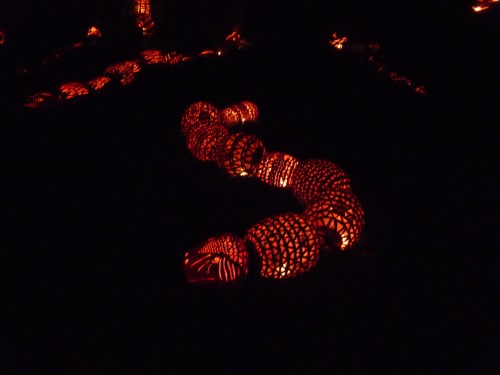
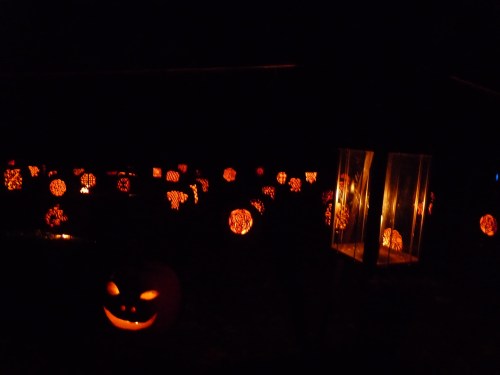
On Friday night, we attended the Great Jack O’Lantern Blaze at Van Cortlandt Manor, an old Dutch estate up at Croton-on-Hudson lit up by more than 5,000 carved pumpkins.  Pictures of the event really don’t do it justice, but here’s a few shots I took to try to give you a feel for just how creepily cool it is.

Everything you see at the Blaze is made of pumpkins, attached to each other with stakes or posts. For example, here’s a bat, swooping down over your head as you enter the property.  Each wing is carved into its own pumpkin, then attached to the central piece containing the body.

P1000397

Squeak!

Next, here’s the approach to Van Cortlandt Manor, lit by lots of yowling, shrieking cats and, if you look closely, even a few brave mice:

Approaching Van Cortlandt Manor.  Beware of cat!

Approaching Van Cortlandt Manor. Beware of cat!

And once you reach the house, Mynherr Van Cortlandt and his wife are waiting there at the top of the stairs to greet you:

The Van Cortlandts preside over the Blaze.

The Van Cortlandts preside over the Blaze.

Rounding the corner, you’ll see a few of the Blaze’s creepier effects.  First, a jungle full of ghostly dinosaurs rage and roar:

Where the wild things are.

Where the wild things are.

Next, it’s a nest of spiders and snakes — including an eerily glowing spiderweb, one of the Blaze’s How’d they do that? moments:

Yuck.

Yuck.

Snakes.  Why'd it hafta be SNAKES?

Snakes. Why'd it hafta be SNAKES?

Here’s a sea of grinning faces, peering out from the clearing:

"We seeeeee yooooou....."

"We seeeeee yooooou....."

Henry Hudson’s ship churns through a ghostly sea of skeleton fish:

"The seas boiled...."

"The seas boiled...."

Meanwhile, skeletons danced:

Grim grinning ghosts.

Grim grinning ghosts.

…and ghostly bees buzzed around a hive — another one of the Blaze’s surprising effects:

P1000440

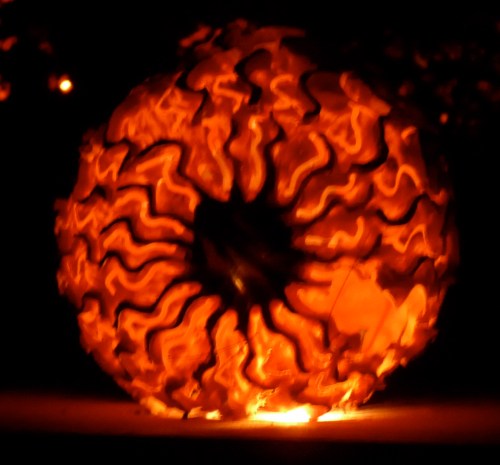
Finally, to give you an idea of the kind of artistry on display, here’s a close up of a pumpkin carved to look like a shell.  Incredible, isn’t it?

Amazing.

Amazing.

The next day, I spoke twice at Sunnyside, as part of their daytime Legends events.  Curator Dina Friedman and her staff were incredibly kind and helpful, and I had a good crowd, with lots of good questions.  Dina even recorded the talks for a series of podcasts Historic Hudson Valley is hoping to launch.  That took a bit of experimenting with the Zoom technology — hence, the first talk went unrecorded, but we managed to catch the second one.  I’ll let you know if and when the podcast will be up over at HHV.

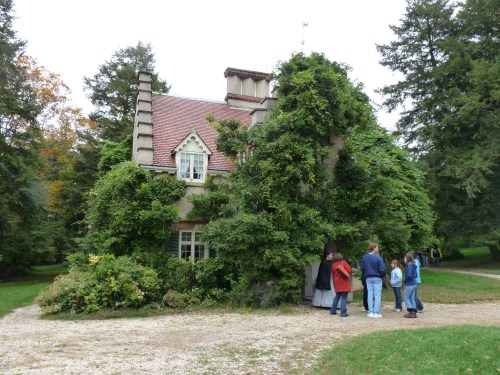
Anyway, here’s just a few quick shots at Sunnyside.  Strangely enough, while I’ve been to Irving’s home many times and have tons of pictures of the place, I had never actually taken a picture of the place with my own camera. Here’s a shot of the path to Irving’s home.  You can see the kind of beautiful fall day we were having:

The road from Tarrytown to Sunnyside.  While today's visitors don't use this path, it's the road your carriage would have used to pull up to Irving's front door.

The road from Tarrytown to Sunnyside. While today's visitors don't use this path, it's the road your carriage would have used to pull up to Irving's front door.

Next, it’s the approach down the hill to Sunnyside, where guests were beginning to queue up to tour the home.  The Hudson River is visible just to the left:

A gorgeous fall day at Sunnyside.

A gorgeous fall day at Sunnyside.

Finally, here’s a shot of the front door — obscured by wisteria, but still giving an idea of its charm.  Both floors of the house were open for touring that day — a real bonus:

Sunnyside.

Sunnyside.

That evening, we went into Sleepy Hollow for the Evening Legends events at Phillipsburg Manor.  Here’s the approach to the property, spookily lit by colored lights, and reflected in ghostly image in the pond:

Phillipsburg Manor by night.

Phillipsburg Manor by night.

Legends evening is an opportunity to walk around the site of an old farm and mill and just watch spooky things happen.  We saw a great magician (who we jokingly called Ryan the Temp, due to his resemblance to a character on The Office), sang along with pirates, stood at the fence as the Headless Horseman galloped past, glowing pumpkin in hand (I tried to catch him with my camera, but missed) and shrieked only twice when we found we were being closely followed by a lumbering catlike creature.

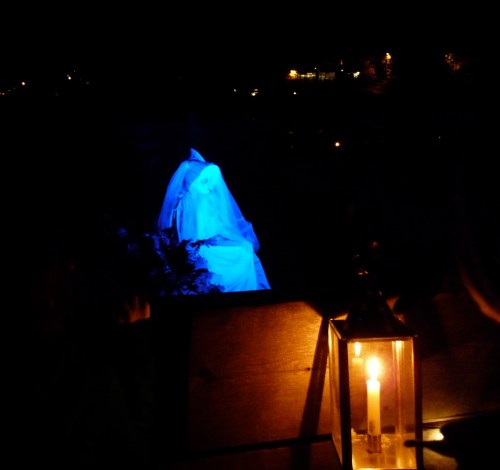
As we passed the graveyard, we peeked over the fence and caught  a glimpse of a ghostly woman, wailing over the loss of her beloved:

P1000457

Every once in a while, we would spot her strolling slowly through the crowd, staring blankly ahead.  Other times, a ghostly violinist would wander the property, playing creaky off-key music.  To keep the spooks away, we huddled near one of several Sleepy Hollow scarecrows:

"What party be ye with??"

"What party be ye with??"

And finally, as we strolled past the barn, we caught a glimpse of ghosts wandering aimlessly about just inside:

P1000462

All in all, a memorable weekend.  Wanna go?  Check out Historic Hudson Valley for more details.